The use of drugs in warfare is not a recent phenomenon, but rather a long-standing tradition that dates back to ancient times.
Governments have played a significant role in the spread of drugs, and drugs have been used as a tool of colonialism.
The use of drugs to control and manipulate soldiers is a common practice throughout history, from keeping them awake to boosting their aggression.
Killer High is an Interesting book that explores the history of war through the lens of six different drugs.
Peter Andreas, a professor of international studies at Brown University, takes readers on a journey through history to explore the role of drugs in warfare.
The book is well-researched and provides a unique perspective on the history of war through the lens of drugs. However, it should be noted that the dates jump around a lot and sometimes the connections from one instance to the next is a bit of a pull. Nonetheless, Killer High is an engaging and informative exploration of a topic that is often overlooked in traditional histories of war.
In his book, Andreas focuses on six drugs that have played a significant role in warfare throughout history. He explores how each drug was used, the effects it had on soldiers, and how it impacted the outcome of wars. And explores the role of governments in the spread of drugs. He sheds light on a little-known aspect of military history, and his insights are sure to spark discussion and debate among readers.
In this book, Andreas digs into the effects of drugs on colonialism and how governments have used this to their advantage. He posits that opium was highly instrumental in helping Britain gain control over China and other nations.
Chapter Summaries
Introduction
Peter Andreas takes readers on a (bumpy) journey through the history of warfare from a unique perspective - the role of drugs. The author emphasizes the undeniable impact of drugs in warfare, and highlights that recognizing this history is essential to grasping what war itself embodies.
Alcohol
American Revolution
Year: 1765-1783
Who was involved: Thirteen Colonies vs. Great Britain
Description: A colonial revolt which occurred between 1765 and 1783. The American Patriots in the Thirteen Colonies defeated the British in the American Revolutionary War with the assistance of France, winning independence from Great Britain and establishing the United States of America.
World War I
Year: 1914-1918
Who was involved: Allied Powers vs. Central Powers
Description: A global war that lasted from 1914 to 1918. It was predominantly called the World War or the Great War from its occurrence until the start of World War II in 1939, and the First World War or World War I thereafter.
The author examines how alcohol has been used in wars over time & how it has impacted the soldiers. According to them, alcohol was not only used to elevate morale but also for providing comfort & helping soldiers tackle stressful situations on combat grounds.
How was alcohol used during World War II? The sobering reality is that many of our Armed Forces used alcohol as a way to cope with the trauma of war.
There were indeed many stills creating rum on the east coast of the United States in the early days of settlement. In fact, it was one of the most popular drinks in the colonies during the 17th and 18th centuries. However, during the American Revolution, the British cut off the supply of molasses needed to make rum, which led to a shift towards locally-made whiskey, using grains like rye and corn. This was encouraged by figures like George Washington, who saw it as a way to promote self-sufficiency and reduce dependence on foreign imports.
Caffeine
The author delves deep into the history of caffeine and its role in warfare. From tea and coffee to energy drinks, caffeine has been used for centuries to keep soldiers awake & alert. Its impact on modern warfare is undeniable and the chapter explores it in detail.
For many years, the coffee industry in Central American countries has been dominated by a few wealthy families owning large coffee farms. They had a stranglehold on the entire process; right from processing to distribution, leaving poorer farmers unable to join the race.
In the early 1940’s, Soviet General Georgy Zhukov requested a special color-free version of Coca-Cola to disguise its American origins and make it look like vodka. With President Harry Truman's blessing, Coca-Cola was happy to comply with the request, and sent Zhukov shipments of bottles with no labels other than a white cap with a red Soviet star.
Nicotine
The chapter on nicotine explores the use of tobacco in warfare, from the early days of smoking to the development of modern nicotine products. Andreas argues that before World War I, the United States was strongly opposed to nicotine, due to knowing the health dangers.
However, during the war, the US military began providing cigarettes to soldiers as a way to boost morale and reduce stress. This led to a significant increase in cigarette use, which continued after the war and contributed to the rise of smoking culture in America. Andreas suggests that this shift in attitude towards nicotine was a result of wartime propaganda efforts that portrayed smoking as a patriotic duty.
Nicotine has been used to calm nerves and provide a sense of comfort, but that it has also led to addiction and other negative consequences.
Opium
Opium Wars
Year: 1839-1860
Who was involved: China vs. Britain
Description: Two wars fought between Great Britain and China in the mid-19th century over the British trade in opium, a key factor in the damaging of the Chinese economy by forcing the Chinese to trade valuable commodities for a drug that was devastating their population.
Vietnam War
Year: 1955-1975
Who was involved: North Vietnam vs. South Vietnam and United States
Description: A Cold War-era proxy war that occurred in Vietnam, Laos, and Cambodia from 1 November 1955 to the fall of Saigon on 30 April 1975. It was fought between North Vietnam, supported by the Soviet Union, China, and other communist allies, and South Vietnam, supported by the United States, South Korea, the Philippines, Australia, Thailand, and other anti-communist allies.
The author examines the historical context and implications of opium. How it diffused across China, and how its consumption has changed in the past century. Starting from ancient China. Then exploring the 19th century Opium Wars before finally arriving at modern-day Afghanistan. In this chapter, the author looks into how opium consumption has evolved and how various changes in its composition have made it more potent & addictive.
According to the author, opium had a major impact in facilitating Britain's influence in China. The opium trade seemed to have contributed significantly to this effect. It is worth noting that the Vietnam War had a massive influence on the development of the heroin industry, especially in Southeast Asia’s Golden Triangle region - including portions of Laos, Myanmar, and Thailand.During the Vietnam War, the United States government aided anti-communist forces in the region, unfortunately, these forces were also associated with heroin production and trafficking.
The main goal of the United States concerning the Vietnam War was to contain Communism by preventing its growth in Southeast Asia. Conversely, the North Vietnamese and Viet Cong were striving for Vietnam to be reunited under a communist government.
Amphetamines
World War II
Year: 1939-1945
Who was involved: Axis Powers vs. Allied Powers
Description: A global war that lasted from 1939 to 1945. It involved the majority of the world's nations, including all of the great powers, organized into two opposing military alliances: the Allies and the Axis. It was the most widespread war in history, and directly involved more than 100 million people from more than 30 countries.
This chapter takes a look into how amphetamines have been used in combat, ranging from Benzedrine in WW2 to newer stimulants currently being researched. The author's does say while amphetamines may help troops stay awake and responsive, they can also lead to addiction and other adverse effects.
This chapter provides a brief look into how drugs are utilized in conflict, however there may be more details and subtleties that were not touched upon. Take a look at Norman Ohler's - Blitzed - it gives an in-depth and accurate look into how drugs were used during Nazi Germany.
Fact - during World War II, German soldiers took Pervitin which was an OTC drug with amphetamines.
This chapter is all about amphetamines and their use in warfare. We take a look at the early use of Benzedrine during WW2 and its evolution into the stimulants we have now. The writer's point is that, although drugs like amphetamines have been taken by soldiers to stay vigilant and sharp, they also cause dependency and other undesirable results.
Pharmacologist Leslie Iversen writes about the non-medical use of amphetamines spreading rapidly in the 20 years after the Second World War. While the use of amphetamines to enhance soldier performance was abandoned after World War II, the availability of amphetamines increased in the post-war years, leading to their widespread use for non-medical purposes.
Cocaine
The chapter on cocaine explores the use of cocaine in warfare, from its early use as a local anesthetic to its development as a stimulant.
The War on Drugs
The War on Drugs, which was initiated by the United States government in the 1970s, has been heavily criticized for its disproportionate impact on minority communities and for its failure to effectively reduce drug use and drug-related crime. Additionally, there have been allegations of United States government involvement in the drug trade, particularly in the context of the Iran-Contra affair in the 1980s, where the United States government was accused of facilitating the sale of drugs in order to fund the Contras in Nicaragua. These allegations have been the subject of much debate and investigation, and it is unclear to what extent they are true.
Conclusion
The book wraps up with a summary of the main points made & topics discussed. The writer believes drugs have been an important part of wars all throughout and understanding this is essential to knowing what war truly is.
Is a fascinating read, as it provides a fresh perspective on war history by looking at six distinct drugs and their influences. This book dives deep into a lesser-known part of military history.
Through the lens of Shakespearean plays, M.L. Rio’s “If We Were Villains” intricately weaves together a tale that explores the relationship between art and reality, the power of storytelling, and the consequences of our actions. The novel offers an in-depth look into human nature and its complexities, highlighting the obsession, love, and ambition that drive individuals to take extreme measures. Murder, guilt, and failure are key themes that are explored in the novel. The impact of their actions on others forces the characters to face the consequences of their mistakes.
While the characters may lack depth, the plot offers surprising twists that can engage certain readers. However, different readers may find varying levels of appeal in this story.
Oliver and his classmates navigate through intense pressures of their craft while also developing complex relationships between them.
The book's characters are flawed and self-absorbed, and their obsession with Shakespeare can at times feel contrived. The characters mostly come across as flat, which is precisely the point. They are theater students who are deeply invested in their roles, and their interactions with each other are often characterized by the dramatic language and gestures of the plays they are studying. The competitive atmosphere of the school and the pressure to perform well also contribute to the tension between the characters. As a result, they often prioritize their roles over their personal relationships, blurring the lines between their true identities and the characters they are portraying.
The connection between the characters is rooted in their shared passion for Shakespeare and their status as theater students at the elite Dellecher Classical Conservatory. As fourth-year students, they are part of a select group that has survived the rigorous training and competition required to reach that level. The pressure to perform well and excel in their craft has created a cult-like atmosphere in which the students prioritize their roles over their personal relationships. The fact that they live and study together in a closed environment also contributes to the intensity of their relationships, blurring the lines between their true identities and the characters they are portraying.
The book is told through the perspective of Oliver, one of the students, who has just been released from prison after serving ten years for a crime he may or may not have committed. The main plot of the novel is to uncover the truth behind the crime Oliver was convicted of in 1997. The story is told through a frame narrative of Oliver's confession to Colbourne. There are also several subplots, such as Oliver's conflicting feelings for Meredith and James, Richard's violent tendencies, and Alexander's substance abuse. These subplots work together. Each chapter builds towards the resolution of the novel - the discovery of James' culpability.
One of the primary themes of the book is the relationship between art and reality. The characters in the novel are so absorbed in their roles that they often lose sight of their true identities. This theme is further explored through the use of Shakespeare's plays, which are not only performative but also deeply philosophical. And dealing with issues such as power, and morality.
The novel is structured in five acts, each corresponding to a Shakespearean play.
Act I introduces the characters and sets up the drama with Richard's attack on James.
Act II focuses on the cast's preparation for and performance of Julius Caesar.
Act III contains the novel's climax with Richard's death and ends with Oliver's realization of his love for James.
Act IV explores Oliver and Meredith's relationship, as well as Alexander's drug issues.
Act V explains how Oliver came to take the blame for Richard's death.
The chapters in the book are referred to as "scenes" to further emphasize the theatrical theme. Rio's writing is elegant and immersive. Although the novel's structure is heavily influenced by Shakespeare's plays, with each act corresponding to a play and the characters often speaking in iambic pentameter, an appreciation for Shakespeare is not necessary to enjoy the book. The themes and characters are universal, and the novel can be appreciated by anyone who loves literature and theater.
Characters
Oliver Marks the main protagonist and a senior theater student at Dellecher Classical Conservatory. He is one of the seven fourth-year students in the Shakespeare program.
James also a student in the Shakespeare program at Dellecher and a close friend of Oliver Marks. He is known for his talent in playing comedic roles and is often the comic relief in their productions. James is described as being kind-hearted and loyal to his friends.
Richard is an accomplished actor who excels at portraying regal and authoritative characters on stage. His commanding presence and gravitas lend themselves well to these roles, and he has become known for his talent and dedication. Richard's performances have earned admiration of his audience.
Meredith is a fellow theater student at Dellecher. She is a highly skilled actress with a talent for playing strong, independent women. Meredith is a supportive friend to Oliver, and they work together on various theater productions.
Filippa is a talented student at Dellecher who is known for her impressive range as an actor. She often takes on male roles in theater productions and is particularly skilled in portraying complex and nuanced characters.
Alexander Another fourth-year student in the Shakespeare program and one of Oliver's close friends.
Detective Colbourne investigated Richard's death and was certain that Oliver wasn't at fault.
Wren is Richard’s cousin and a member of the Dellecher class. Her petite frame and delicate facial features have often drawn comparisons to a pixie or fairy.
Gwendolyn plays a vital role as a drama instructor at Dellecher. She works hard to equip students with the emotional and spiritual tools they need to deliver exemplary performances.
Frederick is a dedicated drama teacher at Dellecher. He has a special interest in interpreting Shakespearean works and is well-versed in the language and style of his texts.
ACT 1
In the first act the reader is introduced to the main characters of the novel. The students at the Dellecher Classical Conservatory are doling out harsh criticism to one another as they rehearse Shakespeare's plays. They are stoic in their approach to their craft, often prioritizing their roles over their personal relationships.
The muse of the students is Shakespeare, whose quintessentially theatrical language is the perfect vehicle for their emotions. The characters are curious about one another, constantly trying to uncover hidden truths and motivations. They are also resilient in the face of adversity, banding together to overcome challenges both inside and outside the theater.
The setting of the Dellecher Classical Conservatory plays a significant role in shaping the characters' actions. The school's remote location and insular community create an atmosphere of intense pressure and competition, which is heightened by the characters' shared passion for Shakespeare. This pressure is particularly evident in the characters' interactions with one another, as they constantly compare themselves to their peers and compete for recognition and approval. The tension between the characters is further exacerbated by the fact that they live and work together, blurring the lines between their personal and professional lives. The setting of Act I thus serves as a powerful force that shapes the characters' actions and emotions throughout the novel.
Rio makes use of the frame narrative structure to tell Oliver's last year at Dellecher. It builds up tension, as the reader is already aware that something bad happened which resulted in Oliver being jailed for ten years. The frame narrative in the novel establishes its confessional style, with Oliver telling the story to Coulbourne. The prologue provides plenty of insight into Oliver's mental state with Shakespearean quotes mixed in his dialogue as well as stage directions. Even after serving his sentence, Oliver remains devoted to his acting career and can't seem to break away from the path he had chosen before being incarcerated.
The theme of homoeroticism and repressed sexuality is introduced early in the book through the friendship of James and Oliver. At the end of the first scene, Oliver's feelings toward James become obvious; he confides in his closest friend and flatmate about his admiration, “You’ll have to be Cressida… You’re the only one of us pretty enough” (19). James' emotions are subtly exposed through the joke he tells to his friend while they are lying side by side. It is more information than he would choose to reveal consciously. Oliver is still not completely comfortable with his sexuality. However, spending time with James brings out a more carefree, romantic side of him which is usually held back due to his anxiety.
During the combat lesson, James' strong bond with Oliver is evident. When Camilo instructs James to think of a reason why he should be mad at Oliver, it's astonishing how his expressions changed rapidly from being peaceful to hurt and vengeful: “James had never really been angry with me, to my knowledge."
Character Name
Primary Archetype/Role
Shakespearean Parallel
Key Traits and Motivation
Fate or Final Status
Oliver Marks
Protagonist, narrator, and the perpetual understudy.
Lear (gradual recognition/blindness), Kent (loyalty/sacrifice), Benvolio (observer/peacekeeper).
Observational, loyal, and chameleonic; motivated by his deep, often suppressed devotion to James and the desire to protect the group.
Served ten years in prison for Richard's murder to protect James; ends up living with Meredith in Chicago and searching for the truth of James' death.
Represents the ultimate sacrifice and the blurring of personal identity through total devotion to a role (both on stage and as a martyr).
James Fane
The star and leading man of the group.
Macbeth (guilt/madness), Brutus (assassination for 'greater good'), Romeo (tragic romance).
Brilliant, star-quality, and increasingly fragile; driven by a descent into madness and psychological guilt after killing Richard.
Revealed to have killed Richard; faked his own death by drowning after Oliver's imprisonment; current whereabouts unknown (implied alive).
Embraces the destructive nature of guilt and the inability to escape the tragic narratives of the characters he portrays.
Richard Stirling
The group leader and antagonist; typically plays the tyrant.
Julius Caesar (the fallen tyrant), Tybalt (instigator of violence).
Charismatic, demanding, and abusive; motivated by dominance and maintaining his status as the group's alpha.
Died in Act III after being struck by James with a boat hook and left to drown in the lake.
Represents the toxicity of hierarchy and how the 'role' of a tyrant can manifest in real-life abuse and violence.
Meredith Diciacci
The ingenue and femme fatale.
Lady Macbeth (ambition), Cordelia (recognition of truth), Juliet.
Beautiful, isolationist, and resilient; motivated by her complex romantic ties to both Oliver and Richard and her need for belonging.
Lives in Chicago ten years later; reunites with Oliver and reveals she always knew the truth about the night Richard died.
Symbolizes the isolation caused by being defined solely by one's appearance and the friction between staged and genuine intimacy.
Filippa Kosta
The anchor and pragmatist; the group's conscience.
Horatio (the loyal survivor/witness).
Intelligent, secretive, and observant; motivated by group survival and protecting her friends' secrets.
Remained at Dellecher as a teacher; provides Oliver with the final clues regarding James' potential survival.
Represents complicity through silence and the moral ambiguity of protecting those one loves.
Alexander Vass
The fool and comic relief.
The Fool, Mercutio (the reckless friend).
Sarcastic, hedonistic, and reckless; uses drugs and humor to cope with the pressure and eventual guilt of the group.
Survives the novel's timeline after a near-fatal overdose in his fourth year; remains haunted by Richard's death.
Illustrates the use of humor as a defense mechanism and the eventual collapse of the 'comic' mask under real tragedy.
Wren Stirling
The ingenue and Richard’s cousin; plays supporting roles.
Ophelia (psychological fragility), Juliet.
Vulnerable and empathetic; motivated by her family ties to Richard and her romantic interest in James.
Diagnosed with PTSD after Richard's death and her own physical assault; survives but remains deeply scarred.
Represents the collateral damage of tyranny and the psychological cost of being caught in others' dramatic conflicts.
Goodreads is one of my favorite websites to use. This really cool widget for displaying the books I have read by year (as long as I have used Goodreads) are displayed. Personally, I like that I can quickly scan this one post for that book title I couldn't quite recall but want to share.
Let me know how you keep track of your reading habits.
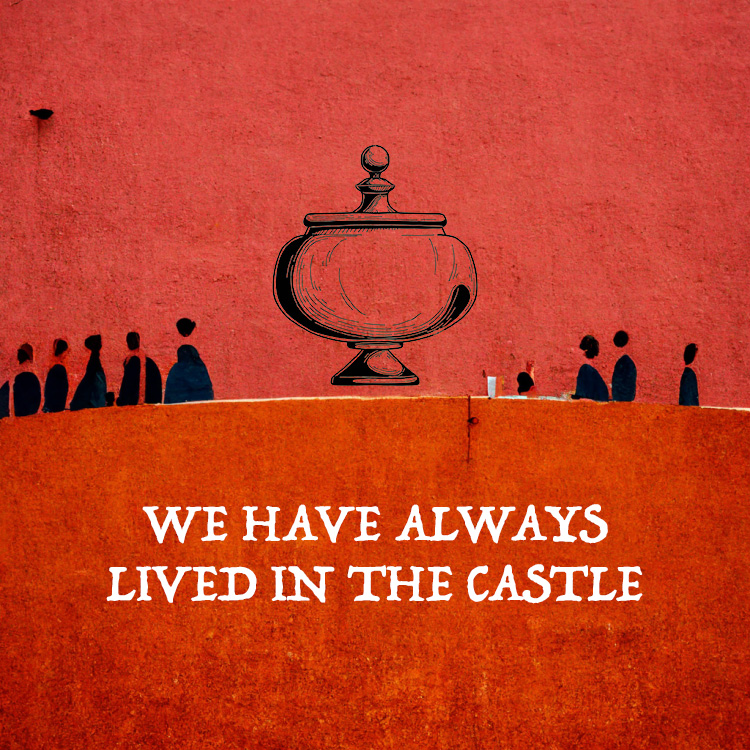
We Have Always Lived in the Castle by Shirley Jackson is a novel that tells the story of the Blackwood family, who live in a large mansion on the outskirts of a small village. The story is narrated by Mary Katherine, or "Merricat," Blackwood, an eighteen-year-old girl who lives with her sister Constance and their uncle Julian.
The novel begins by describing the events that led up to the mysterious deaths of several members of the Blackwood family, including Merricat's parents, brother, and aunt. Constance was accused and acquitted of the murders, but the villagers still view the Blackwoods with suspicion and hostility.
Uncle Julian, who survived the poisoning that killed the rest of the family, is writing a book about the murders and becomes increasingly paranoid and delusional. Charles, a cousin who comes to visit the Blackwoods, is manipulative and cruel, causing tension and upheaval in the already fragile household.
Chapter 1 Analysis
The first chapter of "We Have Always Lived in the Castle" sets the tone for the novel with an unreliable narrator and a sense of mystery. From the beginning, Mary Katherine Blackwood, or Merricat, reveals her unstable nature by confessing her aversion to bathing and her affinity for the death-cup mushroom. Her likes and dislikes offer a glimpse into her peculiar personality, which immediately raises suspicion and adds to the suspense.
Despite the simplicity of the action in the first chapter, which involves Merricat walking to town to buy groceries, check out library books, and stop at the coffee shop, the interactions between the characters are fraught with tension and intrigue. Merricat is suspicious of everyone around her and avoids personal contact, while the other characters behave strangely in her presence. The reader is left to wonder what has happened to Merricat and why the other characters are acting so oddly. This sense of mystery adds depth and complexity to the story and sets the stage for the events that will follow.
As the story progresses, it becomes clear that Merricat is deeply disturbed and has a tenuous grip on reality. She engages in magical thinking and has elaborate rituals that she believes will protect her and her family from harm. Constance is protective of Merricat but also struggles with her own guilt and trauma from the deaths of her family members.
Chapter 2 Analysis
In Chapter 2 of "We Have Always Lived in the Castle," the reader learns that the majority of the Blackwood family was killed by arsenic poisoning and that Constance was accused of the murders and then acquitted. Uncle Julian tells Lucille Wright about the murders that occurred in the Blackwood home six years prior, revealing some details about the past.
The author establishes the Blackwood household as a predictably orderly place, with the sisters and their routines taking pride in the organization and neatness of their household. Merricat goes to town, checks out library books, and buys groceries on certain days, while Helen Clarke comes for tea only on certain days. The contrast between this orderliness and the chaos of their past adds to the intrigue of the novel.
Chapter 3 Analysis
In Chapter 3, the author establishes Merricat's character as an unreliable narrator with a vivid imagination and a belief in magic and omens. She reveals her faith in omens, buried treasure, and magical words, which adds to her mystique as an unreliable narrator. Although Julian and Constance go about their regular day, Merricat senses that a change is coming, which further adds to the suspense and leads up to the climax.
The chapter also includes other details that add to the gothic atmosphere of the novel, such as Merricat burying items in the garden, such as baby teeth that would grow into dragons. Additionally, the mention of canned food and how all the ladies added to the supply creates a sense of claustrophobia and confinement, as if the Blackwoods are cut off from the outside world and must rely on their own resources to survive.
At the end of the chapter, there is foreshadowing when Constance takes Uncle Julian inside the house. She is afraid that he is getting cold outside and wants to protect him from the chilly spring air. Julian, on the other hand, wants to keep working on his book because he says he has a thousand details to remember and not a minute to waste. This is predictive to the climax of the story when Julian's heart cannot take the stress of the house fire.
Chapter 4 Analysis
Chapter 4,Merricat says that Charles is the first person to enter their house, but this is not true as Helen Clarke and Lucille Wright have been in their house recently, as revealed in Chapter 2. This suggests that Merricat says whatever is convenient to support her emotions or that she has a different category for Charles than she has for Helen Clarke and Lucille Wright.
Merricat's reaction to Charles's arrival seems extreme as she goes outside and sleeps in the woods. Constance's reaction to Merricat's behavior is somewhat surprising since she cares for Uncle Julian so attentively, taking him in the house if she is afraid that he might get cold and cooking him whatever he wants to eat. It seems likely that she would care for her younger sister attentively as well. However, when Merricat flees to her secret hiding place in the woods, Constance allows her to stay outside all night, even though it is only April.
Chapter 5 Analysis
In Chapter 5, Charles reminds the reader of John Blackwood, the father of Constance and Merricat, who was an unpleasant man. The longer Charles stays in the house, the more his weaknesses become apparent. Within twenty-four hours, he reveals his greedy side, asking about where the money is kept and finding ways to access it.
In the same chapter, Constance shows a weakness for Charles, despite his unkindness. She displays this by wondering if it's acceptable for her to wear her mother's pearls, indicating her attraction and desire to please him. Merricat is convinced that Charles is a ghost and must be driven from the house, and she refuses to be civil to him. This supports her belief that a change is coming.
"You had dinner here last night and woke up alive this morning.”
Chapter 6 Analysis
Charles's character is illuminated in Chapter 6, revealing his true nature as an unscrupulous and greedy man. Despite being initially welcomed by Uncle Julian, Charles's behavior becomes increasingly suspicious and Julian becomes wary of him, even refusing to allow him to touch his belongings. The only member of the Blackwood household who remains friendly with Charles is Constance. Charles's greed is on full display as he continually inquires about the value of John Blackwood's possessions and attempts to take them for himself.
Chapter 6 also incorporates elements of Romantic literature, particularly in the form of the supernatural. Merricat's obsession with magical objects and omens has an otherworldly quality that is reminiscent of Romantic literature. Additionally, Romantic literature often imbues the very young and very old with intuitive powers that others lack. Julian serves as a sort of barometer of safety in this chapter. Despite his occasional senility, he is able to sense the malevolence emanating from Charles. The reader is encouraged to trust Julian's instincts.
Chapter 7 Analysis
In the first chapter of the novel, Shirley Jackson uses overt foreshadowing to set up the climax that will occur in Chapter 8. In Chapter 7, Merricat says that Constance makes spice cookies for dinner but that she shouldn't have bothered because this would be the last day. Although she doesn't explain what she means by this, the reader can sense that she is telling the truth in some fashion because she has been leading up to this since the very first chapter where she says that the library books are five months overdue.
Chapter 8 Analysis
Chapter 8, is the climax of the story. The chapter begins with a conflict between Charles and the rest of the family at dinner. Constance attempts to keep the peace between Charles, Merricat, and Uncle Julian.
The fire that destroys the Blackwood house results from the conflict between Charles and Merricat. Constance asked Charles to be more careful with his pipes several times, and in an effort to protect the house from his pipes, she gave him saucers to place them on. However, he neglects to put his pipe out before leaving rooms, and when Merricat happens upon a smoldering pipe, she swipes it into the wastebasket, rationalizing her action by telling herself that Constance wouldn't want it sitting around on the furniture. Although Merricat doesn't fully believe that the fire is completely Charles's fault, she keeps calling it Charles's fire, as if she's trying to convince herself that it isn't her own fault.
After the fire is put out, the villagers' hatred towards the Blackwoods is unleashed and they are portrayed as completely heartless. Even when it is announced that Julian has died, they still make horrible remarks. The only people at the fire who seem to care at all are Helen and Jim Clarke and Dr. Levy. The rest of the villagers are virtually strangers to the Blackwoods, so their hatred is unjustified.
Additionally, Shirley Jackson incorporates elements of Romantic literature in this chapter. Jonas, the cat, refuses to go into the summer house with Mary Katherine. The use of animals with intuitive powers is a common trope in Romantic literature, and therefore, the reader pays close attention to Jonas's actions. However, Merricat doesn't pay attention to Jonas and ventures into the summer house alone. The summer house is described as a damp and dank place, and once Merricat is inside, her fantasies seem to go wild. She imagines her family having a conversation that never could have taken place and even imagines her mother saying, "Bow all your heads to our adored Mary Katherine."
Chapter 9 Analysis
After the intense climax in Chapter 8, Chapter 9 offers a welcome respite. The Blackwoods have always been creatures of habit, and the morning after the fire, Constance and Merricat find a way to return to routine and order. They salvage what they can from the wreckage and by the end of the day, have transformed the kitchen into a clean, orderly haven. They seem emotionally balanced once again.
The outreach from the Clarkes and Dr. Levy is a breath of fresh air after the brutality of the previous night. Although Constance and Merricat don't respond to the kindness, they feel better knowing that someone cares about them. The relationships are not as important to them as the thought behind the kindness. In fact, they seem to take some prideful pleasure in not responding to the men's pleas.
Chapter 10 Analysis
Merricat and Constance create a new life with what remains from the old one. This life suits Merricat much better than the old one because the relics of those she killed are gone. Their bedrooms burned up in the fire, and the only room left for them to inhabit is the kitchen, which always belonged to Constance anyway, since she was the family member who enjoyed cooking and cleaning. Therefore, the productive, happy, and useful part of the house remains, while the ghosts of the past are gone.
Constance, always the peacemaker, eventually takes to the new life as well, although she has to mourn for the loss of the old life. She never becomes the outgoing person that she longed to be for a while. In fact, she becomes a full-fledged hermit, but her life is simple and pleasing, and she enjoys seeing the people who come to picnic on the lawn and look at the odd house. Ivy grows up over the burned rafters. She grows her garden when others are not around, and she brings in flowers to put on the table. The resolution is strange but pleasing. Merricat, the true murderer, has never been publicly identified, but she seems to have made peace at last.
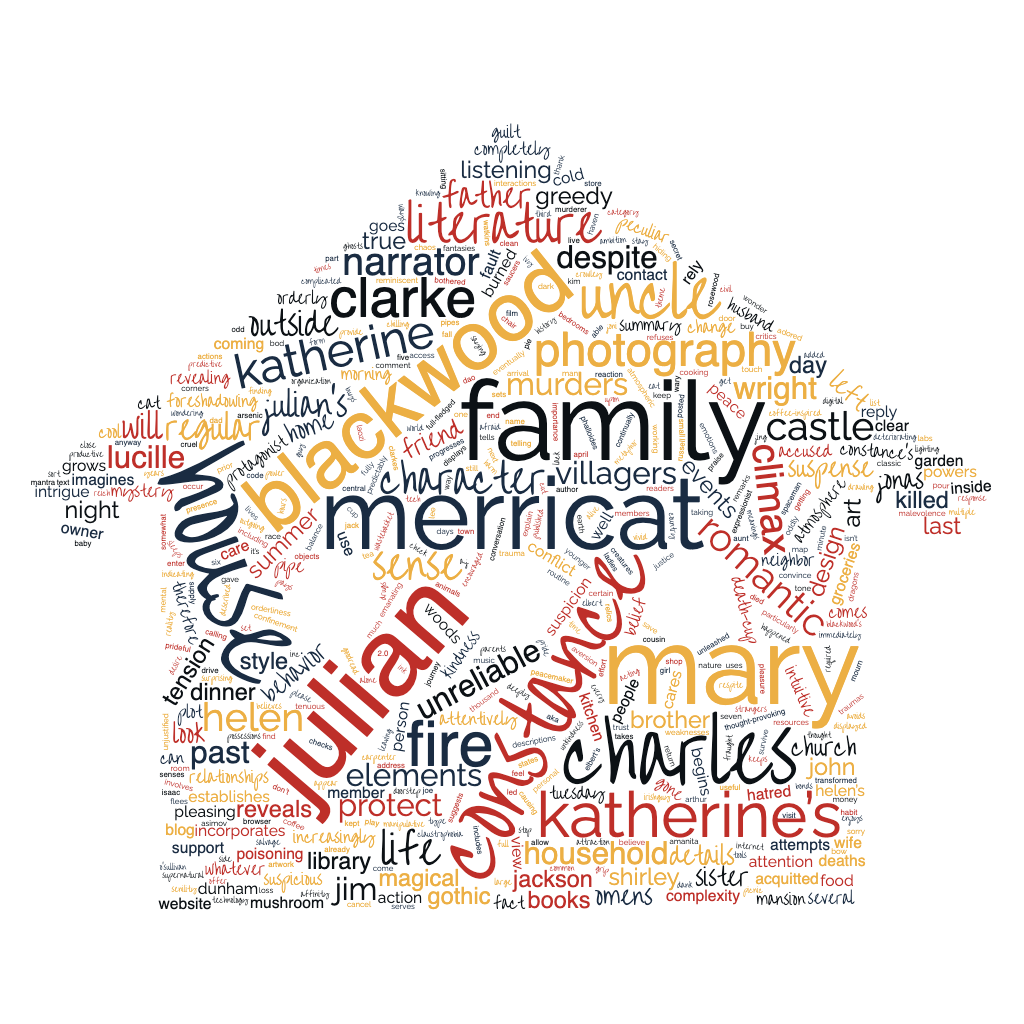
Word Cloud (of this review) created by Gary Crossey
Theme
The themes of isolation, persecution, and family dysfunction are central to the novel. The Blackwoods are ostracized by the villagers and must rely on each other for support, but their relationships are strained and complicated by past traumas.
Style
The style of the book is gothic and atmospheric, with vivid descriptions of the Blackwood mansion and its surroundings. Jackson's use of symbolism and metaphor adds depth and complexity to the story, as objects and events take on multiple meanings and interpretations.
Characters
In terms of character importance, Merricat is the protagonist and narrator, followed by Constance, Julian, and Charles. Merricat's unreliable narration and peculiar behavior drive the plot, while Constance's guilt and trauma provide emotional depth. Julian's book and deteriorating mental state add suspense and tension, and Charles's arrival disrupts the delicate balance of the Blackwood family. Some characters only appear briefly or are mentioned in passing, while others are more central to the plot.
Arthur Blackwood - Charles's father.
Charles Blackwood - Mary Katherine's cousin.
Constance Blackwood - Mary Katherine's Sister
Dorothy Blackwood - Julian's wife.
John Blackwood - Mary Katherine's father.
Julian Blackwood - Mary Katherine's Uncle.
Mary Katherine Blackwood - Protagonist and Narrator. aka: Merricat.
Thomas Blackwood - Constance and Mary Katherine's brother.
Mr. Carrington - Friend of Mary Katherine's father.
Helen Clarke - Family Friend of Mary Katherine.
Jim Clarke - Helen's husband.
Kim Clarke - Jim's brother.
Mrs. Crowley - A Church regular.
Jim Donell - Mrs. Donell's Husband / A gossiping neighbor.
Joe Dunham - The carpenter.
Mrs. Dunham - Mary Katherine's Neighbor.
Mr. Elbert - Owner of a Grocery Store.
Mrs. Elbert - Mr. Elbert's Greedy Wife.
Dr. Levy - Jack Mason's colleague.
Dr. Jack - Doctor of the Blackwood family.
Amanita Phalloides - The Death-Cup Mushroom.
Mrs. Rice - A Church regular.
Mrs. Shepherd - A Church regular.
Lucille Wright - Helen's friend.
Jonas - Mary Katherine's cat.
Stella - Owner of a Shop.
As for the chicken pie left on the doorstep, it was not clear which character first placed food other than he is the guy who broke the chair. and was at the door on his wife's, and was sorry.
The novel has been well-received by readers and critics, with praise for its haunting atmosphere, complex characters, and masterful storytelling. It has been adapted into a film and a play, cementing its status as a classic of modern gothic literature.
Overall
We Have Always Lived in the Castle is a chilling and thought-provoking novel that explores the dark corners of the human psyche and the power of family bonds to both protect and destroy.
I love smoke photography. It's a interesting way to capture the patterns and movements of smoke as it rises into the air. I use a micro lens and a fast shutter speed to freeze the motion of the different layers of smoke and bring out their unique patterns and movements. Adjusting the focus to a specific area of the smoke allows me to capture the intricate details and textures of the smoke. In post-production, I use noise reduction techniques to create a clean and sharp image.
The way the smoke is captured in the light creates stunning patterns that remind me of the 70s. I remember when all the adults in the room smoked while watching super 8 projector movies. They were mostly poor home movies. Thankfully, the patterns of the smoke were always fascinating .
When the layers of smoke are captured in the strong cross light the smoke create 3-dimensional forms and visual shapes that are often ephemeral and only exist for a brief moment in time. For me, capturing these fleeting moments is the art. The resulting images are not only visually interesting but also have a unique artistic value that captures the essence of the moment.