The Answer Engine – Tokyo Mix
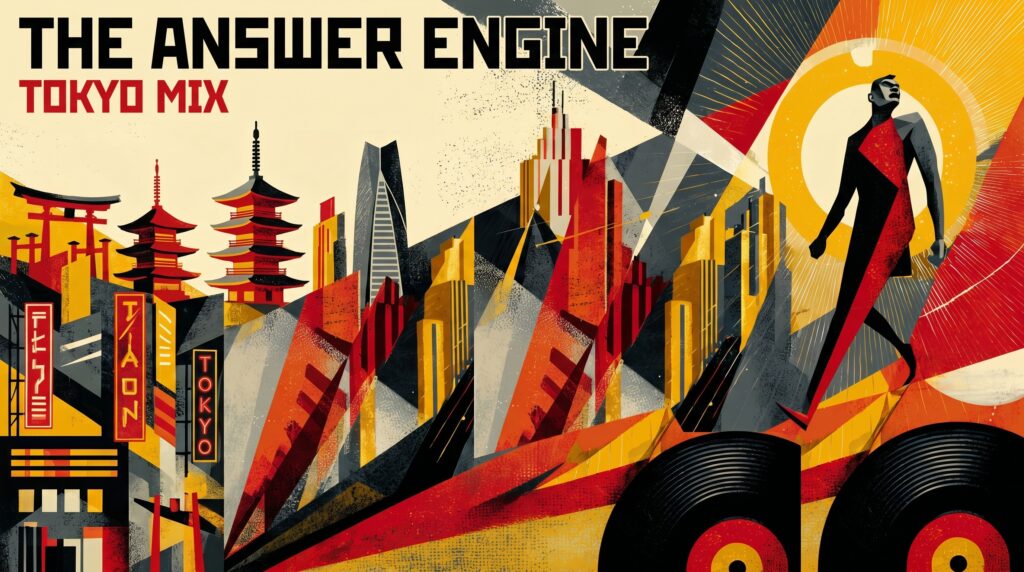
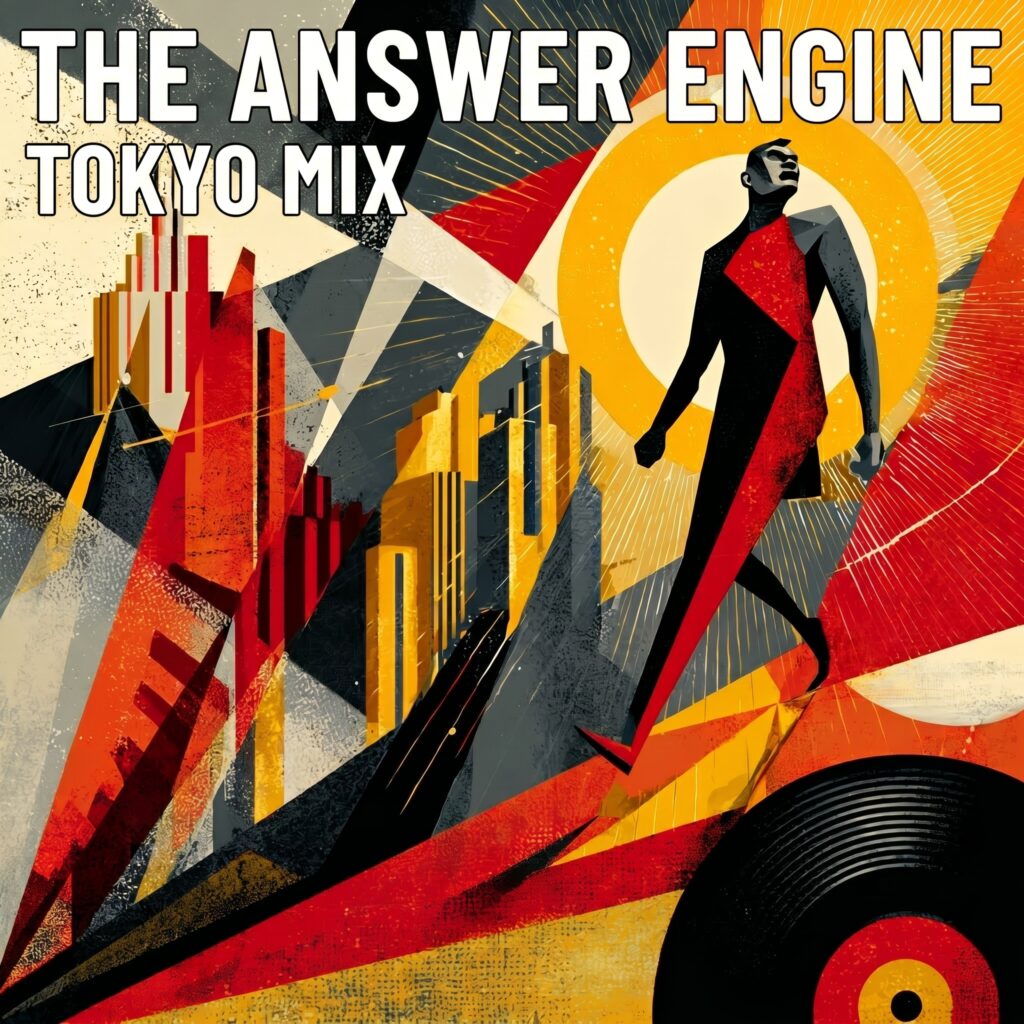
The Answer Engine — Tokyo Mix (DJ mix)
The mix series continues: four tracks for late-night reflection, forward motion, and the quiet work of becoming honest with yourself.
If The Answer Engine is my long-form project about turning the archive into music—journals into lyrics, memory into sound—then the mixes are where that world gets rearranged. Same themes, different lighting. Different pacing. Different weather.
Tokyo Mix is a small, focused sequence built around a particular mood: the feeling of motion without certainty. The feeling of being in transit—through a city, through a season, through a version of yourself that’s starting to wear thin.
I wanted this to live in the zone where trip-hop, downtempo, and late-night electronic mood music overlap—music with patience, texture, and space to think. A mix that doesn’t try to “win” your attention so much as hold it, quietly, long enough for something to loosen.
Tracklist (Tokyo Mix)
- Stop Pushing Forward (Extended Mix)
- The Record Kept Spinning (303 Mix)
- Trust Yourself
- Club Light Dawn (Tokyo Mix)
Stop Pushing Forward (Extended Mix)
This track feels like a thesis statement: stop forcing momentum and start choosing direction.
It’s built on a slow, hypnotic boom-bap groove—head-nod tempo, deep sub-bass, that trip-hop sense of dim light and internal monologue. The voice is intimate and worn-in, delivered in spoken word: not performing at you, more like speaking from inside the room.
The sound design matters here. Scratches, backspins, stutter edits, chopped syllables—the DJ language isn’t decoration, it’s the method. The edits become percussion. The track’s insistence is subtle but clear: you can keep moving and still be lost.
The Record Kept Spinning (303 Mix)
This is the “keep going” track—steady motion, but not the kind that pretends everything is fine.
Four-on-the-floor pulse, minimalist structure, and a bassline that feels like determination rather than celebration. The vocal sits in that space I keep returning to across The Answer Engine: breathy, close, slightly distant at the same time—like a memory talking.
Lyrically it plays with road and car metaphors—escape, pressure, the moment you realize you’re trying to outdrive something you actually have to name. It’s danceable, but emotionally it’s still looking over its shoulder.
Trust Yourself
“Trust Yourself” is the emotional center of the Tokyo Mix—an introspective trip-hop cut that blends R&B warmth with downtempo spaciousness.
The groove is slow and grounded: punchy kick, crisp snare, vinyl crackle giving it that lived-in grain. A smooth bassline holds the harmony while jazzy electric piano chords and shimmering pads open the track into something dreamlike—like a room you can’t quite find the door to.
But the defining element is the vocal. Soft, smoky, intimate—delivered with a vulnerability that feels unguarded, not theatrical. The recurring phrase “trust yourself” becomes less a hook than a survival line: something you repeat because you need it to become true.
There’s also a shift that I love: the song moves from melancholic self-doubt toward something closer to defiance, including a rawer spoken section filtered into that lo-fi “telephone” distance. It’s still quiet—but it’s not passive.
Club Light Dawn (Tokyo Mix)
This track is a bridge into what’s coming later this year.
I’ve been working on a Club Light Dawn reworking with Japanese vocals, and the Tokyo Mix version is where that thread starts to show. I’ve been learning Japanese, and translating the song has been a surprisingly intense process—not just swapping words, but re-understanding what the song actually means when you have to rebuild it from the ground up.
Translation forces clarity. It exposes which lines were doing real emotional work, and which lines were just atmosphere. It also changes the feeling in your mouth when you sing it—different rhythm, different weight, different kind of honesty.
The official single version is on the way later this year, but Tokyo Mix is the first glimpse of that direction.
What this mix is really asking
Underneath the versions and BPMs, Tokyo Mix keeps circling the same question:
What happens when you stop worshipping “forward” as a virtue—
and start asking toward what?
That’s the larger engine behind The Answer Engine project for me: not nostalgia, not aesthetic moodboarding, but the hard, sometimes unglamorous work of meaning-making. Using sound and voice as a way to tell the truth sideways—so it can get past your defenses.
If you listen straight through, I hope it feels like one continuous piece: four scenes, same night, different angles.

The Answer Engine – Pop a Pill
https://youtu.be/gR2WHDwSWK4?si=5u8azBY6gqtwrLAlWorking with My 20-Year-Old Self: A Portal through My Archival Records
The Time Machine in My Desk
I’ve been staring at this desk drawer for thirty years without really seeing it. Not the physical drawer—that’s changed half a dozen times through moves and upgrades—but what’s been buried underneath the current layer of life. The cables that fit nothing anymore. Receipts from places that don’t exist. The archaeology of right now, piled on top of something that shouldn’t still matter but does.
A few months ago, I pulled out a journal from 1996. Folded, creased, the handwriting almost unfamiliar. I was nineteen when I wrote it—an immigrant kid in Florida, no safety net, building a life one bureaucratic form at a time. The words inside weren’t casual diary entries. They were architecture. I’d spend hours hunting through dictionaries for the exact right word, testing phrases, building sentences as if I were constructing a proof of my existence.
What I found was a voice I’d forgotten I had—raw, precise, unfiltered. And I realized: I can’t write these words anymore. Not because the memories are gone, but because I’m not that person. I really can’t write songs about clubbing. But that nineteen-year-old? He could. He did. And his words were still sitting there, waiting.
It is not nostalgia. It is archaeology. I’m providing the voice, the production, and the musical framework. But the story, the perspective, and the raw truth of what it felt like to be young in mid-90s Florida, navigating friendship and desire and substances and silence, belongs to my younger self.
I recently released Pop A Pill EP. It’s a conversation between two versions of myself, separated by thirty years, united by the same uncompromising need to get the words exactly right. It’s about a night with Justin and John, about pills that might be candy or sound or surrender, about choosing to go south when everyone tells you to go north.
Why should you care? Because we all have a desk drawer. We all have a younger self whose voice we’ve edited out of our current narrative. And maybe—just maybe—that voice still has something to teach us about who we were before we learned to be careful.
The Archaeology of a Single Night: What I Found When I Stopped Editing
Here’s what happened when I opened that 1996 journal: I found a night I’d almost forgotten, written in a handwriting that looked like mine but felt like someone else’s. The entry’s date was in the spring—I can’t remember exactly when, which is part of the point. What I remember is the care I took writing it.
That night, it was Justin, John, and I. Three writers who spent more time trading sentences than small talk. We’d carved out this weird space where we could be honest about the blurred lines between friendship and desire, about wanting things we didn’t have language for yet.
Justin was dark, articulate, and handsome, which made people stop mid-sentence. His mouth was “his greatest love, his grand value”—that’s what I wrote in 1996, and reading it now, I can still see why I spent an hour finding those exact words. He understood the power of saying less. He’d arrive with whatever the night needed—a pill, a sentence, a silence—and hand it over without ceremony.
John was different. Earnest, literal, unable to “see the wood for the trees.” He’d try to explain the feeling away, turn mood into argument, translate experience into something manageable. He meant well. But that night, I told him to leave. Not cruelly—just clearly. Because some moments dissolve the second you try to explain them.
The journal entry documents what happened next with a precision I can’t access . “Last night with Justin, he arrived with the cure / Handed me candy, I was so sure.” The intimacy in that exchange—the trust it required to accept something without asking what it was—that’s the architecture of the song. Not the substance itself, but the nod of agreement. The choice to stop performing coherence.
There’s a line in there that stopped me cold when I read it thirty years later: “Once I considered I could kiss that mouth / But that feeling’s been misplaced now, headed south.” I’d forgotten I ever felt that way about Justin. Not forgetting the attraction exactly, but forgotten how I’d documented its transformation into something else. Companionship. Understanding. A shared vocabulary of silence.
This is what I mean when I talk about archaeology instead of nostalgia. I’m not trying to recreate that night. I couldn’t if I wanted to—I really can’t write songs about clubbing and be out past 7pm anymore. But that’s exactly why the journal entries matter. They’re not filtered through the lens of who I became. They’re written by someone who was living it, who spent hours getting the words exactly right because getting them right was proof that my choices—to leave, to start over, to build something from nothing—were correct.
The night wasn’t about the pill. It was about the moment Justin learned to “shut up” because “he understands somehow.” When three writers stopped writing and just floated together “on the other side” of language. When going south—descending, refusing improvement, stepping away from the part of yourself that performs—became the only honest direction.
That’s the real archaeology here. Not just excavating a memory, but honoring the precision with which they originally documented it. Trusting that the person I was—isolated, deliberate, building proof of my existence one carefully chosen word at a time—knew something about that night that I can never access again.
What I found in that desk drawer wasn’t just a story about Justin and John and a night in mid-90s Florida. It was evidence of a voice I’d forgotten I had. Raw, precise, unfiltered. A voice that understands how relationships transform when you stop performing for each other. When the nod becomes more important than the explanation. When you choose less language, not more.
That voice wrote “Pop A Pill.” I just provided the production thirty years later.
What I’m saying in the Lyrics (and what I’m not)
I’m going to be straight: I don’t always know what the fuck I was going on about in those 1996 pages.
Sometimes I read a line now and think, who wrote this? And then—annoyingly—two sentences later it lands, and it’s ace.
That’s the whole point of this project: it’s not one writer. It’s two. The kid who wrote it, and the man who’s trying not to “improve” him.
The lyric, on the page
- Surface: A specific night in mid-90s Florida with three people—you, Justin, and John. On the surface it’s about taking a pill and riding the altered state.
- Underneath: It’s not really about the substance; it’s about consent without explanation. “No questions asked, just a nod of agreement / To prevent any explanation, any treatment.” The relief is not having to narrate your pain into something digestible.
- Key metaphor: “Going north when I’m heading south.” North is improvement, clarity, being corrected. South is lowering the lights, stepping away from the part of yourself that performs coherence. It’s a refusal of the “fix.”
The stuff the lyric refuses to do
The lyric won’t help the listener in the usual ways—and that refusal is where the intimacy lives.
- It doesn’t name the substance in clinical terms
- It doesn’t tell you what to think about it
- It doesn’t give you the tidy “and then I learned…” ending
It leaves the experience in its original temperature: the moment you choose less language, not more.
The people (the pressures)
This night works because the people aren’t “characters” so much as forces—different ways of handling feeling.
Justin: Dark, articulate; his mouth was “his greatest love, his grand value.” He arrives with whatever the night needs and hands it over without ceremony. He learned to “shut up” because “he understands somehow”—because sometimes care is the opposite of commentary.
John: Earnest, literal, unable to “see the wood for the trees.” He tries to explain the feeling away, turning mood into an argument. You told him to leave that night, not as punishment, but as preservation—because some moments dissolve the second you narrate them.
The transformation: “Once I considered I could kiss that mouth / But that feeling’s been misplaced now, headed south.” Attraction doesn’t vanish; it changes shape—into companionship, understanding, and a shared vocabulary of silence.
The deeper architecture (where the two writers meet)
Here’s what I think the older me can say without stealing the mic from the younger me:
This wasn’t just a night out. It was the rare moment when three writers stop writing and just float together—on the other side of language. And thirty years later, that’s what I’m trying to recreate: not the plot, not the substance, not the morality—just the permission. “South” is the honest direction. The nod is the smallest possible yes. It’s what love looks like when it doesn’t demand an explanation.
Now for the The Golden Rule: The “Double-Dog Dare” of Songwriting. The foundation of this entire project rests on one unbreakable rule: I don’t get to fix my younger self. The journal entries from 1996 had to be used verbatim. No smoothing out the awkward phrases. No updating the perspective for 2026 sensibilities. No apologizing for the rawness. If I spent hours hunting through a dictionary at nineteen to find the exact right word—not the close one, not the adequate one, but the right one—then I have no business “improving” it now.
This wasn’t a casual decision. It was the core integrity of the entire Answer Engine project. I call it the “double-dog dare” of songwriting—the challenge I set for myself that made the whole thing feel honest instead of nostalgic.
Here’s what you need to understand about those journals: they weren’t the frantic scribbling of someone trying to capture a fleeting moment before it dissolved. They were architecture. I would sit there for hours, working and reworking lines, testing phrases, weighing every word. This was deliberate craft, the writing that builds something permanent.
And that care shows now. Three decades later, when I pull out those entries and read them, the prose stands on its own feet. Yes, it comes from an immature mind wrestling with self-discovery, belonging, independence, and often the harder choice. But it reads solid because it was solid—built with intention, one carefully chosen word at a time.
Why did I write Like That?
Context matters here, and I need to be honest about it. I was nineteen years old, an immigrant building a life in a new country with absolutely no safety net. I was navigating the bureaucratic machinery of securing a green card, staying within the lines, doing everything by the book. There was no family support. No help. No backup plan if I made the wrong move.
It was a profoundly lonely time. But it was also formative—a period when every choice carried weight and consequence. One wrong step, one arrest, one bureaucratic flag, and everything I was building could evaporate. So I moved carefully. Deliberately. And I wrote the same way.
The journal became more than a record of what was happening. It became proof. Proof that the choices I had made—to leave Northern Ireland, to start over in Florida, to build something from nothing—were correct. The act of writing with such care was itself an act of self-construction. It was me saying, with no one else around to hear it: I am here. I am doing this deliberately. I will not be careless with my life.
That’s why I couldn’t edit these entries thirty years later. They weren’t just memories I was looking back on—they were evidence of who I was at that moment, evidence I’d carefully constructed. To change them now would be to invalidate the work I did at nineteen, and the precision I insisted on when precision was all I had.
The Palimpsest Effect
So here's what I created with "Pop A Pill": a palimpsest. The modern production—the beats, the vocal delivery, the layers of sound—sits atop the original, carefully crafted ink of 1996. You can see both layers if you look closely enough. The young immigrant finding his footing, writing with a dictionary in hand. And the artist I became three decades later, providing the voice and the music but refusing to rewrite the story.
The result isn’t just a nostalgic time capsule. It’s not me trying to relive my youth or romanticize the past. It’s something stranger and more honest: a genuine dialogue between two versions of myself, separated by time but united by the same uncompromising commitment to getting the words right.
This is the double-dog dare. By refusing to tidy up history, by letting the 1996 voice speak in its own words with all its raw edges intact, I created something that wouldn’t exist any other way. My older self provides the musical framework for stories I would never write now. My younger self provides the unfiltered truth of what it actually felt like to be there.
And maybe—just maybe—that combination creates something more honest than either of us could have made alone.

The Answer Engine – Underground Glow

Verse 1
Basement heat, bodies pressed tight
Warehouse walls keep out the light
DJ spins till the morning breaks
Lost in the rhythm, whatever it takes
Smoke machine haze, laser beams
Living for the beat, chasing dreams
Pre-Chorus
Feel the bass shake the concrete floor
One more track, then one track more
We don't stop till the sun comes up
Fill your soul from an endless cup
Chorus
Midnight strobe, take me higher
Set my heart on fire
Dancing in the underground glow
Midnight strobe, let it flow
This is all we need to know
Verse 2
Sweat-soaked shirts and designer shoes
Bankers and artists paying their dues
Nobody cares who you are by day
Down here we all just come to play
Four-on-the-floor never lets us down
This is our kingdom, our underground crown
Pre-Chorus
Feel the bass shake the concrete floor
One more track, then one track more
We don't stop till the sun comes up
Fill your soul from an endless cup
Chorus
Midnight strobe, take me higher
Set my heart on fire
Dancing in the underground glow
Midnight strobe, let it flow
This is all we need to know
Bridge
When the world gets too heavy to hold
We escape to stories untold
In the darkness we find our light
Surrender everything tonight
Breakdown
(Instrumental breakdown with filtered house piano, building percussion)
Final Chorus
Midnight strobe, take me higher
Set my heart on fire
Dancing in the underground glow
Midnight strobe, let it flow
Midnight strobe, take me higher
Never coming down, never tire
Lost in the underground glow
This is all we need to know
Outro
Midnight strobe... (echoing)
Take me higher... (fading)
Underground glow...