Responsive Menu
Add more content here...
Welcome to 2026: A Year of Intentional Purpose

Welcome to 2026: A Year of Intentional Purpose

For years, Better World With Design has been my creative playground. In 2026, that changes. We will move from reactive creation to intentional curation, and we will anchor our diverse interests in a single, focused mission: amplifying voices that have been systematically marginalized in our cultural conversations.

That mission plays out across three core pillars:

  • Design as a tool for social good.
  • Literature as a lens on power and justice.
  • Technology has both promise and peril in pursuiting equity.

This shift doesn’t abandon what made this blog meaningful. The book reviews, photography essays, music discoveries, and design insights that have defined BWWD remain at our core; they’re just being asked to pull in the same direction.

It also marks a structural shift: AEO Decoded, the podcast and educational work on Answer Engine Optimization, moves to its own dedicated site and publishing cadence, freeing Better World With Design to focus fully on design, literature, technology, and community storytelling.

Alongside the written work, 2026 also marks a new chapter for Answer Engine, my music project. The response to the 2025 releases was so good that I'm excited to release more music in 2026, treating songwriting and production as another way of thinking through justice, memory, and place, not as a bid for late-life pop stardom, but as an honest practice of making music and writing words that fit the world we're trying to build.

The Vision: From Playground to Platform

For the past several years, Better World With Design has been exactly what its evolution suggested, a space where design philosophy, social commentary, creative work, and personal reflection intersected without apology. We explored Montaigne's essays alongside web accessibility guidelines. We analyzed Demon Copperhead while discussing Answer Engine Optimization. We celebrated experimental music while documenting rural tech initiatives.

This eclecticism wasn't confusion; it was authentic curiosity. But authenticity without direction can become diffusion. In 2026, we're bringing intentionality to that curiosity by organizing the work around those three pillars and being explicit about whose stories, histories, and futures we’re centering.

The Belfast Stories

Within that, 2026 also introduces Belfast Stories as a recurring BWWD series: place-based essays grounded in Belfast streets, buildings, routes, and sounds, using memory, photography, and narrative to examine how design, class, history, and community shape everyday life.

Feature: Voices from the Margins

The most significant addition to BWWD in 2026 is the Voices from the Margins series, a recurring feature that centers writers, thinkers, and creators whose perspectives have been excluded from the mainstream literary canons and cultural conversations.

This series matters because representation isn't just about who gets published; it's about whose realities are validated, whose experiences are deemed worth preserving, and whose visions shape our collective imagination. For too long, the literary canon has reflected a narrow slice of human experience-primarily Western, primarily male, primarily reflecting the perspectives of the powerful.

Voices from the Margins deliberately seeks out the alternatives: LGBTQ+ writers from the early 20th century who wrote in code and metaphor because openness meant danger. Women authors who published under male pseudonyms or saw their work attributed to men. Indigenous writers documented cultural genocide even as it occurred. Writers of color chronicling resistance and resilience in systems designed to erase them.

What to Expect in 2026

The editorial calendar for 2026 reflects this intentional evolution while keeping the creative range that has always defined BWWD.

Monthly Features

  • Voices from the Margins (monthly): These are public domain writers whose work has been systematically excluded from literary canons, and this will include historical context, close reading, and links to present-day movements.
  • Belfast Stories (monthly): Place-based essays rooted in Belfast streets, bridges, estates, venues, and routes, using memory, photography, and narrative to explore community, class, conflict, and everyday design.
  • Design Philosophy Essays: Design as a tool for social good, focusing on accessibility, equity, and power in digital and physical spaces.
  • Photography Essays: Documentary and experimental photography that traces place, community, and change.
  • Book Reviews: Reading through a justice lens, looking at how authors handle power, identity, resistance, and transformation.
  • Music Discovery: Artists and genres that push against the center, with attention to experimental and historically marginalized voices.
  • Technology and Ethics: How technology mediates justice, privacy, and equity, grounded in data ethics and accessibility work.

Why Public Domain Literature?

A practical note: this series focuses on public domain works, which means most featured writers died before 1955. This isn't a limitation; it's an opportunity. These texts are freely accessible, allowing readers to engage directly without financial barriers. More importantly, this historical focus shows how long these voices have existed and how deliberately someone suppressed them.

When we read Zitkala-Sa's "The School Days of an Indian Girl" or José Martí's revolutionary poetry, we're not discovering obscure curiosities. We are recovering essential perspectives that systematically excluded stories about our literature, history, and culture.

Series and Recurring Themes

Several thematic threads will weave through the year's content:

  • The Documentary Impulse: Connecting historical documentary photography (Timothy O'Sullivan, Carleton Watkins, Alexander Gardner) with contemporary visual storytelling and the ethics of representation.
  • Literature and Resistance: Examining how writers document, resist, and imagine alternatives to oppressive systems, from Indigenous authors chronicling cultural genocide to LGBTQ+ writers creating coded narratives of survival.
  • Design Justice in Practice: Applying design justice principles to real-world scenarios, from web accessibility to community-centered technology initiatives.
  • Philosophy and Everyday Life: Continuing our engagement with thinkers like Montaigne, exploring how philosophical frameworks illuminate contemporary challenges.

Community Engagement

Better World With Design has always been a conversation, not a monologue. In 2026, we're deepening our commitment to community engagement through:

  • Open Resources: All Voices from the Margins features will include links to freely accessible texts, bibliographies for further reading, and historical context documents.
  • Response and Dialogue: Enhanced commenting and discussion features, with dedicated time for engaging with reader responses and questions.
  • Accessibility Commitment: Continued focus on making all content accessible, including transcripts, alt text, and clear navigation structures.

Why Now? Why This Focus?

The decision to center Voices from the Margins reflects both conviction and historical urgency. We live when marginalized perspectives are simultaneously more visible than ever and under renewed attack. Book-banning campaigns target LGBTQ+ content, Indigenous histories, and narratives of racial justice. Educational curricula whitewash historical atrocities. Cultural conversations about whose stories matter remain contested terrain.

Amplifying marginalized voices isn't just about representation, though representation matters deeply. It's about expanding our collective understanding of what's possible, what's been tried, what's been suppressed, and what's been sustained despite systematic erasure.

When we read Zitkala-Sa's accounts of forced assimilation in Indian boarding schools, we're not engaging with distant history. We're understanding the roots of ongoing trauma in Indigenous communities and recognizing the resilience that has preserved culture despite genocidal policies.

When we explore early LGBTQ+ literature written under the threat of criminalization and social destruction, we honor the courage it took to write truth into existence and recognize that many contemporary battles for equality are continuations of struggles that began generations ago.

When we center writers of color documenting resistance and creating visions of liberation, ‌alternative futures have always existed in the imaginations of those fighting for them.

Why Does This Focus Matter?

This shift reflects personal growth: a deeper understanding that neutrality is impossible. After years of exploring curiosity without constraint, I see that freedom without direction can become its own constraint. By choosing to center certain voices and perspectives, I'm not limiting what Better World With Design can be-I'm focusing its power.

Every design decision, every platform choice, and every act of curation reflects a conscious value. In 2026, we will make these values explicit.

Better World With Design has always reflected my values: curiosity, critical analysis, commitment to justice, appreciation for beauty and craft. In 2026, we're making these values explicit in our content strategy.

Maintaining the Eclecticism

The eclecticism remains, but the focus has shifted. Every post, from photography to design, will be connected by a shared, critical lens: attention to marginalized perspectives, analysis of power structures, celebration of creativity as resistance, and the recognition that beauty and justice are not separate concerns.

You'll still find photography essays exploring technical challenges and visual storytelling. Music reviews will continue celebrating experimental sound and genre-defying artists. Design philosophy posts will still range from Swiss typography to contemporary UX patterns. Book reviews will include science fiction, literary fiction, historical narratives, and philosophical texts.

When we explore documentary photography, we'll examine not just technical mastery but also the ethics of representation and whose stories get preserved. When we review music, we'll consider not just sonic innovation but also whose experiments get canonized and whose get forgotten. When we discuss design, we'll interrogate not just aesthetics but also accessibility, equity, and the distribution of power.

Looking Ahead

2026 represents a commitment to showing up consistently with intentional content that serves both personal curiosity and collective liberation. It's ambitious, 52 weeks of focused, researched, thoughtful content. But it's also necessary.

The cultural conversations we need to have about justice, equity, representation, and power require sustained engagement, not just momentary attention. Building a more just world requires understanding how we got here, whose visions were suppressed along the way, and what alternatives have always existed in the margins.

Better World With Design has always been about exploring how we create, communicate, and build the world we want to inhabit. In 2026, we're making explicit that the world we want to inhabit centers justice, amplifies marginalized voices, and recognizes that design, in all its forms, is never neutral.

Welcome to 2026. Let's build something meaningful together.

Practical Details

For those interested in following along:

  • Publishing Schedule: New content every Wednesday, with occasional bonus features on Saturdays.
  • Social Media: More engagement across platforms, with content snippets, historical photos, and ongoing conversations.
  • Archive Access: All content remains freely accessible with enhanced tagging and navigation to help readers explore thematic connections.
  • Community Guidelines: Comments and discussions are welcome, with moderation focused on maintaining respectful dialogue and centering marginalized voices.

Thank you for being a part of this journey. Whether you've followed Better World With Design from its earliest days or you're discovering it for the first time in 2026, your engagement, questions, challenges, and support make this work meaningful.

Here's to a year of intentional creation, sustained engagement, and collective exploration of how we build the world we want to inhabit.

Founder - 

Gary Crossey

Beyond Straight Lines: Sara Ahmed’s Queer Phenomenology and the Future of Inclusive Design

Beyond Straight Lines: Sara Ahmed’s Queer Phenomenology and the Future of Inclusive Design

Better World with Design Podcast Queer

Hello and welcome back to Better World with Design. I'm your host, Gary Crossey, and today we're diving into a challenging but important work in contemporary philosophy: Queer Phenomenology: Orientations, Objects, Others by Sara Ahmed.

I'll be honest with you—this book pushed me to my limits. Ahmed's dense philosophical exploration of orientation, space, and queer experience is not an easy read. But that's part of what makes this book significant: it asks us to sit with discomfort, to question how we orient ourselves in the world, and to reconsider what we think we know about direction, desire, and belonging.

What struck me most were Ahmed's insights into lesbian networks and queer women's experiences. The way she examines how queer women navigate spaces, create communities, and establish orientations that run counter to heteronormative expectations offers a fascinating lens into how marginalized groups forge their own paths and build worlds within worlds.

Today, I want to unpack some of these ideas, share what resonated with me despite the difficulty, and explore how Ahmed's work might help us think about designing more inclusive, more thoughtful spaces—both physical and social—in our contemporary world.

So let's get oriented—or perhaps, let's allow ourselves to become a little disoriented—as we explore Queer Phenomenology.

What philosophical questions or problems does the author address?

Sara Ahmed's Queer Phenomenology addresses several interconnected philosophical questions that challenge how we understand embodiment, space, and social existence. At its core, the book asks: What does it mean to be oriented? This seemingly simple question unfolds into a profound exploration of how we find our way in the world, how we come to face certain directions rather than others, and how these orientations shape what becomes available to us as objects of desire, attention, and possibility.

Ahmed interrogates the naturalization of heterosexuality by examining it as a spatial and directional phenomenon. She asks: How does heterosexuality function as a compulsory orientation? Rather than treating sexual orientation as merely a matter of identity or desire, Ahmed explores how heterosexuality operates as a "straightening device"—a normalized direction that bodies are expected to follow. This reframes the philosophical problem of normativity in spatial terms: straightness becomes not just a sexual orientation but a way of moving through the world that aligns with social expectations, family lines, and institutional arrangements.

Straightening devices are a subset of orientation devices—the ones that push bodies back onto a single, “proper” line.

That's a powerful way to reframe normativity, not just as a belief, but as a direction your body is forced to take. And it leads directly to her next major point...

The book also grapples with phenomenological questions about how objects orient us and how we orient ourselves toward objects. Drawing on Edmund Husserl's phenomenology, Ahmed examines how certain objects become "reachable" while others remain at a distance, how familiarity creates grounds upon which we gather, and how different bodies encounter different worlds based on their orientations. This raises critical questions about embodied experience: What becomes background and what comes into view depending on how we are oriented?

Think about how your own desk setup makes some things “reachable” and others fade into the background—that’s Ahmed’s point made tangible.

Ahmed challenges the linearity embedded in developmental narratives, particularly psychoanalytic accounts of sexuality. She critiques how Freudian analysis reads sexuality as following a line—tracing development "from its final outcome backwards"—and asks: What happens when we refuse these linear narratives? What if queer desire doesn't represent a deviation from a straight line but rather reveals that there was never a singular, natural line to begin with?

The work also addresses questions of belonging and inheritance: How do queer orientations threaten family lines and social reproduction? Ahmed shows how homosexuality is perceived as a problem not simply because of the gender of one's beloved, but because it threatens "the continuation of the family line as a line of descent." This connects orientation to questions of futurity, legacy, and what gets passed down through generations.

Finally, Ahmed explores how spaces are oriented and how this orientation shapes who can inhabit them comfortably. She examines how heteronormative spaces require certain bodies to twist, adjust, or hide aspects of themselves, while other bodies move through these spaces with ease. This raises broader questions about social justice: Whose comfort is centered? Whose orientations are accommodated? Through these interwoven questions, Ahmed develops a queer phenomenology that reveals orientation as both a philosophical concept and a political problem.

How does the author use reasoning or argumentation to explore these issues?

Alright, how does Ahmed actually make this case? Let’s break it down step by step.

Sara Ahmed employs a distinctive methodological approach that interweaves phenomenological analysis, spatial metaphors, and critical readings of canonical texts to explore orientation as both a philosophical concept and a lived experience. Her argumentation moves through several interconnected strategies that build a cumulative case for understanding queerness through the lens of orientation.

Ahmed's primary argumentative move is to literalize the metaphor of orientation. She takes the spatial dimensions of terms like "orientation," "direction," and "straightness" seriously, showing how these aren't merely figurative descriptions of sexuality but reveal fundamental truths about how bodies navigate social space. By grounding abstract concepts in bodily experience—how we turn, what we face, what comes within reach—she makes philosophical arguments through phenomenological observation.

Her analysis of historical texts, particularly sexological writings by Havelock Ellis and Freud's case studies, demonstrates a critical reading practice that exposes the logic underlying heteronormative assumptions. Rather than simply rejecting these texts, Ahmed reads them carefully to reveal how they construct straightness as natural through circular reasoning—defining women's bodies as "made for men" and then using this construction as evidence of heterosexuality's naturalness.

Ahmed also uses close attention to language and etymology to unpack how orientation operates conceptually. She examines how terms like "deviation," "inversion," and "perversion" encode spatial relationships, revealing how queer desire is framed as going "off track" or "offline" from a presumed straight path. This linguistic analysis supports her broader argument about how heteronormativity operates through spatial metaphors that become naturalized.

Throughout the work, Ahmed employs what we might call "reorienting readings"—she takes familiar philosophical concepts and reads them from a queer angle, asking what becomes visible when we shift perspective. This methodology itself embodies her theoretical claims: by changing our orientation toward canonical texts and concepts, different aspects come into view, and what seemed like background becomes foreground.

What philosophical theories or viewpoints does the author present or critique?

Okay, theory time — but let’s keep it human. Here’s the big picture without the grad‑seminar fog.

Beyond the theories already discussed, Ahmed's Queer Phenomenology engages with several additional philosophical frameworks that shape her argument about orientation and queerness.

Ahmed critically examines Marxist materialism, particularly its emphasis on how objects and labor relations structure social life. She adapts materialist analysis to explore how objects orient bodies in space, creating what she calls "orientations toward objects." However, she extends beyond traditional Marxist frameworks by emphasizing how sexual orientation and racial positioning—not just class relations—determine which objects become "reachable" or available to different bodies.

The work engages with feminist standpoint theory, drawing on insights about how marginalized positions offer distinctive epistemological perspectives. Ahmed argues that queer orientations provide alternative vantage points that reveal what remains hidden from straight perspectives. This connects to her broader claim that disorientation can be productive—when we lose our bearings in heteronormative space, we may glimpse how that space is organized and whom it serves.

Ahmed critiques liberal political philosophy and its assumptions about equality and inclusion. She challenges the notion that simply including queer people in existing institutions achieves justice, arguing instead that these institutions are fundamentally oriented around heterosexuality. True transformation would require reorienting institutional spaces, not merely tolerating diverse orientations within unchanged structures.

The book also responds to poststructuralist theories of performativity, particularly Judith Butler's work on gender performativity. While Ahmed acknowledges how identities are constructed through repeated performances, she emphasizes the spatial and material dimensions that performativity theories sometimes underemphasize. Orientation, for Ahmed, involves not just repeated acts but repeated turnings, directions, and proximities to objects that accumulate over time.

Ahmed engages with critical race theory and scholarship on whiteness, examining how racial orientations intersect with sexual orientations. She explores how spaces are oriented around whiteness, requiring bodies of color to navigate disorientation while white bodies move with ease. This intersectional analysis reveals how multiple axes of orientation operate simultaneously, creating different experiences of belonging and alienation.

Finally, Ahmed critiques evolutionary psychology and sociobiology, which attempt to ground heterosexuality in biological imperatives and reproductive necessity. She reveals how these supposedly scientific frameworks naturalize social arrangements by projecting heteronormative assumptions onto nature itself, then claiming these arrangements are inevitable because they're "natural."

Through these diverse engagements, Ahmed constructs a theoretical framework that refuses single-axis analysis, instead showing how orientation operates across multiple registers—phenomenological, psychoanalytic, materialist, feminist, and postcolonial—simultaneously.

How does this work engage with or respond to other philosophical works or thinkers?

Quick tour through the canon — who’s in the room, and what changes when we swivel the chair a few degrees?

Sara Ahmed's Queer Phenomenology positions itself within a rich conversation across multiple philosophical traditions, creating dialogues that extend beyond the phenomenological and psychoanalytic engagements already discussed.

Ahmed responds to Gilles Deleuze and Félix Guattari's concepts of lines and becomings from A Thousand Plateaus. While Deleuze and Guattari celebrate deterritorialization and "lines of flight" that escape rigid structures, Ahmed questions whether such mobility is equally available to all bodies. She suggests that the celebration of nomadic movement may overlook how some bodies are already displaced while others are comfortably grounded.

The work engages with Michel Foucault's analytics of power, particularly his accounts of how bodies become docile through spatial arrangements and disciplinary techniques. Ahmed extends Foucault's insights by examining how heteronormative orientations discipline bodies through seemingly mundane spatial practices—where we sit, whom we face, what direction we follow.

Ahmed also responds to Elizabeth Grosz's corporeal feminism and theories of embodied space. While Grosz emphasizes sexual difference as fundamental to embodied experience, Ahmed complicates this by examining how orientations create different relationships to space that don't always map onto binary sexual difference.

The book engages with Giorgio Agamben's work on potentiality and impotentiality, exploring what remains unrealized when bodies follow certain orientations. Ahmed considers how compulsory straightness forecloses certain potentialities, making some life directions literally unthinkable.

Finally, Ahmed's work responds to Lauren Berlant's concept of cruel optimism and affective attachments that sustain us even as they limit us. Ahmed explores how orientations involve attachments to objects and directions that may simultaneously provide comfort and constrain possibility, revealing the ambivalent nature of how we find our way in the world.

What are the practical implications or applications of the author's theories or arguments?

Zooming out for the builders in the room—what does this actually change about how we design and run things?

Sara Ahmed's Queer Phenomenology offers practical ways to design for plurality, not straightened defaults.

In institutions: audit defaults. Which policies, calendars, and forms presume a single life path? Rewrite these “straightening devices” so multiple trajectories are reachable by design.

In the built environment: treat accessibility as first‑order design, not accommodation. Plan for many ways of gathering and moving, not just the couple, the car, or the 9‑to‑5.

In pedagogy and teams: create short, intentional moments of productive disorientation that surface whose comfort is centered and whose labor of adjustment is invisible.

The through‑line is simple: design orientation devices that widen reachability for more bodies and futures.

What theories or concepts does the author use to support their argument?

Ahmed's argument relies on several interconnected theoretical concepts that work together to illuminate how orientation operates simultaneously as spatial practice, social structure, and lived experience.

Central to her framework is the concept of "reachability"—the idea that certain objects, opportunities, and futures become literally and figuratively within reach depending on how bodies are oriented. This extends beyond physical accessibility to encompass social possibility: heteronormative orientations make certain life trajectories reachable (marriage, biological parenthood, inheritance) while placing others out of reach.

Ahmed employs the concept of "compulsory heterosexuality", originally theorized by Adrienne Rich, but recasts it spatially. Rather than viewing it purely as ideological pressure, Ahmed shows how heterosexuality becomes compulsory through spatial arrangements that presume, facilitate, and reward straight orientations while making queer orientations require constant negotiation and adjustment.

The notion of "habit" and "habitation" proves crucial for understanding how orientations become naturalized. Ahmed draws on phenomenological accounts of habit to show how repeated orientations toward certain objects create comfortable dwelling spaces. Bodies become "at home" in spaces organized around their orientations, while differently oriented bodies experience perpetual alienation.

Ahmed also utilizes concepts from affect theory, examining how emotions like comfort, discomfort, shame, and anxiety attach to particular orientations. These affective dimensions aren't incidental but constitute part of how orientations are maintained and policed. Discomfort in heteronormative spaces isn't simply subjective feeling but reveals the objective organization of those spaces.

Ahmed develops the concept of "queer angles"—alternative approaches and perspectives that emerge when bodies don't follow straight lines. These oblique orientations generate different knowledges and reveal aspects of social organization that remain invisible from straight perspectives. This conceptual framework collectively demonstrates that orientation isn't merely metaphorical but materially structures whose lives become livable and whose desires become thinkable.

How does the book contribute to the field it is written in?

Queer Phenomenology made orientation a central category of analysis across humanities and social sciences, influencing fields from geography to disability studies to postcolonial theory. Ahmed demonstrated that phenomenology need not remain Eurocentric and heteronormative, but could be transformed into a methodology for examining power, privilege, and marginalization. Her spatial approach to understanding normativity provided concrete analytical tools where previous theory often remained abstract.

The book's impact extends to architecture and design disciplines, where Ahmed's framework enabled practitioners to critically examine how built environments privilege certain bodies while marginalizing others. Urban planners, architects, and designers now routinely reference Ahmed's work when considering how physical spaces encode social hierarchies and shape possibilities for inhabitation.

Perhaps most significantly, Ahmed established orientation as a framework for intersectional analysis, showing how race, sexuality, gender, disability, and other axes of identity operate through similar spatial mechanisms. This contribution moved beyond additive models of oppression toward understanding how multiple forms of marginalization structure spatial experience simultaneously. The concept of orientation became a lingua franca across disparate theoretical conversations, enabling dialogue between scholars who previously worked in isolation from one another.

What are the most compelling or memorable parts of the book?

Let’s hit the highlights — the scenes and concepts that stick to your ribs.

Beyond the family table and slantwise orientations already discussed, several other moments in Queer Phenomenology leave lasting impressions through their ability to defamiliarize the familiar and make visible what typically remains unnoticed.

Ahmed's meditation on the "straight line" as a cultural imperative proves remarkably powerful. Her examination of how developmental narratives, career trajectories, and life courses are imagined as lines moving forward—toward maturity, success, reproduction—reveals how temporal orientation reinforces heteronormativity. The expectation that lives should progress linearly toward predetermined destinations makes wandering, returning, or moving sideways appear as failure rather than alternative modes of inhabitation.

The discussion of objects as "orientation devices" offers another unforgettable insight. Ahmed shows how seemingly neutral objects—desks arranged in rows, wedding registries, demographic forms with limited options—actively orient bodies toward particular futures. These objects aren't passive but perform orientating work, channeling desires and possibilities in specific directions while making others literally inconceivable.

Particularly striking is Ahmed's analysis of the effort required to maintain non-normative orientations. She describes the exhaustion of constantly translating, explaining, and justifying orientations that don't align with presumed defaults. This captures something essential about marginalized experience: the invisible labor of navigation that dominant groups never perform because spaces are already organized around their orientations.

Ahmed's exploration of how comfort itself operates as a technology of normativity remains deeply compelling. She reveals that feelings of being "at home" or "comfortable" aren't natural responses but result from repeated orientation toward objects and spaces designed for particular bodies. Discomfort thus becomes not personal failure but evidence of how spaces exclude certain inhabitants.

Her concept of "queer use" of objects—appropriating things for purposes other than their intended orientation—provides memorable examples of creative resistance. When objects designed to facilitate straight lines get turned toward oblique purposes, they reveal both the contingency of normative arrangements and the possibility of inhabiting space differently.

How does the author's background or perspective influence their interpretation of the topic?

Sara Ahmed's positionality as a queer woman of color fundamentally shapes her phenomenological approach, enabling her to recognize disorientation as epistemologically productive rather than merely deficient. Her lived experience navigating spaces not designed for bodies like hers transforms phenomenology from a method presuming universal embodiment into one attentive to differential access and belonging.

Ahmed's feminist training allows her to recognize how seemingly neutral philosophical concepts encode gendered assumptions. Where classical phenomenology treated "the body" as unmarked, Ahmed's perspective reveals how phenomenological accounts naturalized masculine, white, heterosexual embodiment as the default from which other experiences deviated. Her intervention makes explicit what previous phenomenologists left implicit: that orientation always involves power.

Her positioning within postcolonial studies proves equally significant. Ahmed brings attention to how orientalism operates literally through spatial orientation—how colonial projects involved reorienting colonized populations toward European centers, measuring development by proximity to Western norms. This background enables her to see orientation not just as individual bodily direction but as imperial technology organizing global hierarchies.

Ahmed's training in critical race theory informs her recognition that racialization operates through spatial mechanisms parallel to heteronormativity. She understands that bodies of color experience similar dynamics of disorientation, hypervisibility, and exclusion from spaces organized around white embodiment. This allows her to develop orientation as an intersectional framework rather than focusing solely on sexuality.

Importantly, Ahmed writes from within the academy while maintaining critical distance from its norms. Her awareness of how universities function as orientation devices—channeling bodies toward particular trajectories while marginalizing alternative paths—stems from her position as someone whose presence challenges institutional assumptions about who belongs in philosophical spaces.

How does the author handle opposing viewpoints or arguments?

Ahmed engages opposing viewpoints through a methodology of generous reorientation rather than direct refutation. Rather than dismissing classical phenomenology for its heteronormative assumptions, she demonstrates how its core insights—about intentionality, habit, and spatial experience—can be transformed when applied from queer perspectives. This approach allows her to retain phenomenology's analytical power while fundamentally reorienting its assumptions about whose bodies constitute the phenomenological norm.

When addressing potential critiques that her analysis overstates the role of space in shaping identity, Ahmed doesn't retreat to defensive positions. Instead, she carefully distinguishes her argument from spatial determinism, showing how orientation involves dynamic relationships between bodies, objects, and environments rather than unidirectional causation. She acknowledges that bodies aren't simply produced by spatial arrangements but actively negotiate, resist, and reshape orientations even while constrained by normative structures.

Ahmed also anticipates objections that focusing on orientation might biologize or essentialize sexuality by grounding it in bodily direction. She addresses this by emphasizing that orientations are acquired through repeated action rather than innate, showing how what becomes "natural" results from accumulated habits that could have developed otherwise. Her attention to how orientations can shift, how bodies can be reoriented, and how disorientation opens possibilities for new directions counters any reading of her work as determinist.

Regarding concerns that her framework might privilege sexuality over other identity categories, Ahmed explicitly develops orientation as an intersectional concept applicable to race, gender, disability, and other axes of experience. She shows how multiple orientations operate simultaneously, with bodies navigating overlapping systems of spatial normativity. This prevents her analysis from treating sexuality in isolation while maintaining its specificity.

Perhaps most notably, Ahmed handles the tension between describing oppressive structures and romanticizing marginalization by maintaining attention to both constraint and creativity. She validates the genuine costs of disorientation—the exhaustion, vulnerability, and exclusion—while also recognizing how oblique perspectives generate valuable knowledges. This balanced approach refuses both victimization narratives and celebratory accounts of marginality, instead showing how non-normative orientations involve simultaneous loss and gain.

Does the book stimulate new questions or lines of inquiry for you?

Focus: This section highlights forward‑looking, open questions and emerging horizons (future reorientations for climate and digital environments), not current‑event examples.

While Queer Phenomenology was published in 2006, its framework continues to generate urgent questions that have only intensified in the nearly two decades since. Rather than having "passed," many of the inquiries Ahmed's work stimulates have become more pressing as new technologies and social formations create novel orientating mechanisms.

Two forward-looking threads stand out: first, how emerging digital environments (broadly, not any single platform) will orient attention, connection, and possibility by default settings we haven’t fully debated yet; second, how we might design orientation infrastructures that are plural by design rather than “straightened” toward one normative path.

Perhaps most significantly, Queer Phenomenology prompts questions about climate crisis and environmental futures. If orientation shapes what futures become reachable, how might we reorient collectively toward sustainable inhabitation rather than extractive progress? Ahmed's critique of the straight line as developmental imperative suggests alternative temporal orientations—circular, regenerative, returning—that climate justice requires but that normative frameworks render unthinkable.

How does the book's content relate to current events or contemporary issues?

Focus: This section surfaces concrete, present‑day applications and examples (legislation, migration, accessibility, current AI failures), not future speculation.

Ahmed's phenomenological framework illuminates multiple dimensions of contemporary political and social struggles, demonstrating remarkable prescience about issues that have intensified since the book's 2006 publication.

The resurgence of anti-trans legislation across numerous jurisdictions directly exemplifies Ahmed's insights about how normative orientations police bodily inhabitation of space. Bathroom bills, sports participation bans, and healthcare restrictions function precisely as the orientation devices Ahmed theorizes—channeling bodies toward gender conformity while rendering trans existence spatially untenable. These legislative efforts reveal how heteronormative and cisnormative orientations overlap, with both systems requiring bodies to align with predetermined trajectories or face exclusion from public space entirely.

Ahmed's analysis of comfort as a technology of privilege proves especially relevant to contemporary debates about diversity, equity, and inclusion initiatives. Resistance to these programs frequently frames itself through appeals to discomfort—claims that diverse representation, inclusive language, or acknowledgment of systemic inequality makes dominant groups "uncomfortable." Ahmed's framework reveals this rhetorical move's bad faith: it treats the perpetual discomfort marginalized people experience navigating spaces designed for others as natural background conditions while positioning dominant groups' minor discomfort at losing presumptive centrality as intolerable disruption.

The global refugee crisis and immigration debates gain analytical clarity through Ahmed's spatial lens. Border enforcement, detention facilities, and citizenship regimes operate as orientation devices that determine which bodies can legitimately inhabit which territories. The violence of these systems lies not just in physical barriers but in how they orient entire populations away from safety, survival, and futurity. Ahmed's attention to how orientation shapes what becomes reachable illuminates how immigration restrictions don't simply control movement but foreclose entire life trajectories.

Contemporary discussions about accessibility and disability justice directly engage Ahmed's insights about how built environments presume particular embodiments. The disability rights movement's insistence that access isn't accommodation but justice echoes Ahmed's argument that disorientation results from spatial organization rather than individual deficit. Universal design principles reflect the understanding that spaces should orient toward multiple forms of embodiment rather than treating non-normative bodies as problems requiring special solutions.

Ahmed's framework also illuminates how algorithmic systems and artificial intelligence reproduce normative orientations through technological means. Facial recognition that fails to identify darker-skinned faces, automated hiring systems that filter out non-traditional career paths, and content moderation that disproportionately flags LGBTQ+ content all function as digital orientation devices channeling bodies and desires toward predetermined norms while rendering alternatives invisible or illegitimate.

What assumptions does the author make, and are they justified?

Ahmed's work rests on several foundational assumptions that merit examination. Most fundamentally, she assumes that spatial arrangements and bodily orientations are mutually constitutive rather than merely correlated. This means she treats space not as a neutral container where social relations happen to occur, but as actively productive of those relations. This assumption proves largely justified given her extensive phenomenological evidence showing how repeated orientations become sedimented as "natural" ways of moving and perceiving. However, critics might argue she occasionally understates individual agency in resisting or remaking spatial constraints.

Ahmed also assumes that heteronormativity operates primarily through spatial mechanisms—through how bodies are oriented toward objects, futures, and other bodies. While this spatial reading generates invaluable insights, it potentially obscures other dimensions of heteronormative power that operate through discourse, law, or economic structures less reducible to spatial logics. Yet Ahmed's framework doesn't claim exhaustiveness; rather, it offers one productive lens among others, making this assumption methodologically reasonable even if not totalizing.

A third key assumption involves treating phenomenological description as politically engaged rather than neutral. Ahmed assumes that making visible how spaces orient bodies differently constitutes a form of critique and activism. This breaks with phenomenology's traditional self-presentation as presuppositionless description. Her assumption proves justified insofar as her analyses consistently reveal how supposedly neutral phenomenological accounts naturalized particular embodiments as universal, demonstrating that no phenomenology is truly presuppositionless.

Ahmed further assumes that disorientation, despite its difficulties, can generate epistemological and political possibilities. She treats moments when normative orientations fail not merely as problems to overcome but as openings for perceiving otherwise. This assumption risks romanticizing marginalization if taken too far, but Ahmed carefully balances attention to disorientation's costs and creativity, acknowledging both exhaustion and insight. Her nuanced treatment justifies this assumption as heuristically valuable rather than prescriptive.

Ahmed assumes that readers can recognize themselves or others in her phenomenological descriptions even when their specific experiences differ. This assumption about phenomenology's capacity to illuminate shared structures of experience proves largely warranted, as evidenced by how diverse readers have found her framework applicable across multiple contexts of marginalization beyond sexuality alone.

How does the book fit into the larger context of the author's work?

Without having read Sara Ahmed's other works, I can only offer limited observations about how Queer Phenomenology fits into her larger scholarly project. However, the book itself provides some clues about its relationship to her previous work.

Ahmed explicitly connects Queer Phenomenology to her earlier book The Cultural Politics of Emotion, noting that the concept of orientation was already crucial in that work. She describes how she previously worked with a phenomenological model of emotions as intentional—as being directed toward objects. In The Cultural Politics of Emotion, she explored how "emotions are directed to what we come into contact with" and how they "move us toward and away from such objects." This earlier focus on how emotional responses orient us spatially and relationally clearly laid groundwork for the more developed spatial theory in Queer Phenomenology.

The progression from emotions to orientations represents a methodological deepening. Where her previous work examined how feelings direct our attention and movement, Queer Phenomenology systematizes this insight into a comprehensive framework for understanding how bodies, desires, and identities take shape through spatial relations. Ahmed describes arriving at phenomenology because "the concept of orientation led me there," suggesting that her intellectual trajectory involved following theoretical threads across books rather than making abrupt disciplinary shifts.

This book also signals Ahmed's increasing engagement with queer theory specifically, though her earlier work on emotions already contained attention to marginalized experiences and power relations. Queer Phenomenology represents her explicit turn toward sexuality as a central analytical category while maintaining her characteristic attention to how abstract philosophical concepts encode assumptions about whose bodies and experiences count as normative.

Which modern thought leaders or influencers are actively building upon or challenging the book's key concepts?

Ahmed's theoretical framework has generated significant scholarly and activist engagement since its 2006 publication. Her spatial analysis of orientation has proven particularly influential across disability studies, critical race theory, feminist theory, trans studies, digital media scholarship, and climate justice activism. Scholars in these fields have extended her concepts to examine how built environments, institutional spaces, algorithmic systems, and temporal imaginaries orient bodies toward normative trajectories while rendering alternatives structurally difficult or impossible.

Ahmed's spatial analysis of orientation has proven particularly influential across multiple fields. Disability studies scholars have extended her framework to examine how built environments and institutional spaces orient themselves toward normatively abled bodies, making disability not an individual deficit but a structural disorientation produced by spaces designed without accommodating bodily diversity. This work builds directly on Ahmed's insight that disorientation results from spatial organization rather than individual inadequacy.

Critical race theorists have adapted Ahmed's orientation framework to analyze how racialized bodies navigate spaces that presume whiteness as default. This scholarship extends Ahmed's arguments about heteronormativity to examine how spatial arrangements channel racialized bodies toward particular trajectories—surveillance, suspicion, exclusion—while white bodies move through the same spaces with presumptive belonging. The concept of orientation as directedness helps illuminate how racism operates not just through explicit discrimination but through spatial logics that make certain bodies appear "out of place."

Feminist theorists continue engaging Ahmed's work on institutional orientation, particularly her analysis of how universities orient themselves around particular bodies and histories while treating others as "diversity work." Her concepts have proven especially relevant for understanding how institutions respond to demands for inclusion—often by absorbing critique into institutional processes that ultimately preserve existing orientations rather than fundamentally reorienting institutional space.

Trans studies scholars have found Ahmed's framework invaluable for theorizing how gender operates spatially. Her analysis of how bodies become oriented toward normative gender trajectories helps explain the violence of gender policing, which functions by forcibly reorienting bodies that deviate from expected paths. This work extends Ahmed's insights while also challenging some of her formulations, particularly around how her framework might inadvertently reinscribe binary thinking even while critiquing heteronormativity.

Digital media scholars increasingly apply Ahmed's orientation concepts to virtual environments, examining how platforms, algorithms, and interface design function as orientation devices that channel users toward particular forms of engagement while making others structurally difficult. This represents a significant extension of Ahmed's spatial analysis into domains she could not have anticipated in 2006, demonstrating the framework's adaptability to new technological formations.

Climate justice activists and theorists have begun deploying Ahmed's critique of straight lines and progressive temporality to imagine alternative orientations toward environmental futures. Her argument that normativity operates through presuming particular developmental trajectories resonates with critiques of capitalist growth imperatives and extractive relationships to land. This application extends Ahmed's work in directions she did not explicitly address but that her framework makes possible.

While Ahmed's framework has clearly influenced multiple scholarly fields and activist movements, a comprehensive discussion of specific contemporary thought leaders engaging with Queer Phenomenology would require deeper research into current academic conversations. What we can say is that her spatial analysis continues to resonate across disability studies, critical race theory, trans studies, digital media scholarship, and climate justice—demonstrating the enduring relevance of her insights about how spaces orient bodies toward normative trajectories while making alternatives structurally difficult to reach.

What current academic research or studies validate or contradict the book's main arguments?

Academic research since 2006 has both validated and extended Ahmed's core arguments in Queer Phenomenology, though comprehensive empirical studies specifically testing her theoretical framework remain limited. The following represents current scholarship engaging with her work:

Validation Through Disability Studies

Disability studies scholars have extensively validated Ahmed's arguments about spatial orientation and bodily normativity. Research demonstrates how built environments systematically orient toward able-bodied assumptions, confirming Ahmed's insight that disorientation results from spatial organization rather than individual deficit. Studies of accessibility barriers in universities, public transportation, and digital interfaces consistently support her framework that spaces presume particular bodies as default while treating others as requiring accommodation.

Critical Race Theory Applications

Critical race scholarship has adapted Ahmed's orientation framework to analyze racialized spatial dynamics. Research on stop-and-frisk policies, residential segregation, and surveillance technologies validates her argument that orientation operates through spatial arrangements making certain bodies appear "out of place." These studies extend her heteronormativity analysis to examine how spaces orient toward whiteness as default, though they also challenge whether her framework adequately accounts for the intersections of race, sexuality, and gender.

Trans Studies Engagements

Trans studies scholars have both validated and complicated Ahmed's work. Research confirms her analysis of how normative gender trajectories operate spatially—through bathroom policies, identification documents, and medical gatekeeping. However, some scholars argue her framework risks reinscribing binary thinking even while critiquing heteronormativity, suggesting her phenomenological approach may inadvertently center cisgender experience.

Digital Media and Algorithmic Research

Recent algorithmic studies provide striking validation of Ahmed's orientation concepts in domains she could not have anticipated. Research on content moderation, recommendation systems, and platform architecture demonstrates how digital spaces function as orientation devices. Studies documenting shadowbanning of LGBTQ+ content, facial recognition failures for trans individuals, and algorithmic amplification of normative bodies confirm her argument that orientation operates through making certain paths structurally easier while others require constant navigational labor.

Institutional Diversity Research

Organizational studies examining diversity initiatives strongly validate Ahmed's predictions about institutional orientation. Research on corporate DEI programs, university diversity offices, and nonprofit equity work confirms her argument that institutions can absorb critique without fundamentally reorienting themselves. Studies document how diversity work often becomes marginalized "add-on" labor rather than transforming institutional structures—precisely the dynamic Ahmed theorized.

Limitations and Gaps

A significant limitation in validating Ahmed's work is the scarcity of large-scale empirical studies specifically designed to test her theoretical claims. Most supporting evidence comes from qualitative research, case studies, and theoretical extensions rather than quantitative studies with control groups. Additionally, her phenomenological approach resists certain forms of empirical verification, as lived experience and spatial orientation prove difficult to operationalize for traditional research methodologies.

Contradictions and Challenges

Some behavioral economics research on habit formation and path dependence appears to contradict Ahmed's emphasis on orientation as active directedness rather than passive habituation. Studies showing how defaults and nudges operate unconsciously suggest orientation may function through mechanisms less phenomenologically accessible than Ahmed implies. However, these contradictions may reflect disciplinary differences in conceptualizing agency rather than fundamental disagreement.

Environmental psychology research on spatial cognition sometimes challenges Ahmed's emphasis on social construction, suggesting biological and cognitive factors in orientation that her framework underemphasizes. These studies indicate that while social factors profoundly shape orientation, perceptual and cognitive processes also play roles Ahmed's phenomenological approach may not fully account for.

How might the book's principles evolve or adapt in response to emerging global challenges and cultural shifts?

Ahmed's orientation framework must adapt to address climate crisis, artificial intelligence governance, and transnational migration—challenges that demand both theoretical extension and methodological innovation while preserving her core insights about how normative trajectories structure possibility.

Climate Crisis and Ecological Reorientation

The climate emergency requires expanding Ahmed's spatial analysis beyond human-built environments to encompass ecological systems and planetary futures. Her critique of straight lines and progressive temporality proves essential for challenging capitalist growth orientations and extractive relationships to land. However, adaptation requires moving beyond anthropocentric phenomenology to theorize how human orientation intersects with non-human ecologies. Indigenous scholarship on relational ontologies and land-based knowledge systems offers crucial resources for this extension, suggesting orientation operates through multispecies entanglements rather than solely human intentionality. Ahmed's framework must incorporate how climate displacement disorients communities while revealing that certain populations—particularly Indigenous peoples, Global South communities, and low-income populations—experience structural disorientation from environmental destruction resulting from Global North orientation toward extraction and consumption.

Artificial Intelligence and Algorithmic Orientation

Generative AI, machine learning systems, and algorithmic governance demand theoretical tools for understanding how automated orientation devices increasingly mediate human experience. Ahmed's concepts translate remarkably well to analyzing how recommendation algorithms, content moderation, and predictive policing function as orientation technologies. However, adaptation requires addressing how AI systems operate at scales and speeds that exceed phenomenological apprehension. The challenge involves theorizing orientation when humans cannot directly experience the pathways through which algorithms channel attention and possibility. Critical algorithm studies and abolitionist technology frameworks provide methodological approaches for making these invisible orientation mechanisms legible. Ahmed's work must evolve to address how AI systems don't merely reflect existing heteronormative orientations but generate novel forms of automated normativity that operate through pattern recognition and optimization rather than human intentionality.

Transnational Migration and Border Politics

Global migration patterns, border militarization, and refugee crises reveal how orientation operates at geopolitical scales Ahmed's original framework underemphasizes. Borders function as orientation devices determining which bodies can follow which trajectories, with nationality, race, and class profoundly shaping mobility possibilities. Her analysis of how spaces presume particular bodies must expand to encompass how nation-states orient toward certain populations as legitimate inhabitants while rendering others as threats requiring exclusion. Postcolonial and decolonial scholarship on mobility justice, alongside critical migration studies, offers frameworks for this expansion. The adaptation requires theorizing how orientation operates simultaneously at bodily, institutional, national, and transnational scales—addressing how individual phenomenological experience intersects with structural forces of globalization, imperialism, and border enforcement.

Methodological Evolution

Quick recap before we land: orientation isn’t just a metaphor we analyze; it’s an infrastructure we design. Ahmed’s through‑line is clear — widen reachability, unsettle straightening devices, and build spaces where more trajectories are genuinely within reach.

And with that, let’s land this plane.

Responding to these challenges requires methodological innovation beyond Ahmed's phenomenological approach. Participatory action research involving communities experiencing disorientation can ground theoretical development in lived expertise. Digital ethnography and computational methods can make algorithmic orientation mechanisms visible for analysis. Coalition-building across climate justice, disability justice, abolitionist, and decolonial movements can generate collective reorientations rather than solely individual navigational strategies. Ahmed's framework must evolve from primarily analyzing how orientation constrains possibility toward actively constructing alternative orientation infrastructures—mutual aid networks, cooperative technologies, and solidarity economies that demonstrate viable paths beyond heteronormative capitalism.

Closing Thoughts: Designing a Better World

In wrapping up this exploration of Queer Phenomenology, I want to share something personal: if I had noticed the 2006 publication date before starting, I might have hesitated. Dense phenomenological theory from nearly two decades ago? It seemed like a daunting prospect, and honestly, I wondered about its contemporary relevance.

But now, having worked through Ahmed's challenging ideas, I'm genuinely glad I took the journey—even when it felt difficult. Because here's what I discovered: this book offers something essential for anyone thinking about design, about creating spaces, about building systems and technologies that shape how people move through the world.

Ahmed's core insight is deceptively simple yet profoundly radical: we don't just occupy neutral spaces that we move through freely. Instead, spaces are already oriented—they're designed around assumptions about whose bodies belong, whose movements are natural, whose futures are inevitable. Heterosexuality isn't just a sexual preference; it's a spatial arrangement, a way of organizing the world that makes certain paths smooth and easy while rendering others structurally difficult, requiring constant exhausting navigation.

For those of us working in design—whether physical spaces, digital interfaces, organizational structures, or social systems—this reframes everything. It asks us to recognize that every design choice is an orientation device. Every default setting, every assumed user, every "natural" workflow embeds particular bodies and trajectories as normal while positioning others as deviations requiring accommodation.

The book's difficulty isn't incidental—Ahmed is asking us to reorient our thinking itself, to become disoriented from familiar conceptual paths so we can recognize how normative orientations structure what appears as common sense. That cognitive labor mirrors the navigational labor marginalized people perform constantly while moving through spaces not designed for them.

What makes this work essential for designing better worlds is its insistence that we can't simply add diversity to existing structures. True transformation requires fundamental reorientation—questioning which bodies our designs assume, which futures our systems orient toward, which movements our infrastructures facilitate or obstruct. It means recognizing that accessibility isn't accommodation for deviant bodies but justice acknowledging that spaces should orient toward multiple embodiments.

Nearly twenty years after publication, Ahmed's framework proves remarkably prescient. Her analysis anticipated how orientation would operate through algorithmic systems, platform architectures, and automated technologies. The contemporary resonance validates that she identified something fundamental about how power works spatially—not primarily through explicit prohibition but through making certain paths feel natural while others require swimming against structural currents.

So while I'm glad I didn't see that publication date beforehand, I'm even more glad I didn't let it stop me once I started. Sometimes the difficult texts, the ones that disorient us from comfortable thinking, offer exactly what we need for imagining and building worlds oriented toward justice, multiplicity, and collective flourishing rather than reproduction of narrow norms.

For anyone working to design better futures: read this book. Sit with its difficulty. Let it disorient you. Then use that disorientation as creative possibility for reorienting your practice toward the radical potential of spaces, systems, and structures that welcome bodies and trajectories currently forced to navigate against the grain.

Ahmed’s philosophy asks us to see the world not just as a backdrop, but as a system of directions. To design a better world, we must first learn to design spaces and systems that do not pre-orient us toward normative, limited futures, but that allow for multiple, messy, and queer ways of being.

Here is a draft for the podcast closing segment, building off the themes of disorientation and design from your analysis of Queer Phenomenology

And with that, we step away from the straight line and end our exploration of Sara Ahmed’s Queer Phenomenology. What we've learned is that designing a better world starts with asking uncomfortable questions: Whose comfort is prioritized in this space? What are we being turned toward? And how can we deliberately reorient ourselves and our institutions to make a wider, more diverse range of futures reachable for everyone?

The work of a better world is to embrace the queer angles—to build from the margins, and to never stop questioning the lines we’re told to follow.

Thank you for listening to Better World with Design.

You can find a full transcript of this episode, including all the philosophical concepts and reading recommendations we discussed, on our website.

If you found this conversation valuable, please take a moment to subscribe on your favorite podcast platform. It’s the best way to get a notification as soon as a new episode is released.

I’m your host, Gary Crossey. Until next time, stay curious, and keep designing.

Willem de Kooning: The $160 Million Art Heist and the Artist Who Broke All the Rules

Willem de Kooning: The $160 Million Art Heist and the Artist Who Broke All the Rules

Transcript

Willem de Kooning: The $160 Million Art Heist and the Artist Who Broke All the Rules

Hey everyone, and welcome back! Today, I will explore one of the most fascinating figures in modern art, whose story includes contradictions, crime, and a creative genius that no one can confine. I'm talking about Willem de Kooning, the Dutch-American painter who helped define Abstract Expressionism and then promptly broke all its rules.

Now, if you know anything about mid-20th century art, you've probably heard de Kooning's name thrown around alongside Jackson Pollock and Mark Rothko. He's often painted—pun intended—as this wild "action painter," someone who just attacked canvases with raw emotion and spontaneous energy. But here's the thing: that image? It's only half the story. Maybe not even half.

The real de Kooning was far more complex, more deliberate, and honestly, way more interesting than the myth suggests. He called himself a "slipping glimpser," someone who found meaning not in standing firm but in the fall, in the uncertainty. And when you look at his life and work through that lens, everything makes sense in a beautiful, chaotic way.

So buckle up—we’re about to explore five profound contradictions that defined this incredible artist, including a $160 million masterpiece that vanished for 32 years and was finally found hanging next to a toilet in a small-town New Mexico consignment shop. Trust me, you cannot make this stuff up.

The Deliberate Spontaneity

Let's start with what might be the biggest misconception about de Kooning: that his paintings were spontaneous explosions of emotion. When you stand in front of his famous "Woman" paintings, you can see that he absolutely created them in a fit of rage. Aggressive brushstrokes, clashing colors, and distorted, violent forms characterize the paintings. You'd think he just went at the canvas like a hurricane and called it done.

But here's the reality: de Kooning's process was painstakingly slow and deliberate. Yes, he'd have bursts of furious painting—moments where the energy just poured out of him. But then he'd stop. And he'd stare at the canvas for days. Sometimes weeks. He'd scrape paint off. Add more. Change colors. Rework entire sections. His process was as much about subtraction as addition, constantly editing, constantly questioning.

So, what's the takeaway here? The fury reads as spontaneous, but the paintings are built on slow edits, scraping, and revision—the performance of doubt made visible.

This wasn't the work of someone lost in the moment. This was the work of someone who understood that great art comes from struggle, from doubt, from that uncomfortable space between knowing and not knowing. De Kooning once said he was comfortable being a "slipping glimpser," and I think that perfectly captures his approach. He wasn't trying to nail down the perfect ultimate form. He was trying to capture the experience of almost seeing something, of meaning that shifts just as you grasp it.

And get this—he used some seriously unconventional materials to get the effect he wanted. He didn't just use standard oil paints. He wanted his paint to be really fluid, almost like ink, but still thick enough to hold its shape. So he mixed in things like Damar varnish and mineral spirits. But here's the kicker: he broke one of the cardinal rules of oil painting. He mixed oil and water.

Any art student will tell you that's a big no-no. Oil and water don't mix—literally. But de Kooning wanted what he called an "unhappy texture." He wanted the surface of his paintings to show the history of their creation, to reveal the struggle. And that's exactly what happened. His paintings developed a distinctive cracked, alligator-skin surface that's completely unique to his work. When you see de Kooning in person, you're not just seeing the last image. You're seeing every layer of doubt, every moment of destruction and reconstruction right there on the canvas.

The Revolutionary Betrayal

Now let's talk about the moment that shocked the art world and maybe defined de Kooning's career more than anything else. It's the early 1950s. Abstract Expressionism is at its absolute peak. Rothko is doing his color fields. Pollock is dripping and splashing, pushing toward pure non-representational art. The whole movement is about moving away from representation, from the human figure, from anything that looks like the "old" way of painting.

And what does De Kooning do? He brings the human figure back. But not gently, not subtly. He brings it roaring back with his "Woman" series, starting around 1950.

To many critics, ‌this looked like an absolute betrayal. Here was one of the leading figures of Abstract Expressionism—maybe THE leading figure after Pollock's death—turning his back on everything the movement stood for. Some people were genuinely angry. They felt he was setting art back, returning to outdated forms when everyone else was pushing forward.

But here's what makes this so brilliant: de Kooning wasn't retreating into the past. He was doing something far more radical. He was pulling from about 30,000 years of art history all at once. On one hand, he was looking at ancient fertility symbols like the Venus of Willendorf—those prehistoric female figures with exaggerated features. He was looking at 20th-century American pop culture: pin-up girls, magazine ads, cigarette advertisements.

He would ‌cut smiles out of cigarette ads and use them as starting points for his paintings. That mouth—often grotesque, distorted, almost threatening—became a central focus. These weren't beautiful women in any conventional sense. They were powerful, aggressive, sometimes violent presences that seemed to challenge the viewer. Some critics saw misogyny. Others saw a raw, honest confrontation with desire, fear, and the complexity of the feminine.

What I find so compelling about this is that de Kooning refused to be limited by what was "supposed" to happen next in art history. He wasn't interested in being revolutionary according to someone else's rules. He was going to paint what he needed to paint, even if it meant being called a traitor to his own movement. That takes serious courage.

The Immigrant Success Story

Before we go further, let's back up and talk about how de Kooning even got to America. Because that story itself is pretty remarkable. He was born in Rotterdam in 1904, and he didn't come to America through any official, legitimate channels. In 1926, at age 22, he stowed away on a ship bound for the United States. He ‌hid in the engine room to get here.

When he arrived, he had nothing. He worked as a house painter and a carpenter to survive. He was an illegal immigrant living in extreme poverty, trying to make art in whatever spare time he could find. This went on for years. He didn't have his first solo exhibition until 1948—when he was 44 years old. Think about that. Two decades. Working as an illegal immigrant, a house painter, constantly questioning if this whole “art thing” was even possible.

And then, almost overnight, he became one of the most celebrated artists in the world. By the 1950s, he was at the absolute peak of the art world, a genuine superstar. His paintings started selling for enormous sums. He became the face of American Abstract Expressionism, representing the creative freedom and innovation of the post-war era.

But here's the thing—success didn't make things easier for de Kooning. If anything, it complicated everything. He struggled with alcoholism for most of his life. Fame pressured him, and people expected things from him, and he felt the weight of being seen as a "master."

The Public Masterpiece, The Private Treasure

But the kind of fame de Kooning achieved—the kind that places his work in major museums and values it in the millions—also attracts another kind of attention: the criminal kind.

Okay, now we need to talk about what might be the most bizarre chapter in de Kooning's legacy. In 1985, one of his paintings became the center of one of the most audacious and mysterious art thefts in American history. And the way this story unfolds? You seriously could not make this up.

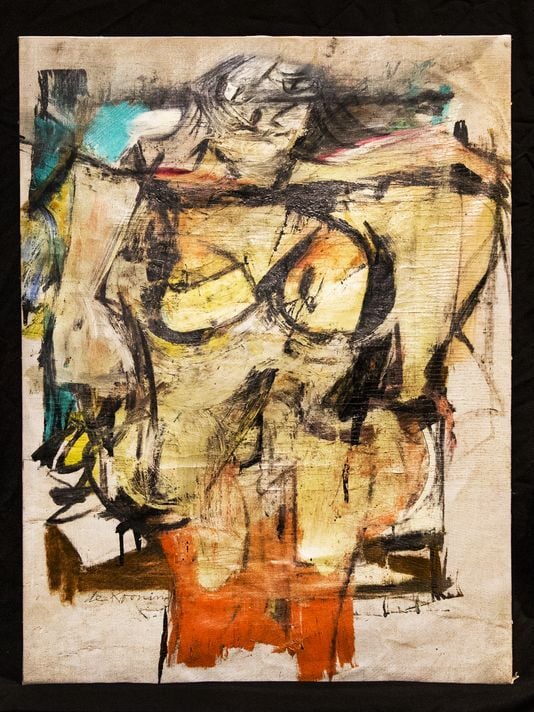
It happened the day after Thanksgiving, 1985, at the University of Arizona Museum of Art in Tucson. The painting is "Woman-Ochre," one of de Kooning's famous Woman series, valued at the time at around $400,000. Today? We're talking about $160 million.

So here's how it goes down. Just before the museum opens, a man and woman walk in together. The woman starts chatting up the security guard at the bottom of the stairs. Just friendly conversation, nothing suspicious. Classic distraction technique. While she's keeping the guard occupied, the man slips upstairs. He pulls out a blade—probably just a box cutter or something simple—and cuts the canvas right out of its frame. He rolls it up, and they're gone. The whole thing takes maybe 15 minutes.

They speed off in a rust-colored two-door car, and then... nothing. Complete silence. For 32 years, this painting just vanished. The trail goes completely cold. Everyone assumes that someone destroyed it or it sits in some private collector's vault somewhere, never to be seen again. Art theft experts, FBI agents, museum curators—nobody can find a single lead.

Key detail: a clean, fast grab with a simple blade—and then a decades-long void that only deepened the myth.

And then, in 2017, the painting resurfaces in the most unexpected way possible.

It's found in Cliff, New Mexico, a tiny town with a population of less than 300 people. The painting is in the home of Jerry and Rita Alter, a couple of retired teachers. Jerry taught music. Rita was a speech therapist. These were not high-flying art collectors. These were unassuming people who lived modestly and kept to themselves.

Unlikely provenance: a tiny town, retired teachers, and no collecting profile—exactly the kind of setting that kept a world-class painting out of sight.

Here's where it gets even stranger. After Rita passed away, their nephew hired an estate liquidator to handle all their belongings. The painting—this $160 million masterpiece—gets sold along with all their furniture to a local consignment shop called Manzanita Ridge. And the owners of this shop? They do not know what they've got. They think it's maybe a cheap print, a knockoff decoration piece.

But then a customer comes in, recognizes the style, and mentions it might be something significant. So, the shop owners do some research. And here's my absolute favorite part of this entire story: while they're trying to figure out what this painting is, other customers are in the shop touching it, trying to scratch it to see if it's a print or an original. The owners get worried that this old, weird painting might get damaged.

A sharp-eyed customer sparks the chain that brings it home.

So what do they do? They move it to the only room in the shop with a lock. The bathroom. That's right—a $160 million Willem de Kooning masterpiece ends up hanging in a bathroom, right next to the toilet, for safekeeping.

Here's why that matters: public value collides with private banality—an artwork built for audiences ends up hidden in plain life.

Eventually, someone Googles "de Kooning" and up pops an article from 2015 about the unsolved theft. They get the museum curator on the phone, and she asks if there are any horizontal lines or cracks on the canvas. There are—from being rolled up all those years ago. Also, because the painting was cut from the frame, it is about an inch smaller than the original dimensions. The damage from the crime itself became proof of authenticity.

Proof in the scars: the roll lines and trimmed edges told the story the thieves never meant to write.

It was Woman-Ochre. They'd found it.

The Perfect Crime?

So now the big question becomes: Who were Jerry and Rita Alter, really? Because the contrast between their public life and this hidden secret is absolutely staggering. They lived this quiet, small-town existence. They were known to be very frugal, careful with money. And yet Jerry retired at 48. On a teacher's salary. How does that work?

They also traveled extensively—all seven continents, with 13,000 slides documenting their trips. Their records also confirm they were in the United States when the painting was stolen, fitting the timeline. But it's all circumstantial, right? There's no confession, no direct evidence.

Let's pause on that for a moment: publicly, the Alters looked frugal and ordinary; privately, they curated a hidden gallery with careful precautions—intent, not accident.

Except... Well, there kind of is. And this is where things get genuinely eerie.

After Jerry and Rita died, investigators discovered that the painting had been hung very deliberately behind their master bedroom door. But here's the detail that got everyone's attention: they had screwed a thick screw into the baseboard, precisely positioned where the door would hit the wall. This screw stopped the doorknob from opening all the way, preventing it from hitting and damaging the canvas.

This wasn't accidental. This was premeditation. This was a painting hung specifically for them, and only them, to see in secret. Every morning, every night, they could close that door and look at their stolen treasure. Nobody else knew. It was their private museum, their secret possession.

And then there's the final, chilling piece of the puzzle. In 2011, Jerry Alter self-published a book of short stories. One of those stories is about a couple who steal a giant jewel from a museum. The woman distracts the guard. The man steals the jewel. They hide it behind a panel in their home, where they can take it out for their own private viewing pleasure.

It's almost beat-for-beat what happened. Was he confessing? Was he bragging? Or was this the only way he could share this massive secret he'd been carrying for decades—by hiding it in plain sight as fiction?

What makes this story so haunting is that the theft was clearly never about the money. If they'd wanted to sell it, they could have done so through underground channels. They could have been rich. Instead, they chose the secret.

They chose the private experience of possessing this masterpiece over any wealth it could have brought them.

They devoted their lives to guarding this secret, and then Jerry left this fictional confession for everyone to find after they were gone.

It raises this profound question: What does it really mean to possess a masterpiece if no one but you ever gets to see it? Is that still art, or does it become something else entirely? The consignment shop owners, by the way, refused the reward for finding the painting—a massive reward. They just said they were humbled to be part of returning it. A really beautiful moment in a story that's otherwise all about greed and secrecy.

The Mind's Decay, The Hand's Memory

There's one more controversy we need to talk about, and it's maybe the most philosophically complex. In the late 1980s, de Kooning was diagnosed with Alzheimer's disease. But he kept painting until 1991. Those final paintings sparked—and continue to spark—a huge debate in the art world.

These late works differ completely from everything that came before. They're light, spare, and very linear. All the thick, encrusted, gestural texture is gone. The violence and energy of the Woman series is replaced by something much quieter, more ethereal. Some people see this as a new phase of his genius, a master stripping away everything unnecessary to reach some pure essence. Others see them as simply the product of a failing mind.

There's a concept in psychology called "over-learning." It suggests that muscle memory—the physical act of doing something over and over—can continue even when higher cognitive function is compromised. In other words, de Kooning's hand might have remembered how to paint even when his mind couldn't fully direct it. His hand was acting on its own, following patterns laid down over decades.

So here's the question: If art requires intellect and intent, what does it mean when the intellect is gone but the hand continues? Are these paintings still art? Are they still de Kooning? The market, for what it's worth, has valued them highly, which only complicates things. If they're worth millions, they must be art, right? But is that really the right way to think about it?

I don't have an answer to this. I don't think anyone really does. But I think the question itself is important because it forces us to think about what we value in art. Is that the intention? Technical skill? The emotional impact? The signature? If de Kooning's hand could still create beautiful, compelling images even as his mind deteriorated, does that diminish the work or reveal something profound about creativity itself?

The Legacy

So what do we make of all this? Willem de Kooning was a man of profound contradictions. He was an immigrant who became the face of American art. As an action painter, he worked with painstaking deliberation. He was a leader of Abstract Expressionism who betrayed the movement by bringing back the figure. He struggled with addiction and doubt while being celebrated as a genius. And in his final years, his body continued to paint even as his mind slipped away.

His story reminds us that the truth behind great art is almost always messier and more complicated than the myths we build around it. De Kooning wasn't a force of nature attacking canvases in fits of spontaneous genius. He was a man who understood that meaning lives in uncertainty, in the space between knowing and not knowing. He was comfortable being a "slipping glimpser"—finding truth not in standing firm but in the fall.

And then there's the painting that was stolen, hidden for 32 years, and found in a bathroom in New Mexico. That story—as strange and compelling as it is—raises its own profound questions about possession, secrecy, and what it means to truly see and own a work of art. Jerry and Rita Alter chose the secret over the wealth. They chose a private experience. And in doing so, they created their own kind of art—a performance that continued for decades, with an audience of two.

De Kooning died in 1997 at 92. His paintings hang in major museums around the world, including the one that was stolen and found. They're studied, analyzed, debated. They sell for hundreds of millions of dollars. But beyond all that, they remain powerful testaments to the value of doubt, the importance of contradiction, and the beauty of never quite settling on a definitive answer.

Because in the end, maybe that's what makes his work so enduring. The answers it gives are not straightforward. It doesn't let us rest comfortably in what we think we know. It asks us to be slipping glimpses too—to find meaning not in certainty, but in that uncomfortable, thrilling space where everything is still possible.

Thanks so much for joining me today.

If you enjoyed this deep dive, please do three things:

One, subscribe to the Better World with Design podcast.

Two, share this episode with anyone who loves art, mystery, or just a great story.

Three, visit the website for additional show materials and resources.

Until next time, keep questioning, keep looking, and keep slipping.

Close
Belfast Stories – Episode 1: The Bowler Hat

Belfast Stories – Episode 1: The Bowler Hat


the bowler hat

The Bowler Hat

Written and narrated by Gary Crossey.

The bowler sat in McGreevy’s window. Black felt ribbon dulled at the bow. The kind a man wore past the cranes when the yard blew its morning steam. I stood for a long while at the glass before I went in.

In those days, the news came like the weather. A bus stop on the Falls. A bin in a back alley in the east. A phone call taken briskly in a police voice. The town learned the lean posture of listening. We walked with our heads turned slightly, as if to hear a second thing behind the first.

The bell above the door gave its small, obedient ring. McGreevy looked up from his newspaper, spectacles making ponds of his eyes.

“Help you?” he said.

“The hat in the window,” I said. “The bowler.”

He came around the counter slowly, as if circling a thing that might yet change its mind. The shop smelt of old cloth and camphor and the thin dust that settles on time. Tea sets with missing cups, a radio with two stations still trapped inside it, a glass dome over a bird whose one eye had gone to milk. A photograph of a team in stripes and shorts hung crookedly behind him, men with old knees and new moustaches, champions of some year the glass refused to remember.

“You play?” he said, following my eyes.

“I watch,” I said. “Mostly I listen to the shouting.”

“Same thing,” he said, not unkindly. He lifted the hat carefully and turned it in his hands. “Good hat, this. They don’t make them the same.”

He passed it to me. The felt had kept its temper. Inside the band, wear thinned the gilt, revealing Dunn & Co., Belfast, and a name pencilled light and sure: T. Hamilton. I traced the ribbon where a thumb had lived; the bow feathered at the edge.

“Try it on,” McGreevy said.

I did. It sat with me like a thing that had been waiting. He nodded once.

“Suits you,” he said. “You know what it means, one of those.”

“I know,” I said. I didn’t add: it will mean what I make it mean. We were all trying that then, taking the city’s nouns and twisting their necks softly until they faced another way.

My father and the street between them spoke two languages, fighting and politics. I had no gift for either. So, I started keeping little vows no one heard. To form a new language. To find a third grammar between their two, and to make some ordinary object treasonous with gentleness. This hat would be a grammar.

He watched me a moment longer, then shrugged as men do when meaning is not their business.

I put the coins in his palm. He weighed them the way a man weighs the hour, and slid them into a drawer that sang a little metal tune.

Outside, Sandy Row held its breath. A woman with two bags passed, the plastic singing against her coat. A child rode in slow circles on a bicycle at the corner. Painted kerbs kept their colours, red, white, blue. The flags on the pub hung still, the look of cloth thinking its thoughts. Two men smoked at the door and watched, not unkindly, not kind.

I walked north with the paper bag under my arm. The hat in it felt heavier than felt should. I thought of putting it on and didn’t. Not yet. Not here.

The city center was wearing its Saturday face. Buses shouldered the curb and pulled away. The green dome showed the weather to itself. A soldier in a doorway looked past me down the sight of his own day. At the corner, a woman sold papers with headlines that were last night’s prayer refused. I sat by a cafe window on Wellington Place and took my tea with the little biscuit that comes whether you want it or not. In the glass I saw the hat behind me on the chair, a black moon.

I turned the cup twice, reading the street in the glass. In this town, nothing is only what it is. The paper bag sat on the chair beside me like something fragile, and I finished the biscuit because leaving it would have felt like tempting the day.

For a year I had been looking. Every market stall, every charity shop, every place with a window that might hold such a thing. Once I put a line in the Telegraph, Wanted: Bowler Hat, Good Condition. No one answered. People had other things on their minds.

At the Albert Clock, I turned toward the water. The cranes were there like halted prayers, their arms naming a work that had gone. This was where such hats came from before the marching and the music. A peg by a door. A man who took his tea standing. A whistle that called him back to iron. A small neat hand that wrote T. Hamilton inside a band and went about its life.

On a bench by the water, I opened the bag and took the hat out. The ribbon frayed where it softened to the bow. The felt was cool. I put it on. It settled as before, a decision made without me.

A man with a dog went past and did not look. A girl on the far bank laughed a laugh that forgets for a second where it lives. Boats cut their little letters into the dark skin of the river, and the letters closed again behind them. In the distance, a siren made its long, level sentence. People kept walking; this is how a town learns its gait.

My father had once said of a march, not knowing I heard: they think the street is theirs. My mother had said of men in masks: they will take the day from you if you let them. Between those two sentences, I put a hat on my head and decided to belong to both streets or to neither. Falls and Shankill both claim the week; I would try to spend it twice.

I walked back with it on. Past the cranes, past the Clock, into shops where women tried on shoes and men compared the prices of saucepans as if saucepans were a currency. Two lads outside a record place with their jackets painted looked at me and grinned. One called, “Wrong parade, mate,” but his voice had pleasure in it, as if a rule broken elegantly is a kind of music.

“What are you spinning?” I asked, stopping at their speaker, which pelted the street with a drum running like feet and a guitar that sounded like metalwork arguing with itself.

“Stiff Little Fingers,” the taller one said. “What else?” He pointed at the bowler. “That’s a shout, that is.”

“It’s a whisper,” I said. “But I’ll let it learn to shout.”

He laughed, pleased by an answer that met him halfway. “My name's Robbie,” he said. The shorter one lifted a hand in a peace he didn’t call peace and tugged the brim of an invisible hat in my direction, as if returning the joke. We stood there a minute, three fools in agreement on a corner that didn’t belong to any parade, and then moved on because the day cannot be held in one place for long.

At the bus stop, a priest stepped off and nodded the small nod that makes room for a stranger without asking his papers. A constable looked at my head and then at my hands and then at the sky, as if meaning might come down in the next shower and save him the trouble. The pub flags did not move. The kerbs kept their colours.

In the window on Wellington Place, the glass gave me back a man I almost knew, the brim level, the crown unbent, the street slanted around him. Behind my head, as if the hat were a theatre, I saw pieces of the day perform: the soldier, the lads with paint on leather, the woman with two bags, the two smokers at the door, the priest with his modest nod. Each part had its pride and its grammar. None asked permission to exist.

I took the longer way home. On the bus, the announcements came in two names for the same stop, and people got off according to their own maps. An old woman in a good coat told me her brother had worn a bowler to his wedding and to his funeral and to most things in between. “God love him,” she said, not unkindly, not kind. “He thought the world could be told what to do if you just wore it right.”

At home, Michael had the television on. Our front door had no bell, just the hard sound of the latch when it caught. A presenter spoke softly into a wind that was not wind. “You found one,” Michael said, as if he had expected I would not.

“I did.”

He shook his head and smiled the way friends do when they decide to let you be wrong in peace. “You’re mad.”

“Maybe.”

In our house, there was always the chair and the key and the quarrel you could set your watch by. My father came in wet with the pub, the smell of hops and cold smoke arriving in the room before he did, and sat like a storm that had decided to be furniture. The chair gave a small creak when he dropped into it, the sound of the evening taking its shape. My mother spoke in the voice people use for the sick and for men who won’t listen.

My father was in the chair now, working at an argument that had no opponent present. “Look at him,” he said, as if I were a match he could light with his stare. “A man in a costume.”

My mother had spent years laying out their life in small plates for me, this bill unpaid, that neighbors tongue, the word he’d thrown like a glass on Tuesday and left sticking in the wall. There are images a boy should not be given: a glass thrown; a hand missing; a mouth set to one word you cannot repeat in front of a priest. But she shared, and I carried their nights folded in my head like orders.

“It’s a hat,” my mother said from the kitchen. “Leave the child.” She set plates like proofs, arranging a case no judge would ever call. “He brings no harm home with a hat.” She turned to me and softened. “Wash up. Tea’s ready.”

“It’s ready,” my father mimicked, and then fell silent, one hand on the arm of the chair as if holding a wild thing that wasn’t there.

At school I learned the timetable; at home I learned the timer on a kettle left hissing behind blue tape. I chose shifts over shouting, work over the worn‑out speech. So I kept to those little vows that no one heard, testing them quietly along the routes the town drew for me.

In my room, I hung the hat on a hook behind the door. It looked right there, as if it understood the wall. A thing that had meant one kind of respect and then another and now, perhaps, a third. I stood a while with the door open; the house making its little noises of surrender. My father coughed in the sitting room, rehearsing an old speech to no one. My mother set plates like a woman arranging proofs. Later I put them back in the cupboard and nothing was acquitted.

The week made its rounds. Work in the shop where the bell rang to the rhythm of small lives. Shoes tried and tried again. A girl with blisters from a job that kept her on her feet. A man with a wedding on Saturday and a suit that remembered a better meal than he would eat that day. I wore the hat to work once, and Mrs Patterson said, “You’ll put the customers off their sandwich,” and I took it off again because a wage is a law you agree to.

I wore it to the library, and an old fellow nodded three times as if I had quoted him correctly. I wore it on a bus across town and sat in the front downstairs and watched two names for one stop pass by, and thought of all the streets that aren’t on any sign.

One evening I walked the line between two places that do not claim each other. Not showing off. Not hiding either. Just the walk a man takes when he decides a day is long enough for two towns. A boy on a wall spat and missed my shoe by a kindness. A woman with shopping pulled her bag closer and then let it go. The air had that special Belfast quiet, the kind that sounds like a glass about to be set down. Somewhere, a drum sounded itself twice and then once, remembering a tune it couldn’t quite manage.

“Where’s your parade?” a man said from a doorway, not moving his cigarette from his mouth.

“Nowhere,” I said. “I’m going home.”

“That’s a route,” he said, satisfied by a logic that returned a man to his door.

On Sunday, I put the hat on a chair and went to church without it, to rest the city from my ideas. The bell on the church door gave a heavier ring than McGreevy’s, a sound that asked you to leave your changeable meanings outside. The bishop spoke of endurance, and the women reorganised the chairs without fanfare and the bread went from clean plate to clean hand, and someone’s child cried once and was soothed, and the hymn worked the dust out of the rafters like a good brush. Outside, the siren wrote its sentence again. Inside, a baby laughed the laugh that forgets where it lives.

Afterward, I walked to my mother’s sister on the other road. I carried the hat because an aunt asks to see the thing you’ve bought, and it is worse not to bring it than to bring it and be told off. My aunt touched the ribbon with a thumb that had known every kind of washing. “That’s a handsome hat,” she said, and then, because she was from people who let kindness standalone, said nothing else.

The days grew into a habit. I wore the bowler along the routes that taught me the edges and the in‑between. I learned the looks that were jokes and the looks that were windows closing. I learned when to take it off, deference is a language too, and when to leave it on, because you cannot keep the bridge in your pocket and call it a bridge. I nodded to the soldiers and to the men who did not use that word. I bought a bun from a woman who measured danger with her eyes and gave me the softest one without saying so. I caught my reflection in a window between two flags and did not flinch, and counted that a small victory of the right kind.

This paragraph is strong and reads beautifully. The prose has a distinctive voice with lovely turns of phrase like "deference is a language too" and "you cannot keep the bridge in your pocket and call it a bridge."

One night there was a bang where a bang should not be, and then the white‑suited men came the way priests used to, tender with the pieces. People gathered, as they do, with the faces they keep in a drawer for such times. A single coin lay on the pavement near the tape, dull in the streetlight, too small to have a side in anything, yet now part of the story. I stood at the edge and kept my hat on because the air had a weather you do not argue with. A constable told us there was nothing to see and then told us there was everything to see, if we had the stomach, and then told us to go home. We did not go. It is hard to obey a sentence that keeps changing its verbs.

The next morning I walked the long way. On the bridge, a man in a coat too light for the day said, “My da wore one of those.”

“Mine didn’t,” I said.

He nodded as if that were the explanation and not the beginning. “There's no shame in starting where you stand,” he said, and the day took that line and used it to hold itself together.

I stopped by McGreevy’s, saying nothing in particular. He had the radio on low, the way men have had radios on since radios were a thing. “You’ve made that hat busy,” he said.

“It’s making me,” I said.

He smoothed an invisible crease on the counter. “Some things you wear,” he said.

“Some things wear on you. If you’re lucky, you meet in the middle.”

He tapped the glass of the team photo with a fingernail. “We didn’t win that year,” he said. “Still framed it.”

I looked at the striped shirts and the crooked glass and thought of the bowler on its hook at home, a thing that had won nothing either, but had been chosen and kept. You frame what you can live with, not only what you’ve won.

Outside, the kerbs kept their paint, and the flags kept their weather, and the lines kept their work. The cranes remained stalled in prayer above the yards that had forgotten their own grammar. The river closed after the boats like a book someone is still reading.

It was a Tuesday, I think, when my father reached for the hat. He had been quiet two days running, which is a language too. He lifted it with both hands and set it on his head at a wrong angle and looked at some wall only he could see. My mother put her hand flat on the table, as if steadying the crockery or the day. Then he took the hat off and handed it back without a word, like a man returning a tool he isn’t trained for. My mother watched his hands as if they were the weather. I hung the hat up, and we ate in peace, which is to say we ate without speaking of the thing we had all witnessed.

Weeks pass in a town like this like weather, some dry, some wet, some that arrive and leave without shaking your sleeve. I took the bowler along roads some maps don’t draw. Not to be looked at. But to look, to see how far a small, stubborn bridge can carry a head across a city that insists on being two. On certain corners, men stopped me to say a word that meant two things, and I replied with a word that meant a third, and between us a grammar formed that could hold the day long enough for both of us to get home.

The Unconventional Playbook: Creative Habits of the World’s Most Brilliant Minds

The Unconventional Playbook: Creative Habits of the World’s Most Brilliant Minds

Book Review: Mason Currey's Daily Rituals

This article draws heavily from Mason Currey's fascinating 2013 book Daily Rituals: How Artists Work, a meticulously researched collection of the daily routines of over 160 writers, composers, painters, choreographers, playwrights, poets, philosophers, scientists, and mathematicians.

Currey's project began modestly—as a form of procrastination. One Sunday afternoon in July 2007, facing a looming deadline but unable to focus, he found himself researching other writers' working schedules online instead of writing his own article. What started as a way to feel better about his own inconvenient predilection for morning work (and afternoon uselessness) became the Daily Routines blog, and eventually this book.

The book's genius lies in its format: brief, digestible portraits that let the subjects speak for themselves through quotes from letters, diaries, and interviews. Currey doesn't mythologize or moralize. He simply presents the facts: when they woke, what they ate, how they worked, what strange rituals they performed, what substances they consumed, and how they protected their creative time.

What emerges is both inspiring and liberating. As Currey notes in his introduction, the book inevitably deals with questions he struggles with in his own life: How do you do meaningful creative work while also earning a living? Is it better to devote yourself wholly to a project, or to set aside a small portion of each day? Are comfort and creativity incompatible, or is finding a basic level of daily comfort a prerequisite for sustained creative work?

The answer, it turns out, is that there is no single answer. For every cheerfully industrious figure who worked nonstop (as V.S. Pritchett observed of the "great men" he wrote about), there is a Franz Kafka or William James—great minds who wasted time, procrastinated, and were racked by doubt. Most fall somewhere in the middle: committed to daily work but never entirely confident, always wary of the one off day that undoes the streak.

Currey's book serves as proof that the obsession with finding the "perfect routine" is misguided. Instead, what matters is discovering the specific conditions under which your best work quietly, consistently happens—even if those conditions look absolutely bizarre from the outside.

This article adapts Currey's research into a practical framework, distilling the most counter-intuitive insights into actionable principles. If you're intrigued by these stories, Daily Rituals is essential reading—a reminder that brilliant work emerges not from perfection, but from deeply personal, often strange, fiercely protected daily practices.

The Myth of the Perfect Routine

In the modern quest for productivity, we’re bombarded with the idea of a perfect routine. We chase the 5 a.m. Miracle Morning, the time‑blocked calendar, and the zero‑inbox lifestyle, often feeling inadequate when our messy reality doesn’t match the ideal. But what if the secret to brilliant work is not found in a flawless schedule? What if instead, it lies in embracing our own strange and personal rhythms?

An exploration into the daily lives of history’s greatest minds reveals a surprising truth: their paths to creativity were often chaotic, bizarre, and deeply unconventional. This article distills the most counter‑intuitive takeaways from their habits into a playbook of actionable insights.

The psychologist William James once argued for forming good habits so that we can “free our minds to advance to really interesting fields of action.” Ironically, James himself was a chronic procrastinator who could never stick to a regular schedule. His struggle highlights a central theme: the most effective routine is the one that works for you, no matter how odd it may seem.

1. Some of the most disciplined minds thrived on chaos

It’s a common belief that creative discipline requires a life of meticulous order. Yet for some of the greatest artists, immense inner focus coexisted with staggering external chaos.

The painter Francis Bacon is a prime example. His studio was legendary for its disorder, with paint smeared on the walls and a “knee‑deep morass” of brushes, papers, and detritus piled on the floor. His life outside the studio was a whirlwind of hedonistic excess, filled with multiple rich meals, tremendous quantities of alcohol, and late‑night partying that would exhaust his contemporaries.

And yet, despite this disarray, Bacon was “essentially a creature of habit.” His work always came first. No matter how late he had been out the night before, he woke at first light and worked for several hours. He did not just tolerate the side effects of his lifestyle; he harnessed them.

“I often like working with a hangover,” he said, “because my mind is bubbling with energy and I can think very clearly.”

Bacon’s routine suggests that profound creative discipline is not always contingent on a tidy, conventional life. True focus is an internal state, not necessarily an external one.

2. Creativity Requires Strange (and Sometimes Unhealthy) Fuel

Many creative geniuses relied on bizarre rituals and stimulants to access the right mindset for work. Their triggers were deeply personal and often defied logical explanation.

The novelist Patricia Highsmith, author of The Talented Mr. Ripley, had an unusually intense connection with animals, particularly snails, which she bred at home. She eventually housed 300 of them in her garden and once arrived at a London cocktail party with a handbag containing a head of lettuce and 100 snails, her companions for the evening. When she later moved to France, she smuggled her beloved mollusks across the border by hiding them six to ten at a time “under each breast.” She also had a habit of taking a stiff drink before writing, not to get revved up, but specifically “to reduce her energy levels,” which she felt veered toward the manic.

Other creative triggers were even stranger. The German playwright Friedrich Schiller famously kept a drawer full of rotting apples in his workroom because he needed their decaying smell to feel the urge to write. And the novelist Honoré de Balzac fueled his brutal 1 a.m. to 4 p.m. work cycle with an extreme coffee habit—by one estimate, he drank as many as 50 cups a day.

These habits reveal creative triggers are not just personal but often primal and subconscious. They resist any simple formula or attempt at logical replication.

3. The Best Work Is Often Done in stolen moments

For many great minds who lacked the luxury of a private study and uninterrupted time, creativity had to happen in the margins of a busy life. They learned to work amidst the noise and demands of their daily obligations.

Franz Kafka, who balanced writing with a deadening day job, captured this tension:

“Time is short; my strength is limited. The office is a horror. The apartment is noisy, and if a pleasant, straightforward life is not possible, then one must try to wriggle by subtle maneuvers.”

Jane Austen is a classic example of this principle. She wrote her masterpieces in the family sitting room, “subject to all kinds of casual interruptions.” She developed a subtle method for protecting her work, writing on small sheets of paper that could be quickly hidden away. Crucially, Austen was “careful that her occupation should not be suspected by servants or visitors,” as writing novels was not considered a respectable or serious pursuit for a woman of her social standing.

Her famous use of a creaking swing door was more than an early‑warning system for approaching visitors. It was a tool of quiet defiance, allowing her to preserve her vital creative life in the face of societal constraints.

Similarly, T.S. Eliot did some of his most important work, including drawing on scenes for The Waste Land, while employed as a clerk at Lloyd’s Bank in London, joining the crowd crossing London Bridge each morning.

These examples demonstrate that constraints do not always hinder creativity; sometimes, the need to steal moments for our work can make that time more focused and precious.

4. Inspiration Is for Amateurs; The Greats Just Show Up

The romantic notion of the artist waiting patiently for the muse to strike is one of the most persistent myths of creativity. The reality for many of history’s greats was far more blue‑collar. They treated their work as a job, showing up to a schedule regardless of how they felt.

The artist Chuck Close put it most bluntly:

“Inspiration is for amateurs… The rest of us just show up and get to work.”

This professional mindset was shared by many. The composer George Gershwin dismissed the idea of waiting for inspiration, saying that if he did, he “would compose at most three songs a year.” He believed that, like a pugilist, a songwriter “must always keep in training.”

The poet W.H. Auden was obsessively punctual and lived by an “exacting timetable,” believing this military precision was essential to his creativity. For him, a solid routine was the very structure upon which genius could be built. “The surest way to discipline passion is to discipline time,” he observed.

This approach demystifies the creative process. It transforms it from a magical, unreliable event into a consistent practice. The greats did not have a special hotline to inspiration; they had the discipline to show up, day after day, and do the work.

5. Your “Unproductive” Time Might Be Your Most Creative

Some of the most essential creative work happens when we are not “working” at all. Activities that seem like distractions or procrastination were, for many historical figures, vital parts of their process.

The Danish philosopher Søren Kierkegaard had his best ideas during his long walks through Copenhagen. He would sometimes get so excited by a thought that he would rush home and, without even removing his hat or setting down his umbrella, begin writing while still standing at his desk. For him, the physical act of walking was inseparable from the mental act of philosophizing.

Others found their breakthroughs in different routines. Filmmaker Woody Allen takes “extra showers” to stimulate “a fresh burst of mental energy” and solve story problems. When he hits an impasse, he goes upstairs and stands under the steaming hot water for 30 or 40 minutes, just thinking. The legendary choreographer George Balanchine claimed, “When I’m ironing, that’s when I do most of my work.”

These habits show the power of allowing the mind to wander. By engaging in simple, physical, or routine tasks, we can allow our subconscious to make connections that focused, deliberate effort cannot. Our “unproductive” time is often where the real breakthroughs occur.

6. The Unconventional Playbook: Design Your Own "Weird" Routine

You do not need to adopt anyone else’s rituals wholesale (and you probably should not copy the 50 coffees a day). Instead, you can reverse‑engineer the deeper principles behind these stories and apply them to your own life in small, grounded ways.

Here is a practical playbook to start designing your own unconventional routine:

  1. Track your real rhythm, not your ideal one. For one week, notice when you naturally feel most alert, restless, calm, or reflective. Instead of forcing a 5 a.m. Miracle Morning, ask: When does my brain actually want to do deep work, and when does it want to wander?
  2. Protect one “stolen moment” block. Choose a 20–40 minute slice of time you can reclaim most days—on a commute, during a lunch break, in the quiet before others wake up. Treat it like Jane Austen’s small pages: portable, interruptible, but sacred.
  3. Identify a harmless “strange fuel” that gets you started. It might be a specific song, a particular beverage, a candle, a walk around the block, or even a particular chair. The content of the ritual matters less than its reliability as a cue: when this happens, I begin.
  4. Design intentional “unproductive” rituals. Instead of doom‑scrolling when stuck, choose a low‑stakes, physical activity that invites wandering thoughts: a walk, a shower, ironing, washing dishes. Go into it with a quiet assignment: hold this question lightly in the back of your mind.
  5. Set a minimum viable showing‑up rule. Borrow from Chuck Close and Gershwin: define a version of “showing up” that you can do even on bad days. Ten minutes at the desk. One paragraph. One sketch. One small move that keeps the creative muscle “in training.”
  6. Make peace with your aesthetic of chaos (or order). If you work best in a tidy, minimalist space, honor that. If your desk looks like Francis Bacon’s studio and you still produce great work, maybe your chaos is not a problem to be solved but an environment your brain knows how to navigate.

You are not trying to win in productivity aesthetics. You are trying to discover the specific conditions under which your best work quietly, consistently happens.

Embrace Your Own Process

If there is one lesson to be learned from the bizarre habits of great minds, it is this: there is no single “correct” way to be creative and productive. A successful routine can be rigid or chaotic, fueled by coffee or quiet walks, performed at the crack of dawn or in the dead of night. The only rule is that it must work for you.

Their stories free us from the pressure to conform to a single, idealized model of productivity. Instead of searching for the perfect routine to copy, the more interesting move is to treat your life as a series of experiments.

For the next seven days, you might try:

  • Protecting one small “stolen moment” for focused work.
  • Choosing one intentional “unproductive” ritual for thinking.
  • Committing to a minimum viable version of “showing up” each day.

At the end of the week, ask yourself:

  • When did I feel most alive and absorbed in my work?
  • Which cues or rituals actually helped me begin?
  • What kind of chaos or structure did my mind seem to prefer?

The goal is not to assemble a perfect routine, but to notice the contours of your own. The most productive thing you may do is give yourself permission to discover, and trust, a process that looks a little strange from the outside—yet quietly works for you.