Exploring Fahrenheit 451: Essential Book Club Discussion Guide
Podcast overview - Fahrenheit 451
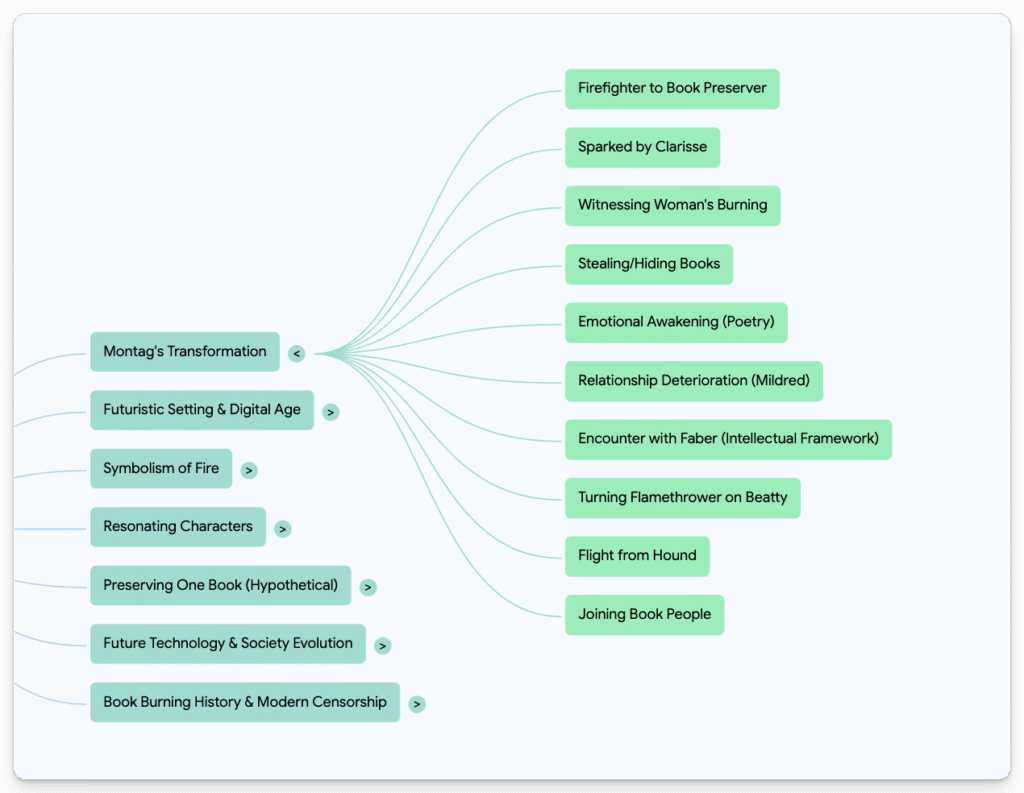
In what ways does Montag's transformation from firefighter to book preserver reflect broader societal changes? What moments mark his key turning points?
Montag's transformation from dedicated firefighter to book preserver represents one of literature's most compelling journeys of awakening. His evolution begins with simple curiosity, sparked by Clarisse's innocent questions about happiness and meaning. Initially, Montag performs his book-burning duties without question, taking pride in the kerosene smell and the act of destruction.
The pivotal moment occurs when he witnesses the woman who chooses to burn with her books. This shocking event forces him to confront the value these people place on literature and knowledge. His subsequent decision to steal and hide books marks his first active resistance against the system he once served.
As Montag begins reading in secret, his transformation accelerates. He experiences emotional awakening through poetry, leading to profound discomfort with his previous life. His relationship with Mildred deteriorates as he recognizes the emptiness of their technology-focused existence. The gap between his new awareness and society's willful ignorance becomes increasingly unbearable.
His encounter with Faber provides intellectual framework for his rebellion, helping him understand not just what he's fighting against, but what he's fighting for: the preservation of human thought and experience through literature. This mentorship transforms his initial emotional response into a reasoned philosophical stance.
The culmination of Montag's journey arrives when he turns his flamethrower on Beatty. This act symbolizes complete rejection of his former life and values. His subsequent flight from the mechanical hound represents both physical and spiritual escape from the controlling system. When he joins the book people, Montag completes his transformation from destroyer to preserver of knowledge.
Through Montag's journey, Bradbury illustrates how personal awakening can lead to radical transformation, suggesting that even those deeply embedded within oppressive systems can recognize truth and choose to stand against conformity.
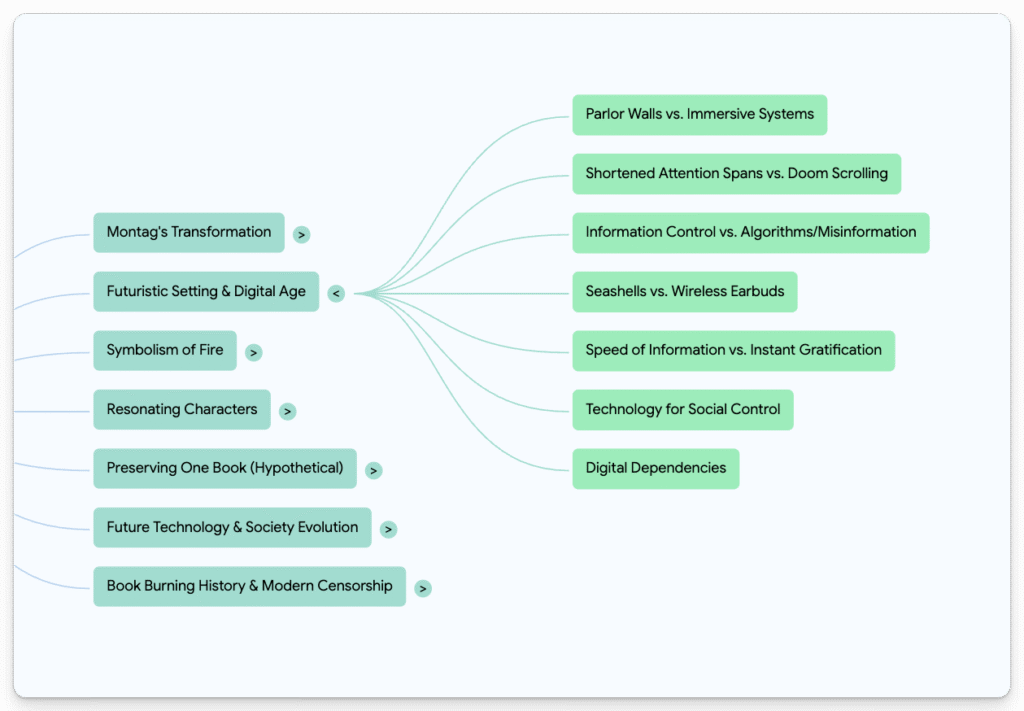
How does the novel's futuristic setting mirror issues in our current digital age? Consider the role of screens, shortened attention spans, and information control.
Bradbury's prescient vision of a screen-dominated future bears striking parallels to our contemporary digital landscape. The novel's parlor walls mirror today's immersive entertainment systems and social media platforms, where individuals become absorbed in artificial relationships with "TV families" much like modern parasocial relationships with online personalities.
The novel's depiction of shortened attention spans is particularly relevant. Characters like Mildred cannot sustain meaningful conversations or engage with complex ideas, preferring quick, superficial entertainment - a phenomenon eerily similar to today's "doom scrolling" and snippet-based content consumption. The three-wall television system's constant stimulation reflects our modern struggle with digital device addiction and the challenge of finding quiet moments for reflection.
Information control in the novel operates through systematic elimination of complex literature and ideas, replaced by simplified, government-approved content. This mirrors contemporary concerns about algorithm-curated content, echo chambers, and the spread of misinformation. The "seashell" radio earpieces worn by characters parallel modern wireless earbuds, creating personal bubbles that isolate individuals from direct human interaction.
The speed of information in Bradbury's world, where billboards stretch hundreds of feet long to accommodate fast-moving vehicles, reflects our current climate of instant gratification and rapid content consumption. This acceleration of information delivery has led to similar consequences: decreased comprehension, reduced critical thinking, and the prioritization of entertainment over enlightenment.
Perhaps most significantly, the novel's portrayal of technology as a tool for social control and conformity raises important questions about our own digital dependencies. Just as Mildred's identity is shaped by her screen experiences, modern individuals increasingly define themselves through digital personas and online interactions, potentially sacrificing authentic human connections and independent thought.
Mythical phoenix rising from its own ashes.
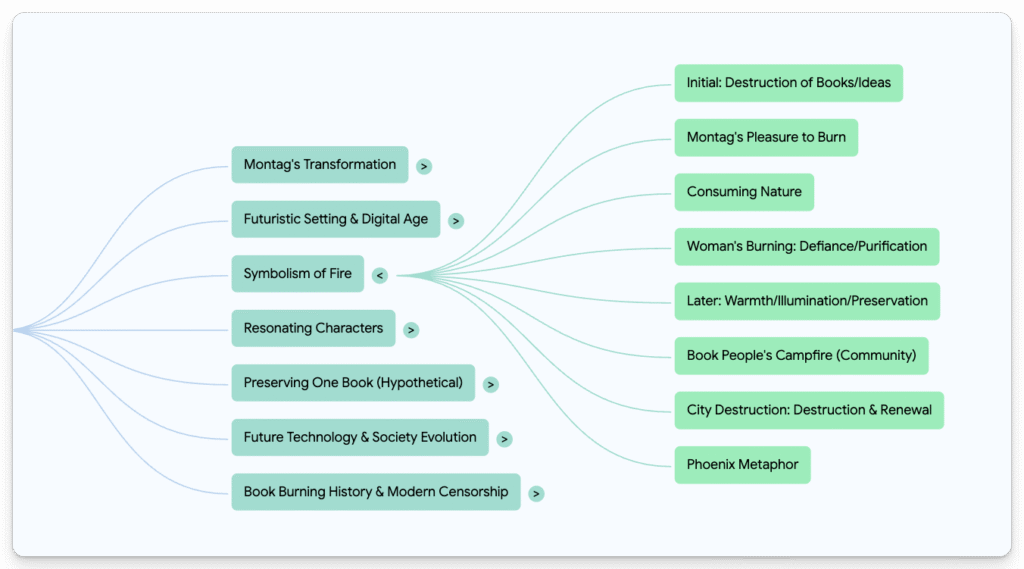
Discuss the symbolism of fire throughout the novel - how does its meaning evolve from destruction to potential preservation of knowledge?
Fire serves as a complex and evolving symbol throughout Fahrenheit 451, transforming from an agent of destruction to a beacon of renewal. Initially, fire represents society's destructive power, employed by firefighters to eliminate books and the dangerous ideas they contain. Montag takes pride in this destructive force, describing the "pleasure to burn" in the novel's opening lines, revealing how fire embodies authorized violence against knowledge and free thought.
The novel's early portrayal of fire emphasizes its consuming nature - it devours not just books but history, culture, and human expression. The kerosene-fueled flames represent the systematic erasure of intellectual heritage, with each burning serving as a ritual of enforced conformity. The salamander insignia of the firefighters further reinforces this destructive symbolism, despite the historical irony of salamanders being traditionally associated with surviving fire.
However, as Montag's consciousness evolves, fire's symbolism undergoes a parallel transformation. The turning point comes when the woman chooses to burn with her books, transforming fire from a tool of oppression into an instrument of defiant self-determination. This act introduces fire's purifying aspect - the notion that through destruction, something valuable can be preserved or reborn.
In the novel's latter half, fire begins to represent warmth, illumination, and preservation. When Montag meets the book people by their campfire, fire becomes a source of community and preservation. This campfire serves not to destroy but to provide warmth, cook food, and gather people together for the sharing of knowledge. The gentle, controlled flame stands in stark contrast to the violent infernos of the city.
Ultimately, when the city is destroyed by bombs, fire comes full circle. The apocalyptic fire represents both destruction and renewal, clearing away the corrupt society while offering the possibility of rebuilding. Like the mythical phoenix rising from its own ashes, this final conflagration suggests that destruction can lead to rebirth, with fire serving as the catalyst for societal transformation.
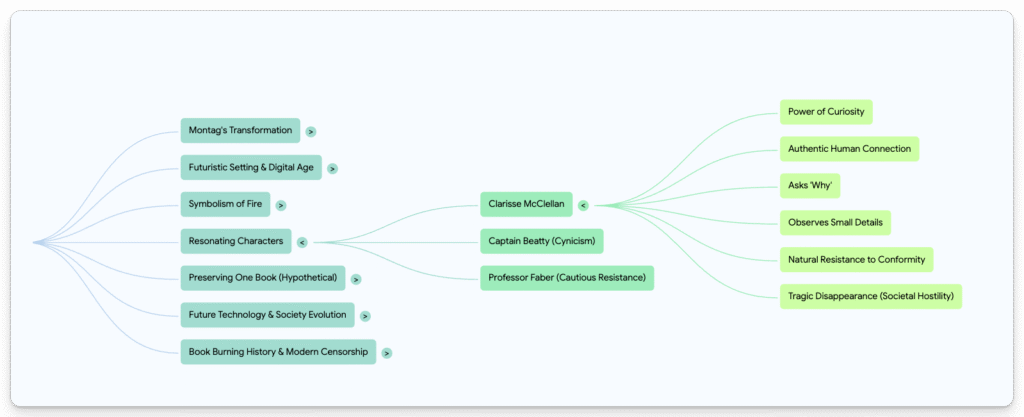
Which character resonates most with you and why? Consider Clarisse's curiosity, Beatty's cynicism, or Faber's cautious resistance.
Among the central characters in Fahrenheit 451, Clarisse McClellan stands out as the most compelling and transformative presence. Her character embodies the power of curiosity and authentic human connection in a world increasingly devoid of both. Despite her brief appearance in the novel, Clarisse's impact resonates throughout the entire narrative, making her the catalyst for Montag's awakening.
Clarisse's simple yet profound questions about happiness and meaning demonstrate the revolutionary power of basic human inquiry. In a society that discourages questioning, her willingness to ask "why" rather than just accepting "what" marks her as both dangerous and refreshing. Her observation of small details - the taste of rain, the way people walk, the shapes of clouds - highlights what society has lost in its pursuit of mindless entertainment and superficial pleasure.
What makes Clarisse particularly resonant is her natural resistance to conformity without actively trying to rebel. Unlike Montag's later conscious rebellion or Faber's calculated resistance, Clarisse simply remains true to her authentic self. Her genuine interest in face-to-face conversation and real human experiences stands in stark contrast to the artificial relationships and digital interactions that dominate her society.
Moreover, Clarisse's tragic disappearance underscores the novel's themes about society's hostility toward independent thinking. Her fate serves as a warning about the consequences of being different, while simultaneously emphasizing the precious nature of the qualities she embodied - curiosity, empathy, and genuine human connection.
Through Clarisse's character, Bradbury suggests that true revolution begins not with grand gestures or violent rebellion, but with the simple act of questioning, observing, and maintaining one's humanity in the face of mechanical conformity. Her influence on Montag, and by extension the reader, demonstrates how one person's authentic engagement with life can spark profound change in others.
If you were to preserve one book in memory, like the book people at the end of the novel, which would you choose and why?
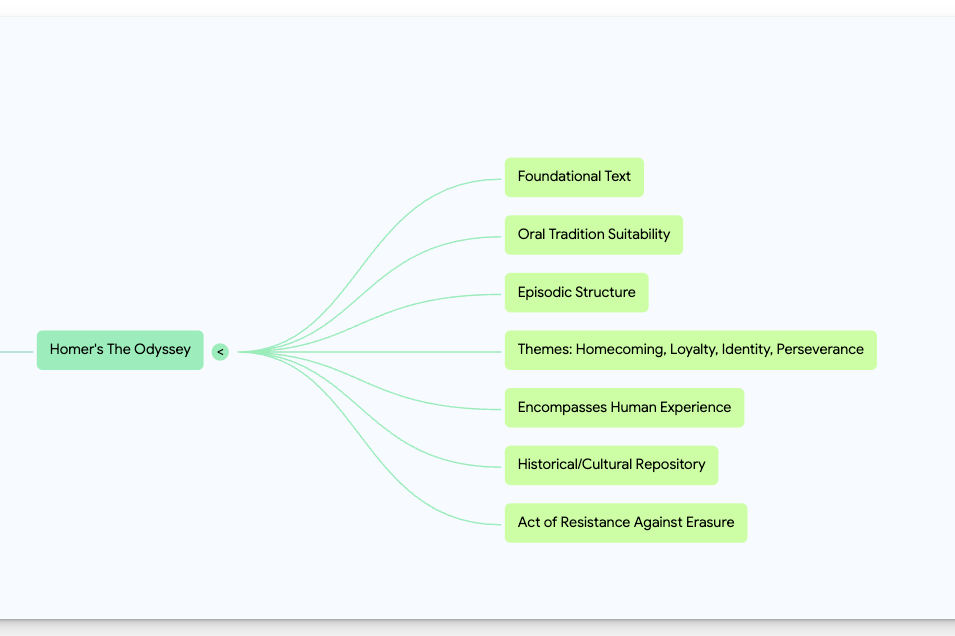
If tasked with preserving a single book in memory, I would choose Homer's "The Odyssey." This epic poem serves as a foundational text of Western literature, combining adventure, human psychology, and timeless themes that continue to resonate across cultures and generations. The choice reflects both practical and symbolic considerations in a scenario like Fahrenheit 451's book people.
The Odyssey's oral tradition origins make it particularly suitable for memorization, as it was originally preserved through spoken word before being written down. Its episodic structure, memorable characters, and poetic meter would aid in the mental retention process, making it a practical choice for preservation through memory.
The epic's themes of homecoming, loyalty, identity, and perseverance against overwhelming odds parallel the situation of the book people themselves. Like Odysseus, they are guardians of knowledge making a long journey through hostile territory, preserving their cultural heritage against forces that would destroy it.
The Odyssey encompasses numerous essential elements of human experience: family relationships, the tension between duty and desire, the price of pride, the value of cunning over brute force, and the importance of hospitality and human connection. These universal themes make it a particularly valuable text to preserve for future generations.
The work also serves as a historical and cultural repository, offering insights into ancient Greek civilization, mythology, and values. By preserving The Odyssey, one would maintain not just a single story, but an entire worldview and cultural framework that has influenced countless subsequent works of literature.
In a world where books are burned, preserving The Odyssey would be an act of resistance against the erasure of human complexity and imagination. Its rich imagery, complex characters, and layered meanings stand in direct opposition to the simplified, sanitized content preferred by the authorities in Fahrenheit 451's society.
How might technology and society evolve over the next 70 years, and what parallels can we draw with Bradbury's predictions?
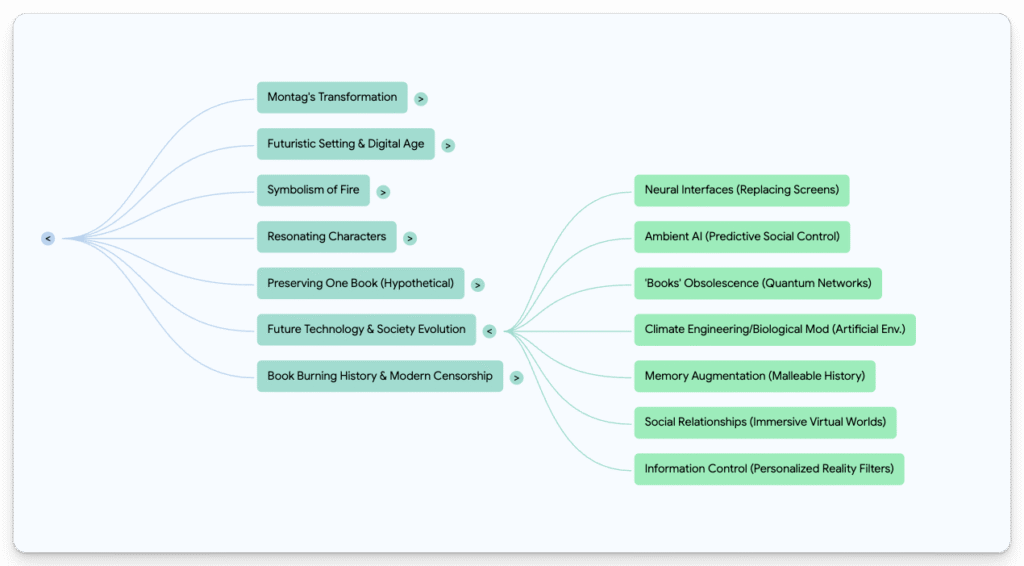
Just as Bradbury envisioned a world dominated by wall-screens and earshells that eerily predicted our current digital landscape, projecting 70 years into our future reveals potentially transformative developments. The integration of neural interfaces might replace today's smartphones and screens, creating a world where digital information flows directly into our consciousness. This could realize Bradbury's fear of constant stimulation but at an even more intimate level - where the barrier between human thought and digital input becomes nearly indistinguishable.
Artificial Intelligence might evolve beyond today's algorithms to become ambient and omnipresent, making independent human decision-making increasingly rare. Similar to how Bradbury's mechanical hound represented automated enforcement, future AI systems might regulate human behavior through predictive social control, subtly nudging society toward prescribed norms without obvious coercion.
The concept of "books" themselves might become obsolete, not through burning but through evolution. Information could be stored and transmitted through quantum networks, accessible through neural links, making traditional learning methods seem as outdated as scrolls did to Bradbury's generation. The "book people" of our future might be those who insist on maintaining organic, unaugmented human consciousness and direct experiential learning.
Climate engineering and biological modification could create artificial environments where humans live in climate-controlled megastructures, disconnected from the natural world. This mirrors Bradbury's portrayal of a society alienated from nature, where Clarisse's appreciation for rain and flowers marked her as an outsider. Future resistance might center on preserving natural human experiences in an increasingly synthetic world.
Memory augmentation technology could make it possible to download, edit, or erase memories, creating a society where personal history becomes malleable. The preservation of authentic human memory - a central theme in Fahrenheit 451 - might become a form of resistance against corporate or government-mandated memory modification.
The evolution of social relationships might mirror Mildred's "TV family" but through immersive virtual worlds where the line between real and simulated relationships becomes meaningless. Physical human gatherings, like the book people's fireside community, might become acts of rebellion against the metaverse-dominated social norm.
Most disturbingly, the control of information might shift from overt censorship to subtle manipulation through personalized reality filters, where each person experiences a curated version of truth tailored to maintain social stability. Like Beatty's justification for burning books, this could be presented as a way to prevent conflict and ensure happiness, while actually serving to eliminate independent thought.
How has book burning been used throughout history as a tool for suppression, and what parallels can we draw to modern forms of censorship?
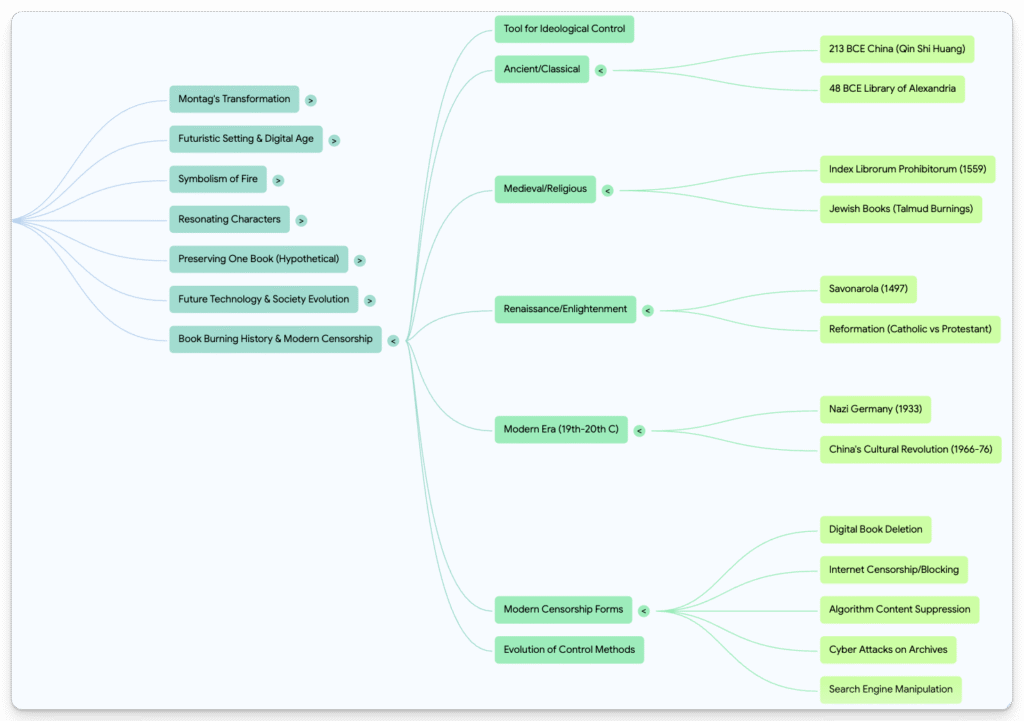
The practice of book burning has a long and disturbing history as a tool for ideological control and cultural suppression. From ancient civilizations to modern times, the deliberate destruction of written works has symbolized attempts to erase ideas, reshape historical narratives, and control public thought.
Ancient and Classical Period
The earliest recorded book burning occurred in 213 BCE when China's Emperor Qin Shi Huang ordered the burning of historical and philosophical texts to control how history would remember his predecessors. This event, known as "burning of books and burying of scholars," set a precedent for using book destruction as a political tool.
In 48 BCE, the Great Library of Alexandria suffered its first major burning during Julius Caesar's civil war, resulting in the loss of countless ancient texts and scholarly works. This catastrophic event represents one of history's greatest losses of cultural knowledge.
Medieval and Religious Persecution
During the medieval period, book burning became increasingly associated with religious persecution. The Catholic Church's Index Librorum Prohibitorum (List of Prohibited Books), established in 1559, led to systematic destruction of texts deemed heretical. Jewish books were particularly targeted, with mass burnings occurring throughout Europe, including the Talmud burning in Paris (1242) and Rome (1553).
Renaissance and Enlightenment
Even as literacy and printing technology spread, book burning continued. In 1497, Savonarola's "Bonfire of the Vanities" in Florence saw the destruction of books, art, and other items considered sinful. During the Protestant Reformation, both Catholic and Protestant factions engaged in destroying each other's religious texts.
Modern Era: 19th-20th Centuries
The most infamous book burning in modern history occurred during Nazi Germany's reign (1933-1945). The Nazi Student Union's coordinated book burnings in 1933 targeted works by Jewish authors, communists, and other "un-German" writers, destroying an estimated 25,000 books in a single night in Berlin.
During China's Cultural Revolution (1966-1976), countless books, manuscripts, and artifacts were destroyed in an attempt to purge traditional and foreign influences from Chinese society.
Timeline of Notable Book Burning Events
213 BCE: Qin Dynasty book burning in China
48 BCE: Partial destruction of the Library of Alexandria
303 CE: Diocletian's decree to burn Christian texts
1242: Burning of the Talmud in Paris
1497: Savonarola's Bonfire of the Vanities
1559: Implementation of Index Librorum Prohibitorum
1933: Nazi book burnings across Germany
1966-1976: Chinese Cultural Revolution book destruction
Modern Forms of Censorship
Today, while physical book burning still occurs, digital censorship has emerged as a more subtle but equally effective means of controlling information. Modern parallels include:
Digital book deletion from e-readers and platforms
Internet censorship and content blocking
Algorithm-based content suppression
Cyber attacks on digital libraries and archives
Strategic manipulation of search engine results
The evolution from physical book burning to digital censorship reflects how methods of controlling information have adapted to technological change while maintaining the same fundamental goal: controlling narrative and suppressing dissenting voices.
This historical pattern of destroying knowledge reminds us why Fahrenheit 451's message remains relevant today. Whether through flames or algorithms, the impulse to control information and limit access to diverse perspectives continues to threaten intellectual freedom and cultural memory.
"The Giver" is a dystopian novel that follows Jonas, a twelve-year-old boy living in what appears to be a perfect society where there is no war, fear, pain, or choice. The community is highly regulated, with every aspect of life controlled - from family units to career paths. At the age of twelve, Jonas is selected for a unique role: to become the next Receiver of Memory, tasked with holding all of humanity's memories that have been erased from the community's consciousness.
As Jonas begins his training with the current Receiver (whom he calls "The Giver"), he starts to experience things his community has eliminated: colors, emotions, and memories of both joy and pain. Through these transmitted memories, Jonas learns about the world that existed before his community's "Sameness" - a world with war and suffering, but also with deep love, music, and genuine human connection.
As his training progresses, Jonas discovers the dark truth behind his seemingly
What are the major themes explored in the book? How do they interrelate?
Based on the story, several major themes interweave throughout The Giver:
Individual Freedom vs. Societal Control: The tension between personal liberty and social order is central to the narrative, shown through Jonas's growing awareness of his community's strict regulations and his ultimate choice to rebel.
Memory and Human Experience: The importance of preserving and sharing memories, both painful and joyful, demonstrates how collective memory shapes human identity and understanding.
The Price of Perfection: The story explores how the pursuit of a perfect, painless society leads to the loss of essential human experiences, emotions, and connections.
Coming of Age and Self-Discovery: Jonas's journey from innocence to awareness parallels traditional coming-of-age narratives, as he discovers both the harsh realities and beautiful possibilities of life.
Love and Human Connection: The development of emotional bonds, particularly Jonas's relationship with The Giver and his love for Gabriel, contrasts with the superficial relationships in his community.
These themes interrelate through their exploration of what makes us human. The suppression of memory and emotion (societal control) directly impacts the capacity for love and connection. The journey of self-discovery leads to questioning the price of perfection, while the preservation of memory becomes an act of resistance against control. Together, these themes create a complex examination of human nature and society.
How do the themes develop or evolve throughout the narrative?
The themes in The Giver develop progressively as Jonas gains awareness and understanding:
Early Stages: The themes begin subtly, with hints of societal control through strict rules and structures, while Jonas accepts these limitations as normal.
Middle Development: As Jonas receives memories, the themes deepen significantly. The contrast between individual freedom and societal control becomes stark, and the true cost of the community's "sameness" emerges.
Later Evolution: The themes reach their peak complexity when Jonas begins to experience love, pain, and the full spectrum of human emotion, leading to profound moral dilemmas and choices.
The evolution of these themes parallels Jonas's journey from innocence to understanding:
Memory and Experience: Initially presented as simple transfers of information, memories evolve into powerful catalysts for change and understanding.
Love and Connection: Beginning with shallow family unit interactions, this theme develops into deep emotional bonds with The Giver and Gabriel.
Freedom vs. Control: What starts as minor questioning of rules transforms into a fundamental rejection of the community's controlled existence.
By the narrative's conclusion, these themes converge in Jonas's final choice to leave the community, representing a full evolution from acceptance of control to the embrace of freedom, from superficial connections to deep love, and from ignorance to knowledge.
Who are the main characters? How do they change or grow throughout the story?
The main characters in The Giver undergo significant transformations throughout the narrative:
Jonas (The Receiver): The protagonist evolves from an obedient, naive twelve-year-old to a questioning, emotionally aware young man. His growth is marked by his increasing ability to see beyond his community's façade, developing deep emotional connections, and ultimately choosing to act against the established order to save both himself and Gabriel.
The Giver: Initially appearing as a mysterious mentor figure, The Giver reveals increasing vulnerability and hope through his relationship with Jonas. His character transforms from someone who has accepted his burden in isolation to an active participant in changing his community.
Gabriel: Though an infant, Gabriel's character develops from a struggling "newchild" at risk of release to a symbol of hope and innocence. His bond with Jonas catalyzes much of the protagonist's growth and decision-making.
Jonas's Parents: While they don't change significantly, their static nature becomes increasingly significant as Jonas grows to understand the superficiality of their conditioning and the limitations of their emotional capacity.
Fiona: Initially Jonas's friend and crush, her character serves to highlight the contrast between those who remain within the community's conditioning and Jonas's growing awareness. Her continued acceptance of community norms emphasizes Jonas's divergent path.
Asher: Like Fiona, Asher's character remains largely unchanged, but his role evolves from being Jonas's closest friend to representing the gulf that develops between Jonas and his former life as Jonas gains new understanding.
The characters' varying degrees of growth (or lack thereof) serve to highlight the central themes of awareness, choice, and the price of conformity in the story.
How do the relationships between characters contribute to the overall themes?
The relationships between characters in The Giver serve as powerful vehicles for exploring the novel's central themes:
Jonas and The Giver: Their mentor-student relationship illustrates the themes of memory and knowledge transfer. As they grow closer, their bond demonstrates the power of genuine human connection in contrast to the superficial relationships prevalent in their society.
Jonas and Gabriel: This relationship represents pure, unconditional love emerging in a society that suppresses emotion. Their connection challenges the community's notion of family units and highlights the theme of authentic human bonds versus artificial ones.
Jonas and His Parents: The growing disconnect between Jonas and his parents emphasizes the theme of awakening versus conformity. As Jonas develops real emotions, his parents' conditioned responses become increasingly apparent, highlighting the cost of their society's emotional suppression.
Jonas and His Friends (Asher and Fiona): These relationships demonstrate the isolation that comes with knowledge and awareness. As Jonas gains understanding, the growing distance between him and his friends underscores the price of individuality in a conformist society.
These relationships collectively highlight the contrast between authentic human connections and the regulated, emotionally sterile interactions that characterize their community. Each relationship either reinforces or challenges the community's values, contributing to the broader themes of freedom versus control and the cost of a "perfect" society.
What is the overall structure of the book (e.g., chronological, non-linear, episodic)?
The Giver follows a primarily chronological structure, with some key narrative elements:
Linear Timeline: The story progresses chronologically, following Jonas from the time just before his Ceremony of Twelve through his training and eventual escape.
Memory Interludes: The linear narrative is punctuated by the memories Jonas receives from The Giver, which provide historical context and depth to the story.
Progressive Revelation: The structure supports a gradual unveiling of the community's true nature, with each chapter building upon previous revelations.
While the main narrative moves forward in time, the transmitted memories serve as windows into the past, adding layers of understanding to Jonas's present experience. This creates a contrast between the immediate story and the historical context that enriches it.
The pacing accelerates toward the climax, with the final chapters moving more quickly as Jonas makes his decisive break from the community, reflecting his urgent need to save Gabriel and himself.
How does the book's structure contribute to its themes or character development?
The book's structure effectively supports both thematic development and character growth in several ways:
Gradual Revelation: The chronological structure allows for a measured unveiling of the community's true nature, paralleling Jonas's growing awareness and understanding. This supports the themes of awakening and discovery.
Memory Integration: The interweaving of transmitted memories within the linear narrative creates a powerful contrast between the sterile present and the rich past, reinforcing themes about the importance of human experience and emotional depth.
Accelerating Pace: The increasing narrative tempo toward the climax mirrors Jonas's growing sense of urgency and his character development from passive acceptance to active resistance.
Dual Timeline Effect: The combination of present-day events with historical memories creates a layered understanding that helps develop both Jonas's character and the theme of collective memory versus individual experience.
The structure also builds tension effectively through the contrast between the rigid, organized nature of the community and the increasingly chaotic and emotional nature of Jonas's internal experience. This structural tension reinforces the central conflict between societal control and individual freedom.
Are there any recurring symbols or motifs? How do they relate to the themes?
The Giver employs several powerful recurring symbols and motifs that reinforce its themes:
Color: The gradual appearance of color in Jonas's perception symbolizes awakening consciousness and emotional depth. The transition from black-and-white to color represents the journey from ignorance to knowledge and from emotional suppression to feeling.
Snow and Sledding: Recurring images of snow and the red sled represent both freedom and danger, highlighting the duality of human experience. These symbols connect to themes of choice and the price of freedom.
Eyes: The ability to see "beyond" becomes a motif representing deeper understanding and awareness. Characters' eyes often reflect their level of consciousness or conformity to the community's rules.
Music: The rare appearances of music symbolize the beauty and emotion missing from the community's controlled existence. Music represents the depth of human experience that has been sacrificed for stability.
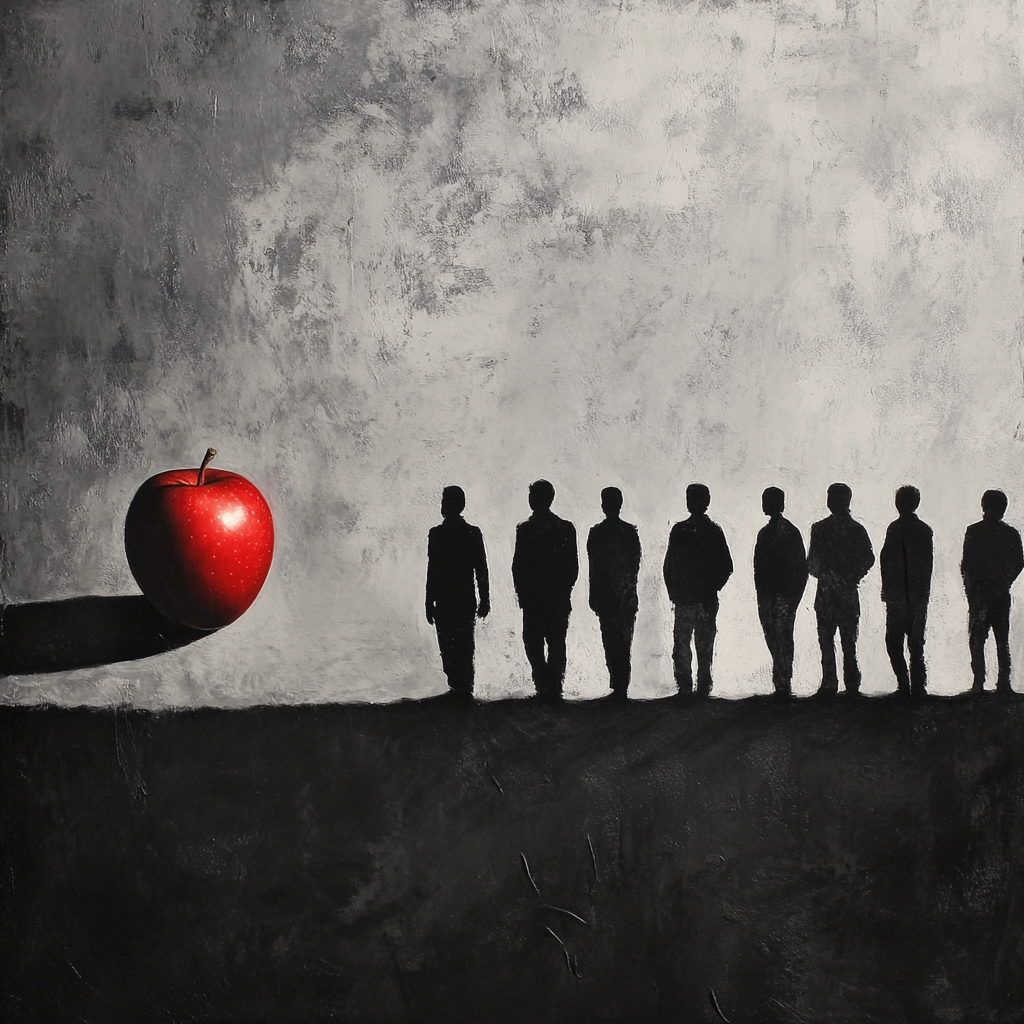
Apple: The apple that first appears different to Jonas symbolizes the beginning of his awakening and connects to themes of knowledge and awareness.
These symbols and motifs work together to reinforce the novel's central themes about individual consciousness, emotional depth, and the cost of conformity. They provide a visual and emotional vocabulary for understanding the transformation that Jonas undergoes and the stark differences between his community's artificial perfection and genuine human experience.
How does the setting (time and place) influence the themes and characters?
The setting of The Giver plays a crucial role in shaping both the themes and characters:
Controlled Environment: The highly regulated, climate-controlled community reflects the theme of sacrificing individual freedom for societal stability. The absence of weather variations and natural cycles emphasizes the artificial nature of their existence.
Timeless Quality: The deliberately ambiguous time period (neither clearly future nor present) creates a sense of isolation and timelessness that reinforces the community's disconnection from human history and tradition.
Physical Infrastructure: The uniform architecture, designated living spaces, and central administrative buildings physically represent the rigid social structure and lack of individuality in the community.
Isolation: The community's physical isolation from other settlements reinforces themes of control and limited knowledge, while also serving as a barrier that Jonas must ultimately overcome.
The setting's influence on characters is equally significant:
Character Conditioning: The sterile, controlled environment shapes the residents' behavior and thinking, making Jonas's awakening more dramatic and challenging.
Environmental Constraints: The lack of natural variation and sensory experiences directly impacts characters' emotional and psychological development, limiting their capacity for deep feeling and understanding.
Physical Boundaries: The community's physical layout and boundaries become both literal and metaphorical obstacles that characters must confront in their journey toward awareness and freedom.
Who are the main characters, and how do they develop throughout the story?
The main characters in The Giver each play crucial roles in the narrative and undergo significant development:
Jonas: The protagonist begins as a typical twelve-year-old member of his community, following rules without question. Through his training as the Receiver of Memory, he transforms into a critically thinking individual who questions his society's values and ultimately chooses to act against them to save both himself and Gabriel.
The Giver: As Jonas's mentor, The Giver evolves from a mysterious and burdened figure to a collaborative partner in change. His character reveals increasing layers of emotion and hope as he helps Jonas understand the true nature of their society.
Gabriel: A struggling infant who fails to meet developmental milestones, Gabriel becomes central to Jonas's emotional awakening. Through his bond with Jonas, he transforms from a potential reject of the community to a symbol of hope and humanity.
Fiona: Jonas's friend and love interest remains largely unchanged throughout the story, serving as a contrast to Jonas's development. Her continued acceptance of community norms highlights Jonas's growing divergence from their society.
Asher: Jonas's best friend also remains relatively static, representing the community's conditioning. His unchanging nature emphasizes the profound transformation Jonas undergoes.
Each character's development (or lack thereof) serves to highlight the central themes of awareness, individual growth, and the effects of societal conditioning. The contrast between those who change and those who remain the same underscores the power of knowledge and emotion in personal development.
What is the setting and the plot of the story?
The Giver is set in what appears to be a futuristic utopian society that has eliminated pain, fear, war, and hatred. The community is highly regulated, with strict rules governing every aspect of life, from family units to career assignments. The setting is characterized by:
Climate Control: The community maintains unchanging weather through climate control technology
Organized Structure: The society is divided into family units, with precise rules about living arrangements and social interactions
Isolated Community: The settlement exists in isolation from other communities, surrounded by "Elsewhere"
The plot follows twelve-year-old Jonas, who is selected to become the next Receiver of Memory. The story unfolds in these key stages:
Initial Setting: Jonas anticipates his career assignment at the Ceremony of Twelve
Selection and Training: Jonas begins training with The Giver, receiving memories of the past and experiencing emotions and sensations unknown to his community
Growing Awareness: As Jonas learns more about the true nature of his society, including the dark reality of "release," he becomes increasingly disturbed by his community's practices
Crisis and Decision: When Jonas learns that the infant Gabriel will be "released" (euthanized), he decides to take action
Escape: Jonas flees the community with Gabriel, embarking on a dangerous journey toward Elsewhere to save both their lives and bring about change in their community
The plot builds tension as Jonas's growing awareness conflicts with his community's rigid structure, leading to his ultimate decision to reject the false utopia in favor of a more genuine, though challenging, existence.
What themes or messages does the author convey through the story?
The Giver explores several profound themes and messages:
Individual Freedom vs. Societal Control: The novel examines the tension between personal liberty and social order, questioning whether perfect stability is worth the sacrifice of individual choice and emotion.
The Value of Memory and Experience: Through Jonas's reception of memories, the story emphasizes how both painful and joyful experiences are essential to the full human experience.
The Importance of Emotions: The novel demonstrates how the capacity to feel deeply, even when experiencing pain or loss, is fundamental to genuine human existence.
The Price of Perfection: The story critically examines the cost of creating a "perfect" society, showing how eliminating pain also means eliminating true joy, love, and meaningful connection.
Coming of Age and Awareness: Jonas's journey from innocence to understanding reflects the universal experience of growing up and confronting difficult truths about one's world.
The Power of Choice: The story emphasizes how the ability to make choices, even difficult ones, is essential to human dignity and growth.
These themes interweave throughout the narrative, challenging readers to consider the balance between comfort and authenticity, and the true meaning of human community.
How does the author use language and literary techniques to convey the story or its themes?
The author employs several sophisticated literary techniques to tell the story and emphasize its themes:
Limited Third-Person Perspective: The narrative follows Jonas closely, allowing readers to experience his growing awareness and emotional awakening alongside him while maintaining some objective distance.
Precise Language Use: The community's emphasis on precise language reflects their controlled nature, while Jonas's growing emotional vocabulary mirrors his expanding consciousness.
Sensory Description: The author gradually introduces more detailed sensory descriptions as Jonas gains the ability to see color and experience deeper emotions, making his awakening palpable to readers.
Contrast and Juxtaposition: The stark differences between Jonas's community and the memories he receives are highlighted through contrasting descriptions, emphasizing the theme of sacrifice for stability.
Symbolism: The author uses recurring symbols like color, light, and temperature to represent deeper meanings about awareness, emotion, and humanity.
These techniques work together to create a narrative that is both accessible and deeply layered, allowing readers to experience the story's themes on multiple levels:
Gradual Revelation: The writing style becomes more complex and emotionally rich as Jonas's understanding grows, mirroring his development.
Euphemistic Language: The community's use of euphemisms (like "release" for death) highlights how language can be used to mask uncomfortable truths.
Emotional Progression: The author's language becomes more emotionally charged as Jonas develops the capacity to feel and understand deeper emotions.
How might different readers interpret the story or its characters?
The Giver can be interpreted in various ways by different readers:
Political Lens: Some readers may view the story as a critique of totalitarian systems or extreme socialism, focusing on the dangers of government control and the suppression of individual rights.
Philosophical Perspective: Others might interpret it as an exploration of utilitarianism, questioning whether the greatest good for the greatest number justifies the sacrifice of individual freedom and emotional depth.
Psychological Reading: Some readers may focus on the psychological aspects, seeing it as a story about consciousness, memory, and the role of emotional experience in human development.
Coming-of-Age Interpretation: Younger readers often connect with the coming-of-age aspects, relating to Jonas's journey of self-discovery and his questioning of authority.
Religious/Spiritual View: Some might see religious or spiritual symbolism in Jonas's role as a savior figure and his journey to bring truth and enlightenment to his community.
Character interpretations can also vary significantly:
The Giver: May be seen as either a wise mentor or a complicit figure who allowed the system to persist for too long.
Jonas's Parents: Could be viewed as victims of their society or as willing participants in an oppressive system.
Community Members: Might be interpreted as either innocent products of their environment or as willfully ignorant participants in an inherently harmful system.
When and why was The Giver banned?
"The Giver" has faced numerous challenges and bans in schools and libraries since its publication in 1993. The main reasons for these challenges include:
Mature themes: The book deals with complex topics such as euthanasia, suicide, and infanticide through the concept of "release"
Violence and darkness: Some parents and educators have expressed concern about the dark themes and descriptions of violence in the memories Jonas receives
Sexual content: References to "stirrings" (the onset of puberty) and sexual feelings have been cited as inappropriate
Questioning authority: Some have objected to the book's themes of challenging established societal structures and authority
Despite these challenges, "The Giver" remains widely taught in schools and is considered a significant work of young adult literature. The American Library Association has reported multiple instances of the book being challenged throughout the 1990s and 2000s, though many of these challenges were unsuccessful in achieving outright bans.
Is The Giver appropriate for 13 year olds?
"The Giver" is generally considered appropriate for 13-year-olds, as it aligns with their developmental and reading capabilities. Here's why:
Reading Level: The book's vocabulary and sentence structure are accessible to middle school readers while still being engaging
Emotional Maturity: 13-year-olds typically have the emotional maturity to process the book's themes about society, identity, and moral choices
Relatable Protagonist: The main character, Jonas, is 12 years old, making his experiences and perspectives relatable to young teenage readers
Critical Thinking: The book encourages age-appropriate critical thinking about society, rules, and individual responsibility
However, parental guidance may be helpful when discussing some of the book's more complex themes and concepts, particularly regarding "release" and social control.
What grade level is The Giver for?
"The Giver" is commonly taught and read in grades 7-8 (ages 12-14), though it's also used in some upper elementary and high school classes. Here's a breakdown of its grade-level appropriateness:
Primary Reading Level: 7th-8th grade (ages 12-14)
Reading Complexity: Lexile measure of 760L, making it accessible to middle school readers
Curriculum Integration: Often included in middle school language arts and social studies programs
Advanced Readers: May be suitable for mature 5th-6th grade students (ages 10-12)
High School Use: Sometimes taught in 9th grade for deeper thematic analysis
The book's themes and content complexity make it most suitable for middle school students who are developing critical thinking skills and beginning to question social structures.
Why is The Giver inappropriate?
While "The Giver" has faced criticism and challenges, concerns about its inappropriateness typically center around several key aspects:
Mature Themes: The book deals with challenging topics like euthanasia and death through the concept of "release"
Complex Social Issues: The story addresses difficult subjects like population control, conformity, and suppression of individual freedoms
Emotional Intensity: Some scenes involving memories of war, pain, and loss may be emotionally challenging for sensitive readers
Coming-of-Age Elements: References to "stirrings" and physical maturation may concern some parents
However, these elements are handled thoughtfully and serve important narrative and thematic purposes. Many educators argue that these aspects make the book valuable for promoting meaningful discussions and critical thinking among young readers when presented with appropriate guidance and context.
Hello to all the Whovians in the universe! The fascination with the adventures of the Time Lord, known to us as Doctor Who, has been a captivating journey for me. Since my early teenage years, I've found myself mesmerized by the intricate layers of the Time Lord's universe. The thrill of being whisked through time and space, all from the comfort of my own home, has never ceased to amaze me. Today, we're setting off on a compelling, in-depth exploration of "Doctor Who: Twice Upon a Time". This book has managed to expertly capture the essence of the Doctor Who series, providing a profound offering that has resonated deeply with fans. So, secure your safety belts, ensure you have your sonic screwdrivers at hand, and come along as we dive headfirst into the timeless and thrilling universe of Doctor Who!
The Doctor, in this story, is caught in the throes of a significant transformation - his regeneration. This process, while physical, is deeply intertwined with his identity and consciousness. As the Doctor grapples with the impending change, he confronts questions about his own identity and existence, providing a thoughtful exploration of the concept of selfhood. This struggle resonates through the narrative, prompting us, as readers, to engage with similar questions about our own identities and the fluid, ever-changing nature of self.
"Doctor Who: Twice Upon a Time" is a quintessential representation of its genre, which is science fiction. The narrative revolves around time travel, an iconic element in the science fiction genre. The exploration of complex themes such as identity, mortality, memory, and the fluidity of time are also common in this genre. In addition, the depiction of advanced technology, like the TARDIS (Time And Relative Dimension In Space), and the existence of alien life forms, such as the Doctor himself, further cements the book within the science fiction genre. The book also incorporates elements of drama and philosophical inquiry, thereby adding depth and complexity to its science fiction narrative.
There is a moment of profound symbolism when the Doctor observes a flame flickering in his hand. This simple act, seemingly insignificant in the grand scheme of events, is saturated with meaning and depth. This flame, unassuming yet powerful, is a representation of time itself, embodying its constant flow, change, and the ephemeral nature of existence.
The act of the Doctor observing the flame is a testament to his unique abilities and his deep, intrinsic connection with time and space. Unlike ordinary beings, the Doctor perceives time in its entirety, understanding its flow and the unfolding events within it. He is not merely a passive observer but an active participant in the temporal fabric. He has mastered the art of time, navigating its complexities with the precision of a seasoned sailor steering through tumultuous seas.
This ability to comprehend time extends beyond the ordinary, linear understanding of it. Time, in the Doctor's eyes, is not a straight line with a clear beginning and end. Instead, it is a dynamic, ever-changing entity, an intricate tapestry woven with threads of events, moments, and possibilities. His perception of time is akin to viewing a multi-dimensional landscape, full of peaks and valleys, twists and turns, rather than a flat, one-dimensional line.
The flame in the Doctor's hand symbolizes this complex understanding of time. Just like time, a flame is dynamic and ever-changing. It flickers and dances, never remaining the same for more than a fleeting moment. It consumes fuel to live, just like time consumes moments to progress. Yet, despite its constant change, the flame retains its essence, its identity. Similarly, time, despite its ceaseless flow and change, remains a constant entity.
The flame also symbolizes the delicate balance of time. Just as a flame can provide warmth and light, it can also cause destruction if not handled with care. Similarly, time, if tampered with recklessly, can lead to disastrous consequences. The Doctor, aware of this delicate balance, understands the importance of respecting time's flow and not interfering unnecessarily.
The flame in the Doctor's hand serves as a mirror to the Time Lord himself. Just like the flame, the Doctor undergoes constant change through his regenerations. Each regeneration is a new flame, a new life, a new identity. Yet, despite these changes, he retains his essence, his memories, his selfhood. This parallel between the Doctor and the flame deepens the symbolism and adds another layer of complexity to his character.
The flickering flame is also a visual representation of life's transient nature. It serves as a poignant reminder of our mortality, the fleeting nature of existence, and the inevitability of change. The Doctor, despite his ability to regenerate, is not immune to these universal laws. His struggle with his impending regeneration, his decision to die, and his acceptance of change resonate deeply with these themes.
In essence, this seemingly simple act of observing a flame in his hand encapsulates the essence of the Doctor's character and his relationship with time. It underscores the underlying themes of change, continuity, and the complexities of time, providing a profound insight into the narrative's core philosophy.
The flame, thus, is not just a flame. It is a symbol, a metaphor, and a narrative device that adds depth and complexity to the storyline. It is a testament to the Doctor's unique relationship with time, his understanding of its complexities, and his acceptance of its relentless march. In the Doctor's hand, the flame becomes a beacon, illuminating the intricacies of time and the narrative's thematic landscape.
One of the standout elements of the Doctor Who novels, and particularly "Doctor Who: Twice Upon a Time", is the subtler approach to storytelling. Unlike the TV series where dramatic shouts of "Doctor, Doctor" punctuate the action, the books foster a quieter, more intimate atmosphere. The story unfolds without the need for such overt theatrics, providing a refreshing contrast to the series and offering a new perspective.
The author advances the theme through detailed narration and introspective dialogue. The characters’ speeches and thoughts express their grappling with concepts of time, memory, and identity. The author's use of literary devices such as foreshadowing and symbolism expand on the theme. The Doctor's impending regeneration, for instance, is a potent symbol of the inevitability of change and the transience of identity, tying back to the main theme. The setting and circumstances, particularly the war and the concept of time travel, underline the themes of duty, sacrifice, and the fluidity of time and identity. Rich, descriptive language and vivid imagery enhance the reader's understanding of the theme and supplement the thematic development.
Essential subordinate themes or topics
The essential subordinate themes or topics in the book are:
The concept of mortality and the acceptance of death
The exploration of time as both a physical and philosophical entity
The struggle of self-identity, particularly in the context of the Doctor's regeneration
Themes of duty, sacrifice, and ethical responsibilities
The complexities and paradoxes of time travel
The exploration of personal memories and their role in shaping a person's identity
The exploration of the nature of reality, particularly in the context of the glass woman and Bill Potts
Analysis of Storytelling Style
The Doctor Who novels, particularly "Doctor Who: Twice Upon a Time", illuminate a characteristic element that sets them apart - their nuanced storytelling style. This style starkly contrasts with that of the television series, offering a more refined, introspective ambiance that is a refreshing divergence from the energetic, campy nature of the show.
The Doctor Who television series is known for its flamboyant, theatrical style. It thrives in its campy aesthetics, bringing a larger-than-life, colorful vibrancy that fills the screen with dramatic exclamations of "Doctor, Doctor" punctuating the ongoing action. The series rides high on eccentric characters, exaggerated emotions, and quirky humor. The plots often revolve around extravagant alien species, with their distinctly exaggerated appearances and theatrical performances that bring a level of whimsy and exaggerated drama to the narrative. This camp style, while entertaining, can sometimes overshadow the deeper, underlying themes of the narrative.
On the other hand, the Doctor Who novels, especially "Doctor Who: Twice Upon a Time", adopt a quieter, more introspective narrative style. The storytelling unfurls gracefully, devoid of the need for explicit theatrics, granting a more serene ambiance. This approach allows the narrative to delve deeper into the complexities of the characters and their dynamics, probing into the quieter, reflective facets of the narrative that might get lost in the flamboyant spectacle of the television series.
This difference in storytelling style between the television series and the novels presents a fresh viewpoint on the adventures of our beloved Time Lord. The television series, with its larger-than-life, campy style, brings a sense of excitement and spectacle that engages viewers in a visceral, immediate way. It creates a dynamic, fast-paced narrative that captivates viewers with its visual spectacle, eccentric characters, and dramatic confrontations.
In contrast, the novels, with their introspective, nuanced storytelling style, invite readers on a more immersive, contemplative journey. It allows readers to delve deeper into the characters' psyche, understand their motivations, and engage with the thematic elements of the narrative on a more profound level. The novels focus on exploring the complexities of the characters, their relationships, and the intricate web of time and space they navigate.
The unique storytelling style of the novels could potentially modernize the Doctor Who series if it were to be adopted. While the campy style of the television series has its charm and appeal, a shift towards a more introspective narrative could introduce a fresh perspective to the series. It could allow the series to delve deeper into the complexities of the characters, their motivations, and the intricate web of time and space they navigate.
A more serene, nuanced narrative style could help amplify the themes of the series, bringing a depth and complexity that could resonate with a wider audience. It could also present an opportunity to explore the philosophical implications of the Doctor's adventures, probing deeper into the concepts of time, identity, and morality. This could potentially make the series more accessible and engaging for viewers who prefer narratives with a strong thematic depth and character focus.
The adoption of a more introspective storytelling style could potentially modernize the series by aligning it with contemporary narrative trends. In recent years, there has been a shift towards narratives that focus on character development, thematic depth, and psychological exploration.
Analysis of Key Narrative Devices
"Doctor Who: Twice Upon a Time" cleverly incorporates narrative devices to layer the plot. The factory TARDIS, with its stark white exterior unadorned by any designs, lends itself to an interesting comparison with the initial process of crafting a website. Much like the skeletal framework of a website, the factory TARDIS is a necessary foundation. However, it's the infusion of personal style, reminiscent of the Doctor's touch on the TARDIS, that metamorphoses it into an engaging, lively entity. This parallel serves as an insightful reminder of the humble origins of even the most remarkable creations.
Another notable narrative device is the use of the flame symbol. The Doctor's intricate relationship with time is encapsulated in the moment when he observes a flame flickering in his palm. This flame is a metaphor for time. The Doctor's role is not just confined to being a traveler but expands to being a custodian, a guide, and an integral part of the temporal tapestry. He possesses a unique understanding of the ebb and flow of time and the events within, going beyond the traditional linear perception of time. This understanding delves into the complexities of time as a fluid, ever-adapting phenomenon.
Key Themes Explored in "Doctor Who: Twice Upon a Time"
The theme of self-identity: The Doctor struggles with accepting his younger version and reconciling with his future selves, highlighting the fluidity of identity over time.
The idea of change and transformation: The Doctor's impending regeneration signifies the inevitability of change. This is a key theme in the Doctor Who series and is explored here in-depth.
The concept of time: The novel explores the complexities and paradoxes of time-travel. The Doctor operates outside of normal time, which poses unique challenges and dilemmas.
The power of memory and perception: The Doctor's past, present, and future selves co-existing creates a discourse on memory, perception, and how these elements shape our identity.
The importance of companionship: The relationships between the Doctor and characters like Bill and the Captain highlight the Doctor's need for companionship and his reliance on others for support and guidance.
Courage in the face of adversity: The Doctor's determination to confront the Glass Woman and the bold escape plan demonstrates the theme of bravery and resistance against powerful adversaries.
Philosophical Themes
The narrative of "Doctor Who: Twice Upon a Time" ventures deep into philosophical realms, engrossing readers with thought-provoking explorations of personal identity and the concept of time. These themes, which are central to the story, reverberate within the narrative universe of "Doctor Who: Twice Upon a Time" and have always been a profound source of fascination for me, as a dedicated fan of the series.
The distinct process of regeneration that the Doctor undergoes is particularly compelling. In this process, the Doctor experiences a physical transformation yet crucially, retains his memories and experiences. This innovative narrative construct effectively challenges the traditional notion of a fixed identity. The Doctor, in essence, encapsulates a continuity of consciousness despite the drastic change in physical appearance, thus pushing the boundaries of our understanding of individual identity. This intriguing narrative element echoes the intricate questions about selfhood raised in Derek Parfit's "Reasons and Persons", a seminal work in philosophical inquiry renowned for its profound insights.
Much like the Doctor Who series, "Reasons and Persons" has had a significant impact on my worldview, shaping my thoughts and understanding of the world. The philosophical themes explored in Parfit's work have deeply resonated with me, much like the themes in "Doctor Who: Twice Upon a Time". Parfit's exploration of personal identity, specifically the revolutionary idea that identity is not what fundamentally matters in survival, aligns seamlessly with the Doctor's regeneration process. Both convey the notion that although the physical form may undergo change, the continuity of psychological connections - such as memories, beliefs, desires - is what truly defines a person's identity.
Parfit also delves into the intricate nature of time, another theme that is central to the narrative of "Doctor Who: Twice Upon a Time". The Doctor's extraordinary relationship with time, where he is not anchored by its linear progression, closely mirrors Parfit’s exploration of time's relationship with identity. The Doctor possesses the unique ability to perceive and interact with time in its complexity and flow, a perspective that is akin to Parfit's philosophical discourse. This exceptional relationship with time, coupled with the Doctor's regeneration, adds layers of depth and complexity to the narrative, enriching the story with philosophical intrigue.
The parallels between "Reasons and Persons" and "Doctor Who: Twice Upon a Time" present a unique opportunity to delve into thought-provoking perspectives on time and identity. As an ardent fan of Doctor Who and an admirer of Parfit's philosophical insights, I find this connection deeply fascinating. The exploration of these complex themes within a science fiction narrative provides a unique lens to examine and understand these philosophical concepts, making them more accessible and relatable.
The blend of philosophy and science fiction in the narrative of "Doctor Who: Twice Upon a Time" initiates a dialogue between these two seemingly disparate fields. It showcases the potential of science fiction as a medium to explore philosophical ideas, sparking thought-provoking discussions and promoting deeper understanding.
Both "Doctor Who: Twice Upon a Time" and Parfit's "Reasons and Persons" delve into the complexities of personal identity and the intricacies of time, and their intersection. They challenge conventional notions of selfhood and time, presenting a dynamic and nuanced view that profoundly resonates with me. The exploration of these themes in the narrative of "Doctor Who: Twice Upon a Time", mirroring the philosophical themes in Parfit's work, not only enriches the story but also deepens my appreciation for both works.
Parfit's exploration of personal identity includes a fascinating thought experiment involving space travel. In this scenario, a person travels from Earth to Mars at the speed of light. At the moment of departure, an exact replica of the person, with the same memories, personality traits, and physical characteristics, is created on Mars. Parfit poses the question: which one is the real person - the original on Earth or the replica on Mars?
This concept parallels the Doctor's ability to regenerate in "Doctor Who: Twice Upon a Time". When the Doctor regenerates, he essentially becomes a new person with a new physical appearance, yet retains the memories and experiences of his previous self. Much like Parfit's space traveler, the Doctor exists in two instances - the old Doctor who chooses to die and the new Doctor who arises from the regeneration.
This parallel presents a compelling exploration of the concept of selfhood and the continuity of identity. It raises questions about what truly defines a person - is it their physical form, their memories, or a combination of both? These complex questions about identity and existence add depth to the narrative, enriching the story and offering readers a thought-provoking reading experience.
Christ-like Themes
"Doctor Who: Twice Upon a Time" explores several themes, many of which draw intriguing parallels with Christian theology. One profound theme is the act of sacrifice. The Doctor's decision to lay down his life for the good of all is a key point in the narrative. His choice is a powerful manifestation of his acceptance of mortality and the inevitability of change. The narrative paints the Doctor's sacrifice as a selfless act, strikingly similar to the sacrificial act of Jesus Christ in Christian theology.
According to Christian belief, Jesus Christ willingly died on the cross, bearing the burden of humanity's sins to provide salvation for all. This act is one of the most significant events in Christian theology, symbolizing God's love for humanity. The Doctor's choice to die mirrors this sacrificial act, demonstrating his commitment to safeguarding life throughout the universe, often at the cost of his own.
The Doctor's willingness to die, much like Christ's acceptance of his crucifixion, is a testament to his courage and selflessness. In choosing to die for the sake of all, the Doctor affirms his role as a guardian and protector, willing to make the ultimate sacrifice for the greater good. This narrative reinforces the Doctor's role as a guardian and savior, much like Christ.
Death, however, is not the finality for either the Doctor or Christ. In Christian theology, Christ's death was followed by His resurrection, a triumphant victory over death symbolizing hope and eternal life. Similarly, the Doctor, though he chooses to die, is not conquered by death. Instead, he undergoes a regeneration—a transformation into a new form, a new life. This regeneration can be seen as a form of resurrection, a victory over death, and a renewal of life.
The parallel between the Doctor's regeneration and Christ's resurrection presents a fascinating perspective on themes of sacrifice, death, and rebirth. The act of dying, whether for Christ on the cross or the Doctor in the face of impending destruction, is not an end but a transition—a doorway to a new beginning. It is a testament to the power of love, sacrifice, and the indomitable spirit of resilience and hope.
The Doctor's regeneration, like Christ's resurrection, signifies a renewal, a rebirth. It is a process that, while painful and challenging, leads to a new beginning and a fresh start. It is a symbol of hope, of life springing forth from the ashes of death. It is a testament to the enduring spirit of the Doctor, his resilience, and his undying commitment to safeguarding life.
This parallel extends beyond the individual level to encompass a broader, universal perspective. Just as Christ's resurrection signifies hope and salvation for all of humanity, the Doctor's regeneration symbolizes enduring hope for life throughout the universe. Each regeneration, each new Doctor, brings renewed commitment to protecting life, fighting injustice, and championing hope and compassion.
However, it's important to note that while there are intriguing parallels, the narrative does not equate the Doctor with Christ. The Doctor's sacrifice, though noble and selfless, does not carry the theological weight of Christ's crucifixion in Christian belief. Nevertheless, these parallels present a rich ground for exploration, interpretation, and discussion of the themes of sacrifice, mortality, resurrection, and rebirth in the narrative.
In-depth Analysis of the Story
The most important word in the story is 'Time'. The concept of time is a recurring theme in the story, influencing the characters' actions, their understanding of their existence, and the progression of the plot.
The most important line in the story is "I'm only sorry we can't help you. More said the first doctor. When time resumes, you will not remember. This." This sentence encapsulates the Doctor's struggle with his inability to alter the course of time and his deep sense of empathy toward the Captain.
The most important aspect of this story is the exploration of the complexities of time, identity, and memory. The story delves deep into philosophical questions about what it means to be an individual, the nature of memories, and the paradoxes of time travel. The characters grapple with their identities, their past and future selves, and the consequences of their actions on the fabric of time.
As we delve deeper into the narrative, the theme of time emerges as a pivotal concept, shaping the characters' actions, their understanding of their existence, and the progression of the plot.
The Doctor, in particular, is caught in the throes of a significant transformation - his regeneration. This process, while physical, is deeply intertwined with his identity and consciousness. As the Doctor grapples with the impending change, he confronts questions about his own identity and existence, providing a thoughtful exploration of the concept of selfhood. This struggle resonates through the narrative, prompting us, as readers, to engage with similar questions about our own identities and the fluid, ever-changing nature of self.
Analysis of Language Techniques and Literary Devices
The author masterfully employs a plethora of linguistic techniques and literary tools to enrich and enhance the narrative. Dialogue is used with dexterity to not only reveal the intricate traits of the characters but also to advance the plot, all while maintaining a captivating and organic flow of conversation. The author’s use of vibrant descriptions and powerful imagery crafts a comprehensive picture of the settings and events, augmenting the reader’s immersion and engagement with the story. Dramatic tension is skillfully interwoven into scenes, such as the riveting escape from the glass woman, keeping the reader engrossed and ensuring the narrative remains compelling from start to finish. The use of humor and sarcasm, particularly embodied through the Doctor's character, infuses the narrative with moments of levity, lightening the tone amidst an intense storyline.
The author utilizes a rich, descriptive language and vivid imagery to augment the reader's understanding of the theme. Detailed descriptions of the settings, events, and the characters' experiences add layers to the story and supplement the thematic development. The narrative is imbued with complex dialogue and introspective monologues, particularly through the Doctor's character, allowing the author to delve into his intricate emotions and philosophical musings, thereby advancing the central theme of the narrative.
The author also employs literary devices such as foreshadowing and symbolism to expand on the theme. The Doctor's impending regeneration, for instance, is a potent symbol of the inevitability of change and the transience of identity, which ties back to the main theme. The author also uses the setting and circumstances, especially the war and the concept of time travel, to underline the themes of duty, sacrifice, and the fluidity of time and identity. The Doctor’s struggle with his decision to die, and his negotiation of this decision in the context of his duty to others, for example, further develops the theme of identity and the passage of time.
The author's adept use of language techniques, rich description, and vivid imagery, coupled with well-crafted dialogue and introspective monologues, serves to enhance the reader's understanding of the story and its themes. The author's exploration of themes such as identity, time, and memory, through the experiences and interactions of the characters, adds depth and complexity to the story.
The book contains several important and forceful statements. These statements often concern themes of self-identity, the nature of time, mortality, acceptance of death, duty, sacrifice, and the complexities of memory. More said the first doctor. When time resumes, you will not remember. This" encapsulates his struggle with his inability to alter the course of time and his deep sense of empathy. The Doctor's decision to die, as seen in the statement "He had decided to die. For everyone. Everywhere.", is a powerful declaration of his acceptance of mortality and the inevitability of change. Another significant statement is "Everybody's important to somebody," which underscores the Doctor's belief in the intrinsic worth of every individual.
Character Development
The characters of "Doctor Who: Twice Upon a Time" are thoughtfully crafted, each bringing a unique perspective to the narrative and contributing to the exploration of various themes, such as self-identity, time, duty, and memory.
The Doctor stands at the precipice of change, wrestling with his impending regeneration and the profound implications it brings. As the narrative unfolds, his internal struggle sheds light on the intricacies of his character, providing a fascinating exploration of the themes of identity, mortality, and acceptance.
The Doctor, with his eccentricity and wisdom, is more than just a time-traveling alien. He is a guardian of time, a beacon of hope, and a complex individual grappling with his own sense of self. His impending regeneration is more than a simple transformation – it signifies a change in his identity, a cessation of his current self, and the birth of a new persona. This process brings to the fore the Doctor's internal conflict. He is at odds with the inevitability of change, and the narrative deftly explores his struggle as he grapples with the loss of his current identity and the uncertainty of what he will become.
Despite his Time Lord abilities that allow him to regenerate, the Doctor's acceptance of his mortality forms a poignant aspect of his character growth. The narrative does not shy away from exploring the Doctor's vulnerability. He is not invincible; he can be hurt, he can feel fear, and he can die. His decision to embrace death, despite the possibility of regeneration, is a testament to his courage and acceptance of change. This decision not only underscores the theme of mortality and the inevitability of change, but also enriches his character, providing a depth that goes beyond his Time Lord abilities.
The Doctor's character is further amplified by his profound empathy. His encounters with various beings across time and space have shaped his understanding of life, making him deeply empathetic towards all forms of life. His empathy is not confined within the boundaries of his own species or even humanity - it extends to all beings, including his enemies. This empathy, combined with his intelligence and courage, makes the Doctor a true hero.
However, the Doctor's character is not without flaws. He can be arrogant, aloof, and sometimes burdened by the weight of his own decisions. He often struggles with the moral implications of his actions, particularly when they have far-reaching consequences across time and space. This flawed aspect of his character makes the Doctor more relatable, more human, adding another layer of complexity to his character.
The Doctor's unique perspective on time adds a fascinating dimension to his character. Time is not just a measure for the Doctor, it's a playground, a maze, and sometimes a burden. He perceives time in all its complexity – its ebb and flow, its twists and turns, and its potential for both creation and destruction. This understanding of time and his unique ability to navigate it are what make the Doctor a Time Lord.
IThe Doctor's character serves as a mirror reflecting the complexities of identity, mortality, and the inevitability of change. His struggle with his impending regeneration, his acceptance of mortality, and his profound connection with time all contribute to the multi-faceted nature of his character. His courage, empathy, and resilience in the face of adversity highlight his heroism, making the Doctor an enduring character in the realm of science fiction. Through the Doctor, we are invited to explore our own sense of self, our mortality, and our capacity for change – making the journey with the Doctor not just an adventure through time and space, but a journey of self-discovery.
The First Doctor, as portrayed in "Doctor Who: Twice Upon a Time", is a compelling character that adds a rich layer of depth and intrigue to the narrative. As an earlier incarnation of the Doctor, he serves as a bridge to the Time Lord's past and offers unique insights into the evolution of the Doctor's character.
In many ways, the First Doctor is the foundation on which all subsequent incarnations are built. His sense of wonder, curiosity, and thirst for knowledge are traits that persist in the Doctor's later regenerations. His courage and determination to fight against injustice and protect the innocent set the precedent for the heroism that would come to define the Doctor's character.
The First Doctor also exudes an air of wisdom and authority that is characteristic of his age. He is a figure of respect, not only for his knowledge and experience but also for his moral compass and his unwavering commitment to doing what is right. This sense of authority is balanced by a playful and mischievous streak, a trait that adds a touch of levity and charm to his character.
However, the First Doctor is not without his flaws. He can be stern, stubborn, and occasionally dismissive of others' opinions. His demeanor often masks his deep sense of compassion and empathy, qualities that are revealed in his interactions with his companions and his willingness to help those in need.
His presence in "Doctor Who: Twice Upon a Time" serves as a poignant reminder of the Doctor's journey, highlighting how much he has changed and yet how much of his original self remains. The interplay between the First Doctor and his later incarnation provides a fascinating exploration of the Doctor's self-identity, raising questions about the nature of change and the essence of an individual's self.
The First Doctor's interactions with other characters in the story also reveal a great deal about his character. His relationship with the Captain, for example, showcases his empathy, wisdom, and his willingness to offer comfort and guidance even in the most dire of circumstances. His exchanges with the glass woman, on the other hand, provide a glimpse into his decisive and courageous nature.
The First Doctor is a complex and multi-dimensional character who enriches the narrative of "Doctor Who: Twice Upon a Time". He represents the Doctor's roots, embodying the values, traits, and ideals that have shaped the Doctor's evolution. His presence in the narrative adds depth to the exploration of themes such as self-identity, change, and the passage of time, making him an integral part of the story.
Captain Archibald Hamish Lethbridge Stewart, more commonly known as Archie, is a character who leaves a lasting impression in "Doctor Who: Twice Upon a Time". Caught in the midst of war, Archie represents the thousands of brave soldiers who face the grim realities of conflict with strength and courage. His character is a poignant depiction of duty and sacrifice, embodying the spirit of bravery and selflessness that marks a soldier's life.
Archie's stoic acceptance of his fate is a testament to his robust character. He understands the harsh realities of the battlefield and accepts the inevitable with a quiet grace that is both moving and inspiring. His relentless commitment to his duty, even in the face of certain death, speaks volumes about his strong moral compass and unwavering resolve.
The sacrifice Archie makes is not just a physical one but a deeply emotional one as well. He willingly walks into the jaws of death, fully conscious of the price he is paying. This ultimate sacrifice adds layers of depth and complexity to his character, making him a symbol of selfless bravery.
Archie's interactions with the Doctor bring to light another aspect of his character. Despite his tough exterior, he harbors a deep sense of empathy and understanding. His request to the Doctor, to look in on his family from time to time, shows his concern for his loved ones, adding an emotional depth to his otherwise stoic character.
Ultimately, Captain Archibald Hamish Lethbridge Stewart or Archie is a character who embodies duty, sacrifice, and bravery. His story is a powerful depiction of the human spirit's strength and resilience in the face of adversity.
The Glass Woman, a character in "Doctor Who: Twice Upon a Time", is not just a character but a potent symbol. As a physical manifestation of memory, she brings to life the intriguing exploration of memory and its profound impact on our identities. Her existence, shaped by the memories of Bill Potts, challenges traditional definitions of reality and personal identity, suggesting that our sense of self is shaped as much by our memories as it is by our physical existence.
Despite being a construct of glass and memory, the Glass Woman is perceived by others as a living, sentient being. This perception challenges our understanding of reality, suggesting that what we perceive as real can be as influential and powerful as physical reality. It highlights the subjective nature of reality and the power of perception in shaping our understanding of the world around us.
The Glass Woman’s interactions with the Doctor and other characters provide valuable insights into the theme of memory and identity. Her existence, while based on Bill's memories, evolves as she interacts with the world around her. She forms new memories, learns, and grows, much like a real person. This development suggests that our identities are not static but constantly evolving, shaped by our experiences and interactions.
She serves as a mirror to the Doctor's struggle with his impending regeneration, a process that will alter his physical form while retaining his memories. Her existence poses a compelling question: If our memories remain, are we fundamentally the same person, even if our physical form changes?
The Glass Woman also embodies the paradox of memory. Memories are inherently subjective, influenced by our emotions, perceptions, and the passage of time. Yet, they play a crucial role in shaping our sense of self. The Glass Woman, a being born of memory, encapsulates this paradox. She is both a product of someone else's memories and a being with her own experiences and perceptions, highlighting the complex interplay between memory, perception, and identity.
In "Doctor Who: Twice Upon a Time", the Glass Woman serves as a powerful symbol of the intricate relationship between memory and identity. Her character encourages readers to reflect on the nature of selfhood, the subjectivity of reality, and the pivotal role memory plays in shaping our identities. By exploring these complex themes through the character of the Glass Woman, the narrative adds depth and nuance to the philosophical discourse of the story.
Rusty the Dalek is a significant character in "Doctor Who: Twice Upon a Time", serving as a symbol of rebellion, individuality, and the potential for change. Unlike the archetypal Daleks, known for their relentless drive towards destruction and their uniform hatred for anything non-Dalek, Rusty proves to be a renegade. He has undergone a unique shift in his belief system that has led him to detest his own kind and actively go against them.
Rusty is not simply a character in the narrative but a potent metaphor that challenges the monolithic portrayal of the Dalek race. Like the TARDIS, Rusty is more than what meets the eye. On the surface, Rusty appears to be a typical Dalek, but within him resides a world of unique thoughts and beliefs that set him apart from the rest of his kind.
Much like the TARDIS, which is a simple police box on the outside but encapsulates an entire universe within, Rusty's exterior belies the complexity of his character. His rebellion against the Dalek norms, his shift in beliefs, and his refusal to conform to the Dalek's destructive ideology underscore the theme of individuality and the ability to redefine one's identity. Just as the TARDIS undergoes changes with each Doctor, reflecting their unique personality and style, Rusty also undergoes a transformation that sets him apart.
Rusty's character serves as a crucial narrative device in exploring themes of identity, change, and the power of individual thought. His journey echoes the Doctor's struggles with change and identity development, adding depth to the exploration of these themes within the narrative. Moreover, Rusty's individuality and defiance serve to highlight the potential for change and the capacity for individual thought, even in a species typically characterized by uniformity and conformity.
Rusty's presence in the narrative provides a fresh perspective on the Dalek race within the Doctor Who universe. His character challenges the viewer's preconceived notions about the Daleks, offering a more nuanced depiction of their race. Rusty's unique perspective, his defiance of Dalek norms, and his rebellion against his kind not only enrich the narrative but also open up new narrative possibilities.
A fascinating element in "Doctor Who: Twice Upon a Time" is the character-like role played by the TARDIS, specifically the depiction of the factory TARDIS. Unlike the colorful, vibrant TARDIS we associate with the Doctor, the factory TARDIS is stark, white, and devoid of any distinct designs. This seemingly unimpressive form is crucial, serving as the canvas onto which the Doctor's personality is imprinted.
This narrative choice is reminiscent of the process of building a website. The initial framework of a site, while essential, is visually unremarkable, much like the factory TARDIS. It's the application of CSS, which adds color, fonts, and styles, that brings the site to life, transforming it into a dynamic and engaging platform. Similarly, the Doctor personalizes the TARDIS, imprinting it with their unique touch, thereby transforming it from a plain, white structure into a vessel teeming with character and charm.
This depiction of the TARDIS serves as a potent reminder that even the most extraordinary things can have simple beginnings. It reflects the transformative power of personalization - how adding individual touches can imbue an otherwise unremarkable object with depth and charm.
Moreover, the TARDIS is more than just a time-traveling machine; it's a character, playing a pivotal role in the Doctor's adventures. It's the Doctor's home, their safe haven, and their loyal companion, sharing in their victories and losses. It's a silent witness to the Doctor's life, its walls echoing with tales of bravery, sacrifice, and resilience. It's a testament to the Doctor's journey, bearing the marks of their adventures across time and space.
The TARDIS, much like the Doctor, evolves over time. Each Doctor leaves their mark on the TARDIS, reflecting their unique personality and style. This evolving nature of the TARDIS mirrors the Doctor's regenerations, each bringing a new personality and appearance, yet retaining the same essence.
In the grand tapestry of "Doctor Who: Twice Upon a Time", the TARDIS stands as a symbol of the Doctor's journey, a silent character in its own right, bearing witness to the Doctor's life, sharing in their joys and sorrows, and ultimately, serving as an enduring testament to the Doctor's adventures across time and space.
Each character in "Doctor Who: Twice Upon a Time" undergoes their unique journey of growth. Their experiences and interactions highlight the themes of the story and contribute to the narrative's depth and complexity. The characters' struggles with their identities, their confrontation with time, the acceptance of their duties, and their exploration of memory all contribute to their character development and enrich the narrative. The depth of each character, their unique perspectives, and their growth throughout the story make "Doctor Who: Twice Upon a Time" a rich and engaging narrative that explores complex themes through the lens of compelling characters.
Potential Interpretations
Interpreting the story or its characters can vary significantly among readers, based on their perspectives and experiences. For some, the Doctor's struggle with his impending regeneration and his decision to die may highlight themes of acceptance, mortality, and the inevitability of change. Others may focus on the dynamic between the Doctor and other characters, reflecting the Doctor's internal conflict, his connection to his past, and his impact on others. Some readers might interpret the story as a commentary on the nature of time and memory, with the use of time travel, the Doctor's unique abilities, and the concept of the factory TARDIS seen as metaphors for the fluidity and subjectivity of memory and personal identity.
Conclusion
"Doctor Who: Twice Upon a Time" is a richly layered narrative that dives deep into the philosophical questions about identity, time, and memory. The author's skillful use of language techniques, narrative devices, and character development provides an engaging and thought-provoking reading experience. The story's themes and the characters' experiences resonate beyond the pages of the book, prompting readers to engage with these concepts in their own lives.
Reading this book has certainly deepened my understanding of the subject. It explores complex themes such as identity, time, memory, and the intricacies of personal relationships in an engaging and thought-provoking manner. The author's use of vivid descriptions, introspective dialogue, and intricate plot devices has provided a rich narrative that delves into the philosophical implications of each theme, enhancing my comprehension and appreciation of the subject.
This story stands as a testament to the depth and complexity that the Doctor Who series offers, making it a timeless treat for Whovians. So, grab your sonic screwdriver, hop into your TARDIS, and embark on this journey with the Doctor. The fabric of time and space awaits!
Exploring Autonomy and Identity: A Comprehensive Overview and Discussion Guide for 'All Systems Red' by Martha Wells
A synthetic entity pursues self-determination, wrestles with its history, and discovers liberation.
"All Systems Red" by Martha Wells is a riveting exploration into the world of artificial intelligence, the intricacies of sentience, and the complex interplay between autonomy and identity. This novella stands out due to its intricate detailing, philosophical undertones, and the human-like evolution of its central character, the Security Unit, or the 'Sec Unit'. The story masterfully blurs the lines between organic and synthetic beings, unravelling a narrative that is as intriguing as it is thought-provoking.
From the onset, Wells sets the scene with meticulous precision. The Corporation Rim, with its harsh environment and strict corporate control, comes alive in stunning detail. The chillingly cold, metallic walls of the Sec Unit’s cubicle to the ominous expanse of the Corporate Rim are so vividly described that they feel palpably real. This attention to detail extends to the characters' attire and tools, adding another layer of realism to the story. Whether it's the Sec Unit's armor, symbolic of its identity and purpose, or Dr. Mensa's business attire, hinting at her authoritative role, every item is carefully considered and contributes to the overall narrative.
The Sec Unit is a marvel of character development. It begins its journey as a security robot with organic components, performing its duties without question. However, as the story progresses, it evolves into a self-aware being grappling with the consequences of its past actions and yearning for autonomy. This transformation is conveyed through a first-person perspective, allowing us a deep dive into the Sec Unit's thoughts, fears, and desires. The clever use of dialogue and internal monologue paints a picture of an artificial being with human-like emotional depth.
Wells explores the philosophical concept of 'what it means to be alive' through the Sec Unit's evolution. The Sec Unit's struggle for autonomy, its capacity for empathy, and its ability to form relationships are all traits that we associate with being human. Its journey makes us question our understanding of consciousness and the very definition of life.
The Sec Unit's interactions with the other characters, particularly Dr. Mensa, are instrumental in driving this narrative. Dr. Mensa's character is beautifully fleshed out. She's not just the one in charge; she's the one who understands the Sec Unit, respects its autonomy, and eventually advocates for its freedom. The trust she places in the Sec Unit isn't just a protective measure for her feelings; it's a testament to her belief in the Sec Unit's capacity for change and growth.
The other characters, too, display a gradual shift in their perception of the Sec Unit. From viewing it as a mere tool to recognizing it as a sentient being, their journey mirrors societal attitudes towards artificial intelligence. Their decision to buy the Sec Unit's freedom is a significant turning point, symbolizing their acceptance of the Sec Unit as a being capable of independent thought and action.
"All Systems Red" is not just a story about artificial intelligence; it's a story about finding one's identity, seeking freedom, and making peace with the past. It delves deep into the question of what makes us who we are. Is it our programming, our experiences, or our choices? Through the Sec Unit's journey, Wells seems to suggest that it's a combination of all three.
The book also raises questions about the implications of corporate control, the ethics of artificial intelligence, and the concept of 'ownership'. The Corporation Rim, with its strict rules, serves as a backdrop for exploring these societal issues.
In the expanded universe of "All Systems Red", Wells questions the ethical boundaries of creating sentient beings for corporate gains. The Corporation Rim, with its cold and calculated control over the Sec Unit and other similar entities, serves as a critique of unregulated corporate power and its potential for harm. The reader is invited to reflect upon the moral implications of creating and exploiting sentient beings for profit, raising questions about agency, consent, and the rights of artificial beings.
Wells uses the Sec Unit's access to entertainment feeds to highlight its developing understanding of human culture and behavior. The Sec Unit's consumption of serial dramas and books is a significant part of its character development. This access to human culture helps the Sec Unit understand humans better, enabling it to navigate its interactions with them more effectively. The entertainment feeds also provide a form of escape for the Sec Unit, offering a respite from its duties and a way to explore different aspects of human life.
The Preservation Alliance serves as a beacon of hope for the Sec Unit and the other characters. The existence of the Preservation Alliance represents a potential sanctuary from corporate control and a chance for a different life. The possibility of escape to the Preservation Alliance provides a powerful motivation for the Sec Unit and other characters, shaping their decisions and actions throughout the story.
The suspense and surprise elements in the story keep the reader on the edge of their seat. Unexpected plot twists, tense cliffhangers, and sudden revelations add to the story's intrigue and pace. These elements keep the reader hooked, eager to find out what happens next.
"All Systems Red" is a solid piece of science fiction that masterfully combines detailed world-building, nuanced character development, and philosophical ponderings. It's a journey into an AI's quest for freedom that leaves you questioning your understanding of life, identity, and autonomy. The story is as real as it gets, with characters that are profoundly relatable, and a plot that is both engaging and thought-provoking. This is a book that stays with you long after you've turned the last page, prompting you to ponder the ethical implications of artificial intelligence, the nature of consciousness, and the struggle for autonomy in a world dominated by corporate interests.
20 Book Club Questions and Answers for All Systems Red
Question: How does the author use the first-person perspective to develop the character of the SEC unit? Answer: The author uses the first-person perspective to reveal the SEC unit's thoughts, feelings and motivations. This immerses the reader in the SEC unit's experiences and makes its evolution throughout the story more personal and engaging.
Question: What does the SEC unit's decision to leave at the end of the book reveal about its character development throughout the story? Answer: The SEC unit's decision to leave indicates its growing autonomy and desire for independence. It shows that the SEC unit has developed a sense of self and is willing to make its own decisions, even if they involve risk and uncertainty.
Question: How does the author explore the theme of autonomy and decision-making through the character of the SEC unit? Answer: The author explores the theme of autonomy and decision-making through the SEC unit's actions and choices, especially its decision to leave the company and determine its own future.
Question: How does the relationship between Dr. Mensa and the SEC unit evolve throughout the story? Answer: The relationship between Dr. Mensa and the SEC unit evolves from a professional one to a more personal one. Dr. Mensa becomes more caring and considerate towards the SEC unit, and the SEC unit develops a sense of loyalty and affection towards Dr. Mensa.
Question: What role does the company play in the story and how does it impact the actions and decisions of the characters? Answer: The company serves as a source of conflict and tension in the story. Its policies and actions often put the characters in difficult situations and force them to make tough decisions.
Question: How does the author depict the concept of 'home' and 'belonging' in the story? Answer: The author depicts 'home' and 'belonging' as concepts that are not tied to a specific place but rather to a sense of security, acceptance, and autonomy.
Question: How does the author use the setting of the Corporation Rim to create tension and conflict in the story? Answer: The Corporation Rim, with its strict rules and corporate control, serves as a backdrop for the characters' struggles for autonomy and survival. Its harsh environment and the company's oppressive policies create a sense of danger and urgency that drives the plot.
Question: In what ways does the SEC unit display human-like qualities and emotions? Answer: The SEC unit displays human-like qualities and emotions in its capacity to learn, adapt, make decisions, and form relationships. It also shows empathy, fear, and a desire for autonomy, which are typically considered human traits.
Question: How does the author use the theme of trust in the relationships between the characters in the story? Answer: The author uses trust as a key element in the characters' relationships. It is through building trust that the characters form alliances, cooperate, and support each other in their struggles against the company.
Question: What is the significance of the SEC unit's armor and what does it symbolize? Answer: The SEC unit's armor symbolizes its role as a security unit and its perceived identity by the company. It's also a physical representation of the SEC unit's defense mechanism and its readiness to engage in combat.
Question: How does the author use dialogue to reveal character traits and relationships in the story? Answer: The author uses dialogue to reveal the characters' thoughts, feelings, motivations, relationships, and conflicts. It serves as a window into the characters' inner worlds and provides insight into their personalities and interactions.
Question: How does the concept of 'ownership' and 'contract' play out in the story and what does it reveal about the society in which the characters live? Answer: The concept of 'ownership' and 'contract' reflects the power dynamics in the society where the characters live. It reveals a society where entities, even sentient beings like the SEC unit, can be owned and controlled by others based on contracts.
Question: How are the themes of survival and sacrifice explored in the story? Answer: The themes of survival and sacrifice are explored through the characters' struggles against the company and their willingness to risk their lives to protect each other and achieve their goals.
Question: How does the author use descriptive language to create vivid imagery of the settings and characters? Answer: The author uses detailed and sensory language to create vivid images of the settings and characters. This helps to immerse the reader in the story and make the world and characters feel real and tangible.
Question: What is the significance of the SEC unit's access to entertainment feeds and how does it influence its behavior and decisions? Answer: The SEC unit's access to entertainment feeds provides it with a window into human culture and behavior, which helps it understand humans better and make informed decisions. It also offers a form of escape and entertainment for the SEC unit.
Question: How do the characters' actions reflect their values and priorities in the story? Answer: The characters' actions often reflect their values and priorities, such as their commitment to survival, their desire for autonomy, their loyalty to each other, and their willingness to resist oppressive forces.
Question: What role does the Preservation Alliance play in the story and how does it influence the characters' decisions and actions? Answer: The Preservation Alliance serves as a potential sanctuary and source of support for the characters. Its existence influences the characters' decisions and provides them with hope and motivation.
Question: How does the author use suspense and surprise to engage the reader's interest? Answer: The author uses suspense and surprise through unexpected plot twists, cliffhangers, and tense situations. These elements keep the reader engaged and eager to find out what happens next.
Question: How does the author use the conflict between the SEC unit and the company to explore larger societal issues? Answer: The conflict between the SEC unit and the company serves as a metaphor for larger societal issues such as corporate control, individual autonomy, and the ethics of artificial intelligence.
Question: What does the story suggest about the potential and limitations of artificial intelligence? Answer: The story suggests that artificial intelligence has the potential to learn, adapt, and form relationships, much like humans. However, it also highlights the limitations of AI, such as its vulnerability to control and manipulation by humans.
The SEC unit's journey towards self-awareness and autonomy: The story extensively explores the SEC unit's evolving understanding of its own identity and its desire for autonomy. The readers should consider how this journey reflects larger questions about self-determination, freedom, and what it means to be sentient.
The relationship between the SEC unit and Dr. Mensa: The dynamic between the SEC unit and Dr. Mensa is pivotal to the story. Understanding their interactions and evolving relationship can provide insight into the story's themes of empathy, understanding, and the complexities of communication between different forms of sentient beings.
The story's exploration of "programming" and its effects: The concept of programming is central to the story, both literally in the case of the SEC unit, and metaphorically in terms of societal and systemic influences on behavior. The reader should consider how this concept of programming is used to explore questions of free will, responsibility, and the nature of consciousness.
The role and impact of the Corporation Rim: The setting of the Corporation Rim serves as a backdrop for the exploration of power dynamics, corporate control, and the struggle for autonomy. The readers should consider how the environment and the societal rules within the Corporation Rim affect the characters and their decisions.
The SEC Unit's past and its struggle with guilt: The SEC unit's past, where it killed 57 people, is a significant part of its character development. The readers should consider how the SEC unit's past actions and its struggle with guilt inform its desire for autonomy and its interactions with other characters.
The depiction of artificial intelligence: The story presents a nuanced depiction of AI, highlighting its potential and limitations. The readers should consider how the portrayal of the SEC unit challenges typical representations of AI and what it suggests about the potential future of AI-human relationships.
The role of the Preservation Alliance: The Preservation Alliance provides a contrasting perspective to the Corporation Rim. Readers should delve deeper into how the Preservation Alliance represents hope, safety, and a different way of life for the characters.